
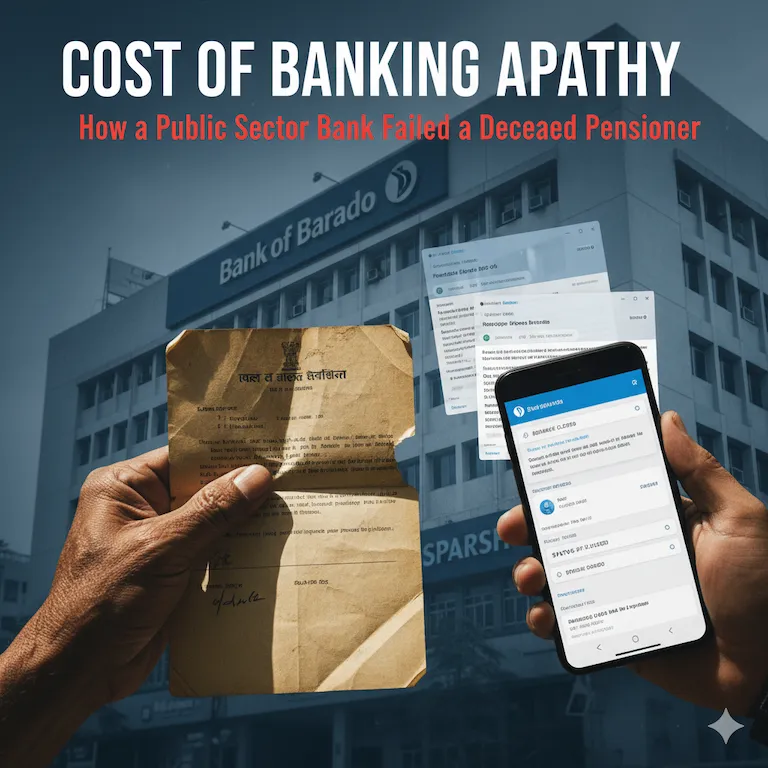
The key takeaways from this blog post highlight a systemic failure in accountability. They illustrate the true Cost of Banking Apathy. They also expose a lack of transparency at the Tilai Bazar Branch of Bank of Baroda. Here are the five critical points:
1. The Physical KYC Paradox is Cost of Banking Apathy
The bank accepted a physical KYC from Mrs. Uma Singh on June 13, 2025, but it failed to credit her pension for the following months. This indicates a failure in the bank’s internal data-entry or upload process to the SPARSH system. Just weeks before her passing, they established her “proof of life” in person.
2. Strategic “Buck-Passing”
The branch has consistently used the SPARSH portal as a jurisdictional shield to deflect responsibility. They claim they have “no authority” over defense pensions. By doing so, they are attempting to bypass their legal obligation. The Point of Service (PoS) is responsible for grievance redressal and document verification.
3. Fabrication of Oral Instructions results from Cost of Banking Apathy
A major point of contention is the bank’s claim that the nominee “orally” requested a delay in his own claim. This accusation serves as a calculated administrative tactic that seeks to explain away the bank’s procrastination. The tactic enables the bank to avoid creating a paper trail of their failure to process the Deceased Claim.
4. Obstruction of Information (RTI Misuse)
The bank legally contradicts itself. It refuses to provide the Nomination Form (DA1). It also fails to share the Action Taken Report. They claim “Third Party Information” (Section 8(1)(j)) as their justification. The nominee had already communicated with the bank via email. Their sudden invocation of privacy laws appears to be an attempt to conceal administrative lapses.
5. Escalation to the CGDA
Authorities managing the SPARSH system will audit the bank’s “jurisdictional” excuses. The battle is shifting from a local branch dispute to a high-level federal investigation. This involves the Joint CGDA (Delhi) and the DOPPW.
Cost of Banking Apathy: How a Public Sector Bank Failed a Deceased Pensioner and Her NRI Nominee
In the landscape of Indian Public Sector Banks (PSBs), they often tout “customer service” as a priority. However, the case of Late Mrs. Uma Singh and the Bank of Baroda (Tilai Bazar Branch, Prayagraj) reveals a darker reality as it demonstrates administrative negligence. They misuse digital portals like SPARSH to deflect blame and strategically obstruct information. This situation highlights how banking apathy can truly impact both pensioners and their nominees.
The Timeline of Negligence
The core of this grievance lies in a sequence of events that defy both logic and banking regulations. As these events unfolded, the cost of apathy within banking systems became alarmingly clear.
- June 13, 2025: Mrs. Uma Singh, a family defense pensioner, physically visited the Tilai Bazar branch. She successfully completed her KYC, withdrew funds, and created a Fixed Deposit. This physical presence served as absolute proof of life.
- August 6, 2025: Mrs. Uma Singh passed away.
- The Discrepancy: Despite completing the June KYC, the bank failed to credit her pension for July and August 2025. Furthermore, they now claim that they stopped the pension as far back as January 2025. This raises a critical issue. Why did they accept a physical KYC in June when the account was already in a “stop-pension” status?
Passing the Buck: The SPARSH and “Oral” Defenses
When the nominee, Mr. Prashant Singh (an NRI), sought clarity, the branch employed two classic tactics of bureaucratic evasion. Ultimately, these banking procedures demonstrated just how the cost of apathy impacts customers and their families.
- The Portal Shield: The bank claims that it has no jurisdiction because the defense pension manager uses the SPARSH portal. This disregards the bank’s role as the Point of Service (PoS) responsible for uploading Life Certificates and KYC data.
- The “Oral” Fabrication: The Branch Manager alleged in a formal response that the nominee “orally” requested a delay. This delay was related to the death claim. This assertion lacks basis and seeks to justify months of bank-led delays in settling the Fixed Deposit and Savings balance.
Transparency Denied: The RTI Obstruction to increase Cost of Banking Apathy
A concerned individual filed an RTI to uncover the truth. They sought the Action Taken Report and a certified copy of the Nomination Form (DA1). The Bank’s response blatantly misused the law, further demonstrating the broader cost associated with banking apathy when it denied transparency.
- The Rejection: The CPIO rejected the request under Section 8(1)(j), labeling the information as “Third Party.”
- The Contradiction: The branch rejected the nominee. This happened even though they had already been in email correspondence with the nominee’s representative. They acknowledged the nominee’s standing and invited them to the branch.
The Path to Accountability: CGDA and the First Appeal (Cost of Banking Apathy)
The battle for justice has now escalated to the highest levels of oversight. At every step, the cost involved in challenging banking apathy becomes apparent to those seeking accountability.
- The CGDA Escalation: A grievance (DOPPW/E/2026/0006440) is currently with the Joint CGDA (Delhi). They are investigating the technical failure to credit Lifetime Arrears (LTA).
- The RTI First Appeal: The Zonal Office in Varanasi received an appeal. Its reference number is BKOBD/A/E/26/00051. The appeal aims to strike down the “Third Party” claim. Additionally, this appeal seeks to force the disclosure of the Nomination Form and FD status.
Conclusion: A Call for Systemic Reform
Public Sector Banks must prioritize accountability to defense families, as this case illustrates. When a bank disregards a pensioner’s physical presence, it erodes trust. By obstructing her nominee, the bank further undermines the very trust upon which banking relies. Clearly, analyzing the costs of banking apathy highlights the urgent need for reform.
The struggle of Mahesh Pratap Singh (Yogi M. P. Singh) against Bank of Baroda serves as a reminder that “Digital India” cannot succeed if bank officials use digital portals as a maze to hide administrative incompetence.
Key Takeaways
- The Cost of Banking Apathy highlights systemic failures in accountability at the Tilai Bazar Branch of Bank of Baroda.
- The bank mishandled KYC processes, failed to credit pensions, and used the SPARSH portal to deflect responsibility.
- There was obstruction of information, with the bank improperly invoking privacy laws to deny access to important documents.
- The situation escalated to federal investigation, highlighting the bank’s administrative negligence and evasion tactics.
- This case underscores the urgent need for reforms in public sector banking to regain trust with customers and their families.
To ensure you have a consolidated record for your follow-ups, here are the structured details. These include all application IDs, contact persons, and web links related to your ongoing cases as of February 1, 2026.
1. Active Application & Grievance IDs
| Portal | Registration Number | Subject | Current Status |
| DOPPW (Central) | DOPPW/E/2026/0006440 | Pension Arrears (LTA) & CGDA Investigation | Forwarded to CGDA HQ |
| RTI Appeal | BKOBD/A/E/26/00051 | Rejection of “Third Party” claim for DA1 Form | Appeal Received |
| CPGRAMS (Bank) | DEABD/E/2026/0004632 | Harassment & Mismanagement by Branch | Closed (Under Dispute) |
| RTI Original | BKOBD/R/E/25/03381 | Information regarding FD & KYC status | Request Rejected |
2. Public Authority Contact Details to make enquiry to reduce Cost of Banking Apathy
A. Defence Pension Authority (CGDA)
- Officer: Smt. Molly Sengupta (Joint CGDA)
- Email:
mollysengupta.dad@gov.in - Phone: 011-25674783
- Address: CGDA HQ Office, Ulan Batar Road, Palam, Delhi Cantt.
B. Bank of Baroda (Zonal/Appellate)
- FAA Officer: Mithilesh Kumar (General Manager, Varanasi Zone)
- Email:
zm.zovaranasi@bankofbaroda.com - Phone: 0542-2372767
- Nodal Officer Email:
dgm.pio@bankofbaroda.com
C. Bank of Baroda (Regional/CPIO)
- CPIO Officer: Manoj Kumar Tiwari (Regional Manager, Prayagraj)
- Email:
rm.allahabad@bankofbaroda.com - Phone: 9151889001
D. Tilai Bazar Branch (Base Branch)
- Branch Email:
tilaib@bankofbaroda.co.in - Mobile/WhatsApp: 9151889075
3. Essential Web Links for Tracking
- CPGRAMS/DOPPW Tracking: pgportal.gov.in
- RTI Online (Appeal Status): rtionline.gov.in
- SPARSH Migration Status: sparsh.defencepension.gov.in (Use Bank Account No. 29430100016368 to verify if the PPO has migrated)
- Banking Ombudsman (RBI CMS): cms.rbi.org.in (Contact the RBI CMS if the RTI Appeal is delayed)
4. Nominee’s Verified Details (For Reference)
- Nominee Name: Mr. Prashant Singh
- Registered Email:
pmarshalx@gmail.com - Nominee Phone: +91-9999200506
Next Strategic Step:
Since you have the CGDA Officer’s phone number (011-25674783), I recommend a brief follow-up call during office hours (10:30 AM – 1:00 PM) next week. Simply state: “I have emailed additional proof for DOPPW/E/2026/0006440 showing the bank failed to process a physical KYC visit from June 2025.


Facing a similar challenge? Share the details in the box below, and our team of experts will do their best to help.