
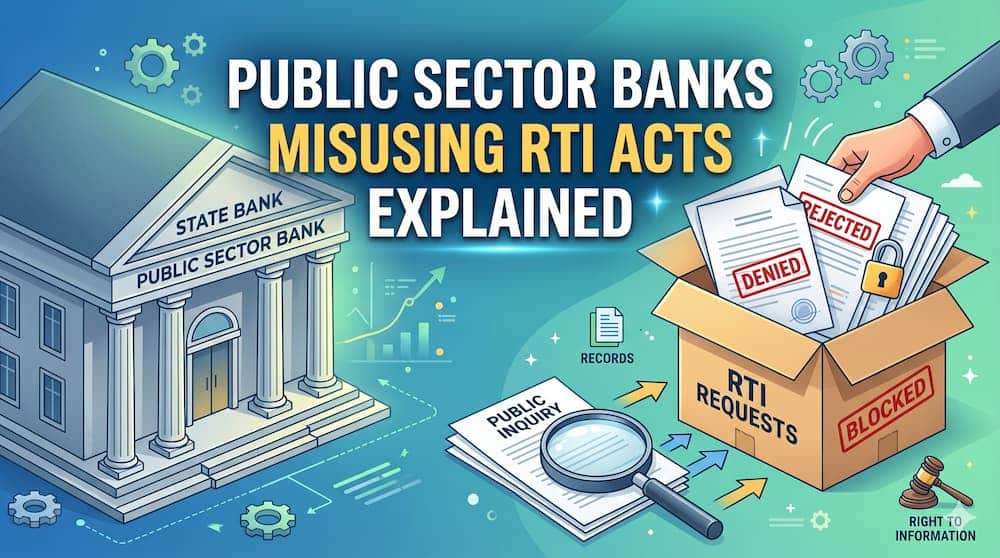
The Veil of Secrecy: How Public Sector Banks are Allegedly Misusing the Right to Information Act (Public Sector Banks Misusing RTI Acts)
The Right to Information (RTI) Act was heralded as a revolutionary milestone in democratic governance. It was designed to promote transparency, curb administrative corruption, and empower ordinary citizens to hold public institutions accountable. Among the various entities subject to this legislative scrutiny, Public Sector Banks (PSBs) occupy a critical position. These institutions manage vast sums of public money and orchestrate national development policies. They occasionally require taxpayer-funded bailouts, so their operations must remain transparent. However, a troubling trend has emerged recently. There is a systematic misuse and evasion of the RTI Act by public sector banks to shield themselves from public scrutiny. This article explores the serious issue of Public Sector Banks Misusing RTI Acts and the implications for democratic accountability.
Key Takeaways
- Public Sector Banks Misusing RTI Acts undermine transparency and accountability, allegedly hiding inefficiencies and controversial decisions.
- Banks exploit legal exemptions like fiduciary and commercial confidence to avoid disclosing information about bad loans and wilful defaulters.
- Administrative stonewalling tactics, such as vague replies and exorbitant fees, frustrate RTI applicants and delay responses.
- Judicial backlash against banks confirms the public’s right to transparency, urging stricter penalties for non-compliance with the RTI Act.
- Citizens can combat misuse by establishing legal standing, filing formal authorisations, and escalating cases to the Central Information Commission.
#### The Core Conflict: Confidentiality vs Accountability
At the heart of this conflict lies the careful balance between financial privacy and the public’s right to know. PSBs often hold very sensitive financial information, ranging from the personal savings accounts of private citizens to multi-billion-pound corporate loan structures.
While protecting the privacy of individual, law-abiding depositors is crucial, critics increasingly accuse banks of misusing these privacy rules. Rather than helping the vulnerable, banks often use these measures to hide problems, rising Non-Performing Assets (NPAs), questionable loan write-offs, and controversial lending decisions that benefit politically connected corporate entities.
#### The Strategic Misuse of Exemption
To understand how PSBs evade transparency, one must examine the specific legal exemptions they routinely exploit. Under most RTI frameworks, certain clauses allow public authorities to withhold information under strict conditions. Banks have turned these narrow exemptions into broad shields:
1. **The ‘Fiduciary’ Shield:** Under typical RTI legislation, information held in a fiduciary capacity—such as the trust-based relationship between a doctor and patient—is exempt from disclosure. PSBs have creatively stretched this definition, arguing that their relationship with massive corporate debtors, even those who have wilfully defaulted on loans, is strictly fiduciary. By classifying corporate default details as confidential, banks actively prevent the public from learning which industrial giants are draining the nation’s financial resources.
2. The ‘Commercial Confidence’ Loophole: Another frequently abused loophole involves the exemption concerning “commercial confidence” or “trade secrets”. When journalists, activists, or citizens request information about massive bad loans, recovery processes, or the terms of corporate debt restructuring, banks routinely deny these requests. They assert that such disclosures would harm their competitive position in the market. However, this argument falls flat when weighed against the public interest. When banks write off billions in public funds, the public has an absolute right to know the terms and beneficiaries of those decisions.
Banks frequently classify the names of wilful defaulters and corrupt officials as “personal information”. This is done to avoid disclosure. This misinterpretation contradicts the principle that public servants acting in their official capacity cannot claim absolute privacy regarding actions that affect the public exchequer.
Beyond the creative interpretation of legal exemptions, PSBs often engage in deliberate administrative stonewalling to frustrate RTI applicants. This tactical resistance manifests in several ways:
Vague and Fragmented Replies: Instead of providing comprehensive answers, Public Information Officers (PIOs) within banks often provide evasive, incomplete, or highly technical jargon-filled responses. These are designed to confuse the applicant.
Exorbitant Fees and Bureaucratic Hurdles: Applicants are sometimes asked to pay unjustified costs for photocopying or processing data. They are also redirected to different branches, creating an endless bureaucratic wild goose chase.
Exploiting the Appeal Process: Banks frequently delay their responses until the very end of the statutory deadline. When applicants appeal, the banks leverage their vast legal resources to prolong the cases through appellate authorities and high courts. This effectively exhausts the resources of independent citizens and journalists.
### The Judicial Backlash and the Way Forward
This culture of secrecy has not gone unnoticed by the judiciary. In several landmark rulings, the Supreme Court and information commissions have repeatedly chastised public sector banks and central regulatory authorities. They have done so for their stubborn resistance to transparency. Judges have affirmed that a bank’s primary duty of trust is to the public and its depositors. This duty is not to delinquent borrowers or corrupt administrators. The courts have clarified that disclosing the list of defaulters and details of bad loans is a matter of grave public interest. This public interest overrides any claim of commercial confidentiality.
Despite these clear legal precedents, the systemic resistance within PSBs remains robust. For the RTI Act to truly serve its purpose in the financial sector, there must be a cultural and structural shift:
Stricter Penalties: Information Commissioners must penalise PIOs. They should act against those who deliberately withhold information. This should happen when there are no valid legal grounds.
Proactive Disclosure: Banks should publish data proactively. This includes information on large bad loans and wilful defaulters. They should also disclose internal audits on their public websites. This will reduce the need for citizens to file RTI applications.
Independent Oversight: An independent auditing body is necessary. This body should monitor how banks handle RTI requests. It will ensure compliance with both the letter and the spirit of the law.
Ultimately, transparency should not be viewed by public sector banks as an operational threat but as a vital mechanism for restoring public faith in the financial system. Only by dismantling these walls of secrecy can we hope to foster a fairer, more accountable, and economically stable society.
Public Sector Banks Misusing RTI Acts: Public Sector Banks Misusing RTI Acts to Evade Accountability
When an older citizen goes to a bank branch, they are physically verified. They update their KYC records and deposit their savings in a Fixed Deposit. Common sense suggests that their active status is checked everywhere.
However, in the complex system of Indian state banking and pension distribution, family members often face challenges. They find themselves in a wearying battle against technicalities. This occurs when they try to settle the affairs of a deceased relative.
This post breaks down a real-world case involving a deceased defence pensioner, Bank of Baroda, and a local family representative fighting a rigid systemic wall. By analysing the structural breakdown of this case, we highlight a growing, frustrating trend: Public Sector Banks Misusing RTI Acts to evade operational accountability—and how citizens can strategically fight back.
1. The Core Dispute: A Timeline of Administrative Disconnect
The conflict centres around the savings account of the late Mrs Uma Singh at Bank of Baroda’s Tilai Bazar Branch. The timeline reveals a stark disconnect between banking operations and pension disbursement:
- December 2024: Regular family defence pension credits unexpectedly cease.
- 13 June 2025: The pensioner physically visits the Tilai Bazar branch, successfully completes an in-person KYC verification, and opens a Fixed Deposit.
- 06 August 2025: Mrs. Uma Singh passes away. PDF+ 4
- Post-Demise: The family notices that despite the physical validation in June, the pending pension for July and August 2025 was never credited.
When the local representative, Shri Yogi M P Singh, filed grievances and an RTI application to uncover why the system failed despite a successful in-person KYC, the bank locked its gates.
2. The Shield: How Public Sector Banks Are Misusing RTI Acts
To avoid answering tough questions about their internal workflows, the bank’s Central Public Information Officer (CPIO) rejected the RTI application under Section 8(1)(j) of the RTI Act, 2005. This clause is designed to protect personal privacy, exempting “third-party information” from public disclosure.
The Technical Trap Used to Hide Lapses
Because the RTI was filed by the son-in-law (Yogi M P Singh) rather than the registered NRI nominee (the deceased’s son, Prashant Singh, currently in Oman), the bank legally classified the representative as an unauthorised “third party.
This case is a prime example of Public Sector Banks Misusing RTI Acts. By hiding behind this rigid legal definition, the bank successfully avoided disclosing:
- Internal Action Taken Reports (ATR) on outstanding grievances. PDF
- The back-end processing status of the Fixed Deposit created during that June visit. PDF+ 1
- Certified copies of the account’s Nomination Form (Form DA1).
3. Shifting the Ground: Procedural Data vs. Personal Data
The breakthrough in fighting institutional stonewalling comes from a sharp strategic pivot: separating personal data from procedural accountability.
The nominee already possesses the private account credentials, death certificates, and banking receipts. Therefore, a representative does not need the bank to disclose “confidential personal data”. The legal fight, instead, must focus entirely on the bank’s official performance, guidelines, and administrative actions.
Under the law, a public sector bank cannot claim that its own operational efficiency, its handling of public grievances, or its institutional guidelines for NRI claimants constitute “third-party private data.
4. How Citizens Can Fix Institutional Accountability
When facing instances of Public Sector Banks Misusing RTI Acts, citizens have definitive legal avenues to dismantle their defences:
A. Establish Explicit Legal Standing
Implied authorisation—such as a nominee handing transaction files to a relative—is not recognised by rigid bank portals.
To permanently destroy the bank’s “third-party” excuse, the registered nominee must execute a formal, signed Letter of Authorisation or a Limited Power of Attorney explicitly naming the local representative.
For NRIs, having this document that explicitly names the Indian Embassy completely nullifies the bank’s privacy objections.
B. Escalation to the Central Information Commission (CIC)
When a bank’s First Appellate Authority blindly upholds a CPIO’s rejection, the ultimate safeguard against their power is the Second Appeal under Section 19(3) of the RTI Act.
Filing a Second Appeal before the CIC forces the bank’s legal team out from behind their local desks.
Conclusion: Transparency is a Right, Not a Favor
Public sector banks are custodians of public money and are bound by statutory duties of transparency. Cloaking administrative lapses or disjointed database updates behind privacy exemptions is a clear distortion of the law.
By systematically securing formal authorisations, citizens can dismantle bureaucratic barriers. They can escalate technical rejections to higher commissions. This approach helps to stop Public Sector Banks from misusing RTI Acts and dodging accountability.
Here is the completely cleaned and structured directory of the public authorities, registration IDs, and web portals—free from formatting artefacts, broken text, or source clutters.
1. Bank of Baroda (Regional & Zonal Authorities) (Public Sector Banks Misusing RTI Acts)
Central Public Information Officer (CPIO)
- Name & Designation: Manoj Kumar Tiwari, Regional Head & P.I.O
- Office Address: Regional Office (Prayagraj Region), Baroda Bhawan, 2nd Floor, C.P.-01, Dev Prayagam Awas Yojana, Kalindipuram, Jhalwa, Prayagraj, Uttar Pradesh – 211011
- Mobile Number: +91-9151889001
- Email ID: rm.allahabad@bankofbaroda.com
First Appellate Authority (FAA) (Public Sector Banks Misusing RTI Acts)
- Name & Designation: Mithilesh Kumar, General Manager & First Appellate Authority
- Office Address: Zonal Office, Baroda Bhawan, Plot No. 24, Industrial Estate, Chandpur, Varanasi – 221106
- Phone Number: 0542-2372767
- Email ID: zm.zovaranasi@bankofbaroda.com
Nodal Officer Details (Public Sector Banks Misusing RTI Acts)
- Telephone Number: 022-66985881
- Email ID: dgm.pio@bankofbaroda.com
2. Bank of Baroda (Tilai Bazar Base Branch) (Public Sector Banks Misusing RTI Acts)
- Designation: Branch Manager
- Office Address: Tilai Bazar, P.O. Dheenpur, HPO: Mau Aima, Prayagraj, Uttar Pradesh
- Mobile Number: +91-9151889075
- Email ID: tilaib@bankofbaroda.co.in
- Branch MICR Code: 211012538
- Branch IFSC: BARB0TILAIB
3. Department of Pension & Pensioners’ Welfare / CGDA (Public Sector Banks Misusing RTI Acts)
- Officer Name: Smt. Molly Sengupta
- Officer Designation: Jt CGDA, Pension Cell
- Contact Address: CGDA HQ Office, Ulan Batar Road, Palam, Delhi Cantt
- Contact Number: 011-25674783
- Email ID: mollysengupta.dad@gov.in
4. Key Registration IDs & Reference Numbers
| Authority / Portal | Document / Grievance Type | Registration / Reference ID |
| RTI Online Portal | Original RTI Application | BKOBD/R/E/25/03381 |
| RTI Online Portal | First Appeal Registration | BKOBD/A/E/26/00051 |
| Bank of Baroda (RO) | CPIO Rejection Order Number | BOB/RO/PRAYAGRAJ/RTI/2025/37 |
| CPENGRAMS Portal | Pension-Related Grievance | DOPPW/E/2026/0006440 |
| CPGRAMS Portal | Bank Grievance ID (Closed) | DEABD/E/2026/0004632 |
| CPGRAMS Portal | Active Bank Grievance ID | DEABD/E/2026/0004636 |
| Bank of Baroda Portal | Internal Bank Complaint Number | 202526011045733 |
| CPGRAMS Portal | Original Grievance (RTI Point 4) | DEABD/E/2025/0110227 |
5. Web Links & Portals
- RTI Online Filing & Status Portal: https://rtionline.gov.in
- Central Information Commission (CIC) Portal: https://www.cic.gov.in
- Bank of Baroda New Deceased Claim Portal: https://apps.bobinside.com/deceasedclaimportalnew
- Old Deceased Claim Portal Link: https://apps.bobinside.com/DeceasedClaimPortal


Facing a similar challenge? Share the details in the box below, and our team of experts will do their best to help.