
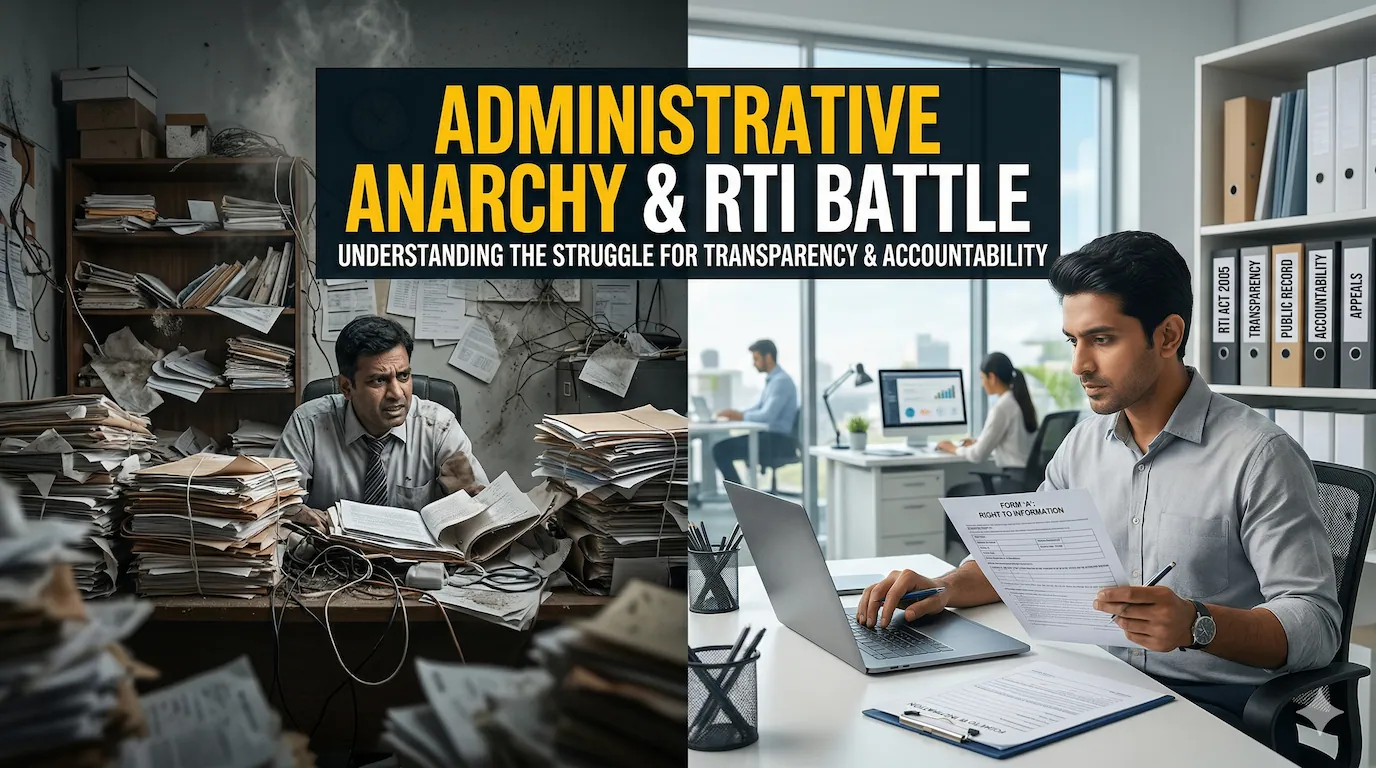
Key Takeaways (Administrative Anarchy & RTI Battle)
- The Administrative Anarchy & RTI Battle in Mirzapur reveals systemic obstruction and coordinated resistance in accessing information under the RTI Act.
- A critical dispute involves the partition of ancestral land, where authorities failed to execute a court order for six months.
- The appellant emphasizes the ‘Right to Reason’ to hold decision-makers accountable, highlighting the lack of transparency and responsibility among officials.
- The case showcases misuse of power, where police mislabel the situation and close grievances falsely, avoiding the core issue of administrative compliance.
- The Chief Information Commission steps in, indicating broader administrative failures, and the case highlights the need for persistent demands for transparency and accountability.
Administrative Anarchy & RTI Battle: A Case Study of Systemic Obstruction in Mirzapur
The Right to Information (RTI) Act, 2005, is designed to increase government accountability by enabling citizens to access information. In practice, however, citizens often encounter coordinated resistance when administrative departments overlap. This situation can sometimes be described as an Administrative Anarchy & RTI Battle. In Mirzapur, Uttar Pradesh, Appeal No. S-09/A/2210/2025 highlights this issue. In that case, executive officers used the police to avoid judicial accountability. This demonstrates deliberate systemic obstruction.
The Genesis: A Land Partition Ignored
The core of this dispute lies in a routine but vital legal process—the partition of ancestral land. On September 13, 2024, the Court of the Additional Officer, Sadar, issued a preliminary decree in Case No. T202216530107209 (Atul Singh vs Ashok Kumar Singh). Importantly, the decree determined a three-way equal split of land in Mauza Babura.
Under Section 116 of the U.P. Revenue Code, the next step required the Lekhpal to submit a ‘Fhaat’ (partition) report to divide the plots. Despite the order, six months passed with no action. This inaction exemplifies the inertia that defines an Administrative Anarchy & RTI Battle—precisely what appellant Yogi M. P. Singh challenged under the RTI Act.
Point One: The “Right to Reason” and Decision-Maker Accountability
A key argument in this case is the appellant’s emphasis on accountability. In Point 1 of his RTI application, he asked for the name and designation of the official who decided to treat a Lekhpal’s non-compliance as a police matter instead of a revenue issue. This request aims to identify individual responsibility in decision-making.
- The PIO refused to provide a name, giving only a general account of how officers “decide” jurisdiction.
- The appellant argues that denying this information violates the “Right to Reason,” a fundamental administrative law principle. By concealing the decision-maker’s identity, the department effectively prevents individual accountability for misdirecting the grievance. The key argument here is that without transparency, officials cannot be held responsible for their actions.
The Reinforcement of Preliminary Measures: A Misuse of Power
Instead of assisting in executing the partition, police initiated proceedings under Sections 126/135 of the BNSS (previously Sections 107/116 CrPC). The process thus diverged from the expected course.
The appellant argues that labeling the situation as the “Reinforcement of PreliminaThe appellant argues that labelling the situation as the “Reinforcement of Preliminary Measures” is a misuse of power. Applicant: Using criminal-preventive laws against a citizen seeking his legal rights.
- Shielded the Executive: Diverted attention away from the Tehsildar Sadar and the Lekhpal’s failure to submit the partition report.
- Closed the Grievance: Marked the grievance as “resolved” on the IGRS portal using “preventive action taken” status. However, the court order remained unexecuted.
The PIThe PIO’s Contradictions: Mala Fide Intent Fuelling the Administrative Anarchy & RTI Battle. The transparency battle intensified when the PIO provided mutually exclusive answers to the State Information Commission.
- Claim vs Reality: In response to Point 3, the PIO stated that they had “complied with” the court order. However, when addressing Point 4, the PIO admitted that they had not complied with any orders due to a lack of instructions from the revenue court.
- Irrefutable Evidence: Handwritten court records dated as late as November 26, 2025, show that the partition remained unexecuted—six months after the police investigation claimed it had been settled. This discrepancy is the basis for the appellant’s request for a penalty of ₹250 per day under Section 20(1) of the RTI Act.
Statutory Breaches: Sections 6(3) and 8(1)(j)
The examination of procedural handling is equally revealing. Beyond substantive failures, systemic disregard for RTI procedures compounded each injustice.
- Failure to Transfer (Section 6(3)): If the police determined that the matter was a revenue-related matter, they had to transfer the application to the Revenue Department within five days. Instead, they held the application and provided evasive replies.
- Illegal Exemptions (Section 8(1)(j)): The PIO denied information regarding Circle Officer Vivek Jawla’s educational qualifications and posting history, citing “personal information. The appellant argues that the service records of public servants are public records. These records are essential for ensuring transparency in their public duties.
The Commission Steps In: Notices to the SDM and Tehsildar
The Chief Information Commissioner has issued notices to the Tehsildar Sadar and the Sub-Divisional Magistrate (SDM) Sadar, recognising that the core issue is broader administrative non-compliance, with the police acting as enforcers of this failure. Moreover, the Commission’s intervention reframes the case as a test of accountability. It is not just a routine grievance.
As of April 7, 2026, the case remains “For Further Hearing“. Importantly, the appellant’s persistence has successfully moved the needle. This Administrative Anarchy & RTI Battle in Mirzapur is more than a local land dispute; it is a fight for the “Right to Reason” and the integrity of judicial orders. When authorities reinforce preliminary measures to bypass court decrees, they do not merely delay justice. Instead, they systematically undermine the rule of law. Every unanswered RTI query, every misdirected grievance, and every contradictory PIO response chips away at the citizen’s constitutional right to transparent governance. As a result, cases like this serve as a reminder that the RTI Act is only as powerful as the citizens willing to wield it patiently. When authorities reinforce preliminary measures to bypass court decrees, they do not merely delay justice — they systematically undermine the rule of law.
The lesson for every citizen in such battles is clear: demand transparency through evidence, and refuse “arbitrary and inconsistent” reporting. Persistence with proof is the antidote to obstruction. Yogi M. P. Singh shows that citizens who refuse to be silent force the system to respond.
Current Case Status: * Appeal Registration: A-20250901935
- Last Update: April 7, 2026
- Next Hearing: April 8, 2026 (Room S-9)
Based on the uploaded documents, here are the specific identification and contact details for the public authorities and application processes involved in this matter:
I. Case & Application Identifiers
- State Information Commission Appeal No: S-09/A/2210/2025.+1
- Commission Registration Number: A-20250901935.+1
- RTI Online Registration Number: SPMZR/R/2025/60124.+1
- First Appeal Registration Number: SPMZR/A/2025/60031.+1
- IGRS Complaint Reference Number: 60000250091069.+1
- Public Grievance (PMO) Registration Number: PMOPG/E/2025/0058583.+1
- Revenue Court Case Number: T202216530107209.+1
II. Public Authority Contact Details (Administrative Anarchy & RTI Battle)
| Designation | Name | Mobile Number | Email Address |
|---|---|---|---|
| First Appellate Authority (SP Mirzapur) | Somen Verma +1 | 9454400299 | spmzr-up@nic.in +2 |
| PIO / ASP Operation | Om Prakash Singh +2 | 9454401105 | asp-op.mi@up.gov.in +2 |
| Circle Officer (City) | Vivek Jawla +2 | 9454401590 +1 | Not provided in documents |
| ASP City | Prakash Swaroop Pandey | Not provided | asp-city.mi@up.gov.in +1 |
| Investigating Officer (SI) | Ganesh Pandey +1 | 9453226887 | Not provided |
| State Information Commission Clerk | Shakuntala Gautam +1 | Not provided | hearingcourts9.upic@up.gov.in +1 |
III. Web Links & Digital Resources (Administrative Anarchy & RTI Battle)
- Online Hearing Link: https://upsic.up.gov.in/cispu/onlinehearing/8cbe….+1
- U.P. Information Commission Portal: https://upsic.up.gov.in/.
- RTI Online Status Link: https://rtionline.up.gov.in/request/regdetails.php?regId=….+1
- U.P. Police Official Website: Referred to in PIO responses as the source for official manuals and posting details.+1


Facing a similar challenge? Share the details in the box below, and our team of experts will do their best to help.