
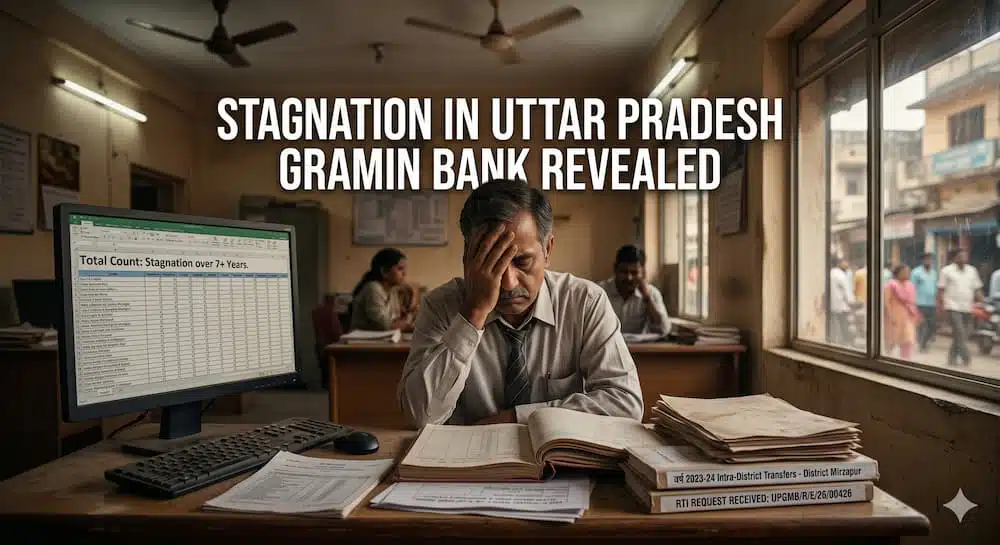
Stagnation in Uttar Pradesh Gramin Bank is obvious from the fact that several staff are stuck at the same place for many years. This lack of career progression not only demotivates employees but also breeds an environment where complacency can fester. As individuals grow comfortable in their roles, the potential for innovation and improvement diminishes, ultimately affecting the bank’s service quality. Furthermore, it is only promoting corruption within the financial institution, as stagnant positions can lead to unethical practices being overlooked. To address these issues, it is crucial for the management to implement a robust promotion policy that encourages growth, accountability, and transparency within the organization, thereby revitalizing the workforce and improving customer trust in the bank once again.
Key Takeaways
- Stagnation in Uttar Pradesh Gramin Bank affects employee motivation and service quality, creating an environment prone to corruption.
- An RTI application aims to uncover the manipulation of transfer policies and long-term staff stagnation in District Mirzapur.
- The inquiry focuses on managerial mapping, stagnation metrics, transfer ratios, and the bank’s policy framework to address these issues.
- Intra-District transfers allow employees to remain in the same area, undermining compliance with banking guidelines.
- The applicant has submitted the RTI application successfully, and the bank must respond within 30 days to ensure accountability.
EXPOSING THE ROT: RTI Filed to Unearth Transfer Scams and Staff Stagnation in Uttar Pradesh Gramin Bank (District Mirzapur)
The fight for administrative transparency and institutional accountability in public sector banking just took a massive leap forward. Specifically, on June 24, 2026, an activist formally lodged a meticulously structured Right to Information (RTI) application against the banking authorities. Consequently, the portal registered this statutory filing under tracking number UPGMB/R/E/26/00426. Most importantly, this application targets a persistent, systemic failure within human resource management: the long-term staff stagnation in Uttar Pradesh Gramin Bank and the manipulation of transfer policies within District Mirzapur.
For years, a veil of secrecy shielded local banking administration from public scrutiny. Standard operating procedures dictate regular, transparent rotations of bank officers to maintain financial integrity. However, the ground reality points toward deep institutional favoritism. Therefore, this RTI application aims to systematically tear down that secrecy. In doing so, it will expose how unchecked stagnation in Uttar Pradesh Gramin Bank compromises public service.
The Core Issue: Chronism, Loop-Holes, and Institutional Stagnation
Undeniably, a severe compromise in administrative integrity plagues the banking operations in District Mirzapur. Regional Rural Banks (RRBs) must serve the rural populace with a high standard of accountability. However, the same officials frequently remain anchored to prime locations for consecutive years. As a result, a dangerous nexus develops between local vested interests, influential actors, and bank managers.
Standard banking guidelines—backed by Central Vigilance Commission (CVC) directives—mandate a maximum tenure of 3 to 5 years for officers at any single branch. This rule prevents financial malpractice and ensures fresh administrative oversight. Yet, a massive loophole undermines this policy in Mirzapur. Evidently, vested interests actively fuel stagnation in Uttar Pradesh Gramin Bank by weaponizing Intra-District transfers against Inter-District transfers.
Shuffling the Deck: The “Intra-District” Transfer Mirage
To begin with, how do bank employees stay stuck in District Mirzapur for a decade or more? Why does the corporate Head Office fail to notice? Undoubtedly, the answer lies in the art of the “internal shuffle,” which directly causes severe stagnation in Uttar Pradesh Gramin Bank.
When an employee reaches their maximum tenure at a premium branch, management steps in. Instead of moving the official out of the district via an Inter-District transfer, they simply execute an Intra-District transfer. Thus, the employee moves to another branch just a few kilometers away within the same district lines. On paper, the bank records a valid transfer to show compliance. On the contrary, the employee never leaves their comfort zone or their localized network of influence.
Furthermore, this continuous rotation breeds an unhealthy culture of stagnation in Uttar Pradesh Gramin Bank. Consequently, this practice leaves honest, rule-abiding officers exposed to arbitrary deployments in distant areas. Meanwhile, a select few remain permanently protected.
Deconstructing the RTI Application: Five Pillars of Inquiry
In order to break this cycle of complacency, the newly filed RTI application forces the bank’s Nodal Officer and Central Public Information Officer (CPIO) to provide hard data. The application moves past vague generalities. Instead, it demands specific, category-wise disclosures to uncover the true scale of stagnation in Uttar Pradesh Gramin Bank:
1. Complete Branch Managerial Mapping
First, the application demands a comprehensive directory of every operational branch under the Mirzapur Regional Office. In particular, it tracks the exact employee code, scale, and deployment date of every sitting Branch Manager. Ultimately, this will map exactly who controls the district’s primary financial touchpoints.
2. High-Rank Structural Overview
Second, administrative rot requires top-down oversight. Therefore, the filing forces a disclosure of the complete hierarchy at the Mirzapur Regional Office. This includes Regional Managers, Chief Managers, and Senior Executives. As a result, we can audit how long the decision-makers themselves have been embedded in the district.
3. Chronological Stagnation Metrics
Third, this inquiry forms the absolute heart of the investigation. Specifically, the bank must officially declare the names and designations of all staff members who have spent more than 3, 5, or 7+ consecutive years within Mirzapur. In short, this data will map the exact anatomy of stagnation in Uttar Pradesh Gramin Bank.
4. Transfer Ratio Contradictions
Fourth, the RTI forces the bank to provide a strict numerical comparison of Intra-District versus Inter-District transfers. To achieve this, it reviews all data from the financial years 2023-24, 2024-25, and 2025-26. Clearly, a heavy tilt toward internal shuffles will statistically prove systemic manipulation.
5. Policy Framework and Discretionary Exemptions (Stagnation in Uttar Pradesh Gramin Bank)
Finally, the application demands a certified copy of the bank’s active Transfer and Placement Policy. In addition, if employees overstayed their legal limits, the bank must produce copies of the explicit written approvals. Hence, the public must see the official file notings that allowed these violations.
Confronting Portal Barriers with Digital Precision (Stagnation in Uttar Pradesh Gramin Bank)
Initially, filing this application required careful strategy. Online RTI portals notorious for utilizing character-count limits often block comprehensive, long-form legal drafting. Moreover, the system frequently rejects detailed applications that contain special characters.
To bypass these systemic bottlenecks, the applicant stripped the text input box down to a highly concentrated, 247-character reference notice. Subsequently, this notice cleanly steers the CPIO toward a masterfully composed PDF document attached securely to the portal. Because the applicant paid through the secure SBI MOP (Multi Option Payment System) gateway, the application successfully bypassed all entry barriers. As of today, it sits officially on the bank’s active ledger.
What Lies Ahead: The Statutory Timeline for Accountability
| Milestone | Target Date / Status | Legal Expectation |
|---|---|---|
| Registration Date | June 24, 2026 | Instantly, the portal officially acknowledged the application under code UPGMB/R/E/26/00426. |
| Statutory Deadline | July 24, 2026 | Accordingly, the CPIO faces a strict 30-day legal window to deliver a point-wise response. PDF |
| Escalation Window | Post-July 24, 2026 | Alternatively, the applicant will file a First Appeal if management denies or falsifies details. PDF |
Presently, the clock is ticking for the bank administration. In fact, the Nodal Officer (legal.ho@upgb.bank.in) has exactly 30 days to clear the air. Furthermore, any attempt to hide this data under the guise of “personal information” will face fierce contestation. After all, employee place-of-posting directories are explicitly mandated public disclosures under Section 4(1)(b) of the RTI Act. (Stagnation in Uttar Pradesh Gramin Bank)
In conclusion, this is more than just a routine application for records. Rather, it is a direct campaign against institutional stagnation in Uttar Pradesh Gramin Bank. Undoubtedly, true public service cannot survive where transparency is treated as an afterthought. Therefore, we will lay the findings of this RTI bare before the public the moment they arrive. The struggle for accountability continues.
Here are the verified contact credentials, portal links, and registration records for the public authorities responsible for addressing the systemic issues outlined in your filing:
🏢 Core Public Authority Contact Metrics (Stagnation in Uttar Pradesh Gramin Bank)
| Parameter | Official Record Details |
| Public Authority Name | Uttar Pradesh Gramin Bank (Head Office / Nodal Operations) |
| RTI Registration Tracking ID | UPGMB/R/E/26/00426 |
| Official Telephone Number | 0522-4522666 |
| Nodal Officer Email Address | legal.ho@upgb.bank.in |
| Payment Gateway System | SBI MOP (Online State Bank Multi-Option Payment System) |
🌐 Essential Web Links & Portals (Stagnation in Uttar Pradesh Gramin Bank)
- Primary State RTI Electronic Filing Portal: RTI Online Gateway (Uttar Pradesh)
- Corporate Web Platform: Baroda UP Bank Official Website (Note: Purvanchal Bank and Kashi Gomti Samyut Gramin Bank structurally amalgamated into this entity).
- Centralized Grievance Redressal (CPGRAMS): Central Public Grievance Portal
- State Integrated Grievance System (IGRS Jansunwai): UP Jansunwai Portal
👤 Applicant Registration Summary on Portal (Stagnation in Uttar Pradesh Gramin Bank)
- Registered Applicant Name: Yogi M P Singh
- Mobile Communication Link: +91-7379105911
- Primary Telephone Record: +91-737910591
- Email Identification Link:
yogimpsingh@gmail.com - Registered Site Address: Surekapuram colony, Jabalpur Road, Shri Laxmi Narayan Baikunth Mahadev Mandir, Mirzapur City, Uttar Pradesh


Facing a similar challenge? Share the details in the box below, and our team of experts will do their best to help.