
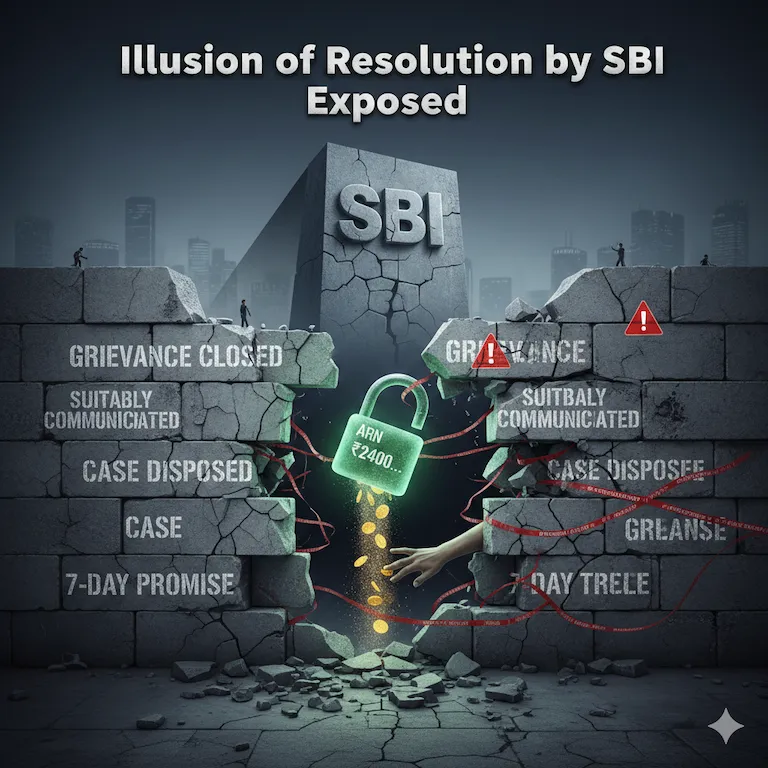
Here are the main points from the analysis of the dispute. It covers your missing refund and the bank’s procedural conduct. This case highlights what many customers experience as the Illusion of Resolution by SBI.
1. Systematic Failure of Technical Traceability (Illusion of Resolution by SBI)
- The ARN Gap: SBI has the Acquirer Reference Number (ARN) 82305096028500012763392, which is the definitive digital “fingerprint” for tracing funds. Despite this, they have failed to locate the ₹2,400 refund for nearly a month.+2
- Forex Complexity: The bank has categorized this as an inward remittance of a Forex transaction. However, they have not provided any technical evidence from their Forex or ATM departments. They need to explain why the funds haven’t reached your account.+1
2. Breach of Formal Commitment
- The Broken Deadline: A Chief Manager (Operations) formally promised via email on February 17, 2026. They assured that the credit would be processed within 7 days.+1
- Expiration Today: That 7-day window officially expired today, February 24, 2026, with the funds still not reflecting in account 34645721675.+1
3. “Mechanical” Grievance Disposal (Illusion of Resolution by SBI)
- Premature Closure: SBI closed the initial grievance (DEABD/E/2026/0021712). They also closed the subsequent appeal based on a future promise of action. This was done rather than providing an actual financial resolution.+1
- Misleading Remarks: The bank’s remark that the “customer has been suitably communicated” is highlighted as misleading. Communicating a promise does not equal the recovery of the missing money.+2
4. Substandard Service Standards
- Premier Institution Failure: A premier institution like SBI is unable to honor its own written timeline. This reflects a significant deficiency in service. It also indicates a lack of due diligence.
- Statistical Priority: The case closure suggests the bank focused on improving “disposal statistics.” This focus came at the expense of ensuring the customer actually received their funds.+1
5. Active Regulatory Escalation (Illusion of Resolution by SBI)
- RBI Intervention: You have officially moved the matter to the Reserve Bank of India (RBI). This was done under RTI Registration RBIND/R/E/26/01761 to seek accountability for these procedural lapses.+1
- Legal Grounds: The case is now positioned as a challenge to the legality of banks closing CPGRAMS grievances. They do this without providing actual technical confirmation or credit entries.+1
Illusion of Resolution by SBI: How India’s Premier Bank is Failing the Digital Customer
The Indian government and the Reserve Bank of India (RBI) are pushing for a “Digital India.” In this era, the banking sector must remain reliable. It is the foundation of public trust. However, recent events involving the State Bank of India (SBI) suggest a troubling trend, described as the Illusion of Resolution by SBI. There is a shift from substantive grievance resolution to “mechanical disposal” of complaints. This case study involves a missing Forex refund. It also involves a broken promise by bank leadership. These issues highlight the systemic mismanagement currently plaguing customer service in premier banking institutions.
The Core Conflict: A Vanishing Refund
The issue began on January 27, 2026. On that date, a merchant (AIOSEO) initiated a refund of ₹2,400 to a customer’s SBI account. To ensure full transparency, the merchant provided a definitive digital trail. The Acquirer Reference Number (ARN) was 82305096028500012763392.+3. In fact, the lack of clarity around the resolution process can be experienced as an Illusion of Resolution by SBI.
In the world of modern banking, an ARN is not just a number. It serves as a unique identifier. This identifier allows banks to trace funds across the global financial network. Yet, despite being provided with this “fingerprint,” SBI has shown technical inertia. This response contributes to the illusion that SBI provides resolution, when in reality, the process falls short.
The “Future Promise” Trap: A Violation of CPGRAMS Norms
On February 13, 2026, the customer filed a grievance through the CPGRAMS portal (Registration No. DEABD/E/2026/0021712). What followed was a masterclass in bureaucratic avoidance. Unfortunately, the Illusion of Resolution by SBI appeared once again with this future promise tactic.
- The Evening Promise: On February 17, 2026, at 7:02 PM, the Chief Manager (Operations) at RBO-7, Robertsganj, sent an email. The email promised that the credit would be processed within 7 days.+3
- The Morning Disposal: Less than 15 hours later, on the morning of February 18, the bank officially closed the grievance.+1
- The Misleading Remark: The closure was justified with the vague remark: “Customer has been suitably communicated”.
This tactic involves closing a file based on a future promise. It does not depend on the actual credit of funds. This approach is a direct violation of the spirit of the CPGRAMS portal. The so-called illusion of resolution, championed by SBI, artificially inflates “disposal statistics” while leaving the customer’s bank balance unchanged.
Broken Deadlines and Substandard Service (Illusion of Resolution by SBI)
The most critical failure occurred today, February 24, 2026. This date marked the end of the 7-day window stipulated by the Chief Manager. As of this deadline, the ₹2,400 remains missing. The bank’s internal “technical team” has failed to provide any concrete trace of the ARN.+3. Indeed, the Illusion of Resolution by SBI is revealed in these broken deadlines and unkept commitments.
When a “Premier Banking Institution” like SBI fails to honour a timeline set by its own senior management, it shows a problem in service. This situation borders on negligence. The bank admitted that the amount was not in the customer’s account or the branch’s account. Yet they felt justified in closing the appeal on February 21, 2026.+1. Clearly, the resolution illusion cultivated by SBI leads to diminishing trust in its service.
Systemic Issues: Accountability vs. Statistics
This case highlights three core issues in the current banking landscape. To reiterate, the Illusion of Resolution by SBI is embedded in these systemic failures.
- The Tracking Gap: Why can a merchant provide an ARN that a multi-national bank cannot trace within 30 days?.+1
- The Disposal Culture: Banks are prioritising “closing tickets” over “solving problems” to satisfy government performance metrics.+1
- The Lack of Transparency: Banks provide vague remarks like “suitably communicated.” This helps them avoid technical accountability for missing funds. It also reinforces the illusion of genuine resolution by SBI.
Escalation: Seeking Regulatory Intervention
Frustrated by this mechanical disposal, the customer has now escalated the matter to the Reserve Bank of India (RBI). Under RTI Registration No. RBIND/R/E/26/01761, the customer is seeking clarity on the Illusion of Resolution by SBI and its broader impact.
- Mandatory Turnaround Times (TAT) for ARN-linked refunds.
- The legality of closing grievances based on “promises” rather than “credits”.
- Compensation for delays exceeding the bank’s own self-stipulated timelines. In summary, a key concern remains the illusion of resolution perpetuated by SBI.
Conclusion: A Call for Banking Reform
The missing ₹2,400 is a small sum for a bank with SBI’s assets, but the principle at stake is massive. If a customer cannot trust the word of a Chief Manager, the digital payment ecosystem is at risk. Trust in the traceability of an ARN is also crucial to maintain the system’s integrity. Above all, the Illusion of Resolution by SBI undermines genuine accountability in India’s banking sector. (Illusion of Resolution by SBI)
Banks must be held accountable not for the emails they send, but for the balance they reflect. Until “Grievance Closed” actually means “Money Received,” the promise of Digital India will remain unfulfilled for the common man. Unfortunately, as seen in this example, the illusion of resolution that SBI upholds continues to challenge true digital progress.
Based on the documents provided, here are the essential identification numbers, contact details, and web links for the public authorities involved in your case:
1. State Bank of India (SBI) – Local & Regional
This is the primary level where the delay and broken promise occurred.
- Branch: City Branch, Mirzapur.+1
- Regional Business Office: RBO-7, Robertsganj – 231216.
- Chief Manager (Operations): Binod Prasad.+1
- Email:
cmcomp7.zovar@sbi.co.in. - Mobile: 9672148295.+1
- Email:
- Contact Centre Numbers: 1800 1234 / 1800 2100.+1
2. State Bank of India (SBI) – Corporate & Appellate (Illusion of Resolution by SBI)
These are the higher authorities to whom you escalated your appeal.
- Appellate Authority Email (CPGRAMS):
cpgrams.saa@sbi.co.in. - Appellate Authority Phone: 022-22740430.
- General Manager (Customer Service): * Office: Corporate Centre, 16th Floor, State Bank Bhawan, Madam Cama Road, Mumbai.+1
- Email:
gm.customer@sbi.co.in.+1 - Contact Number: 022-22740970.+1
- Email:
3. Reserve Bank of India (RBI) – Regulatory & RTI
This is the authority you have now moved to for mismanagement oversight. (Illusion of Resolution by SBI)
- RTI Registration Number: RBIND/R/E/26/01761.
- Nodal CPIO Contact: * Email:
cpiorbi@rbi.org.in.- Phone: 022-22642678.
- Address: Central Office Building, Shahid Bhagat Singh Marg, Mumbai – 400001.
- RBI Ombudsman Portal: https://cms.rbi.org.in
4. Grievance Tracking IDs (Illusion of Resolution by SBI)
Use these numbers in all future correspondence to link your previous history.
- Initial Grievance No: DEABD/E/2026/0021712.+1
- CPGRAM Appeal No: DEABD/E/A/26/0002688.+1
- Transaction ARN: 82305096028500012763392.+1
Would you like me to draft a final warning email to the SBI General Manager (gm.customer@sbi.co.in) citing your new RTI registration number?


Facing a similar challenge? Share the details in the box below, and our team of experts will do their best to help.