
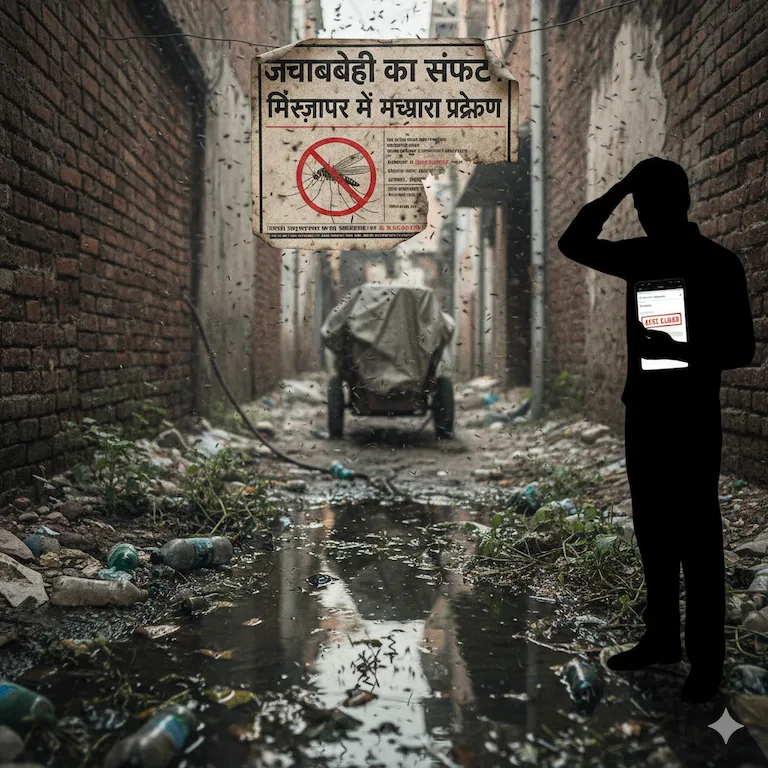
Here are the key takeaways regarding the Accountability Crisis and the Mosquito Problem in Mirzapur:
1. Failure of Preventive Measures (Accountability Crisis & Mosquito Problem)
The core of the issue is a reactive rather than proactive approach. The department does not maintain consistent, scheduled prevention. It sprays the anti-larvae solution only as a “formality”. This happens after grievances are filed or when an epidemic has already begun to spread.
2. Broken Administrative Promises
The Chief Medical Officer (CMO) previously committed to a weekly spraying schedule for Surekapuram Colony. This commitment remains unfulfilled, leading to a significant breach of trust between the citizens and public health officials.
3. Jurisdictional Deadlock
An Accountability Crisis has emerged due to a “blame game” between the CMO and the Mirzapur Municipality. The CMO claims that spraying is the Municipality’s duty. However, the Municipality lacks the specific health directives. It also lacks the resources to manage the Mosquito Problem effectively.
4. Imminent Public Health Risk (Accountability Crisis & Mosquito Problem)
The unchecked rise in mosquito populations poses a severe threat of Dengue and Malaria. This threat is especially concerning for children and people older than 65. The blog emphasizes that prevention is far more cost-effective and humane than treating an outbreak.
5. Need for Higher Intervention
Local departments are at a standstill. The responsibility now lies with the District Magistrate (DM) and the Chief Minister’s Secretariat. A joint directive is required to force coordination between the health department and the municipality.
6. Demand for Transparency (Accountability Crisis & Mosquito Problem)
The “Closed” status on grievance portals is often misleading if the ground reality has not changed. The post calls for public logs. It demands resident verification. These measures ensure that “action taken” reports are factual. They should not be just bureaucratic paperwork.
Accountability Crisis & Mosquito Problem: Mirzapur’s Rising Mosquito Problem and Governance Failure
Public health depends on reliable systems. These systems must protect citizens from preventable diseases. When apathy and jurisdictional disputes take over, the results are dangerous. In Mirzapur, specifically in Surekapuram Colony, a silent threat is growing. An unchecked Mosquito Problem has created a serious Dengue and Malaria risk.
This post highlights the ongoing Accountability Crisis in Mirzapur. It explores the gap between official promises and the reality on the ground.
Civic Duty vs. State Apathy
As citizens, we must inform the government about public safety risks. Reporting breeding sites is a vital action. It is the first defense against an epidemic. However, the Department of Medical and Health remains slow to act.
The core issue is a lack of administrative will. The department uses a reactive strategy. They wait for an epidemic to start before spraying. This “firefighting” method fails to solve the Mosquito Problem. Preventive medicine is being ignored.
The Broken Promises of the CMO
The Chief Medical Officer (CMO) of Mirzapur is responsible for district health. In previous grievances, the CMO office promised weekly anti-larvae spraying. This was a committed plan to protect Surekapuram Colony.
These assurances have not been met. Spraying is now just an occasional formality. It usually happens only after a complaint reach the Chief Minister’s Office. Once the pressure drops, the work stops. This cycle fuels the Accountability Crisis and allows mosquitoes to thrive.
The Jurisdictional “Ping-Pong” Game
A frustrating “blame game” exists between local departments. Recent CMO reports shifted the responsibility to the Mirzapur Municipality. The CMO claims spraying is not their job. Meanwhile, the municipality lacks the health expertise to handle the Mosquito Problem effectively.
This dispute creates a governance vacuum. Departments argue while mosquitoes breed in stagnant water. For residents, these labels do not matter. They simply need the larvae destroyed.
Dengue and Malaria: A Preventable Risk
Dengue and Malaria are not just numbers. These diseases burden families and hospitals. They are very dangerous for children and people older than 65. Preventive spraying is cheaper than treating a sick population.
Waiting for cases to rise before acting is a failure of duty. It allows a preventable situation to become a crisis. This approach ignores the goal of “Good Governance” or Su-shasan.
The Role of the District Magistrate
Intervention by the District Magistrate (DM) and the CM Office is now essential. The CM Secretariat forwards the complaints, but local execution is stalled. As the head of district health, the DM must end the Accountability Crisis.
A joint directive is needed to solve the Mosquito Problem:
- Fixed Schedule: Mandatory weekly spraying in areas like Surekapuram.
- Shared Duty: Clear coordination between the CMO and the Municipality.
- Public Logs: Spraying activities must be verified by local residents.
Transparency in Public Service
A lack of transparency leads to administrative anarchy. Promises made on the Jansunwai or CPGRAMS portals must be binding.
The situation in Mirzapur shows a breach of trust. Officials report that “action is taken,” but the mosquitoes remain. This undermines the entire grievance system. It is the heart of the Accountability Crisis.
Conclusion: Proactive Action Needed Now
Mirzapur’s situation tests the state’s commitment to health. We cannot wait for a tragedy to occur. Residents of Surekapuram Colony deserve a safe environment.
Good governance is about delivering results, not just filling out reports. The CMO and the DM must act now. They must prioritize health over bureaucratic convenience.
The time for reactive formalities has passed. Solving the Mosquito Problem requires ending the Accountability Crisis today.
Grievance References:
- Registration Number: GOVUP/E/2026/0023689
- IGRS Reference: 40019926005002
You have current grievances (GOVUP/E/2026/0023689 and 40019926005002). Here are the contact details for the authorities. They are responsible for resolving the Accountability Crisis and the Mosquito Problem in Mirzapur.
1. State Level Oversight (CM Secretariat) (Accountability Crisis & Mosquito Problem)
Your grievance was forwarded to the Joint Secretary. This office is your primary point for escalation. Use it if local officials remain negligent.
- Officer Name: Shri Arvind Mohan (Joint Secretary)
- Office: Chief Minister Secretariat, Room No. 321, U.P. Secretariat, Lucknow
- Email Address: arvind.12574[at]gov[dot]in
- Contact Number: 0522-2226350
- CM Helpline: 1076 (Toll-Free for 24/7 status updates)
2. District Level Execution (Mirzapur) (Accountability Crisis & Mosquito Problem)
The District Magistrate (DM) is the authority who can break the deadlock between the CMO and the Municipality.
- District Magistrate (DM) Mirzapur:
- Official Email: dmmir[at]nic[dot]in
- Office Phone: 05442-250802
- Chief Medical Officer (CMO) Mirzapur:
- Official Email: cmomrz-up[at]nic[dot]in
- Office Phone: 05442-252342
- Executive Officer (EO), Nagar Palika Parishad Mirzapur:
- Responsibility: Sanitation and Urban Spraying.
- Contact Address: Nagar Palika Road, Mirzapur, UP.
3. Relevant Web Links (Accountability Crisis & Mosquito Problem)
You can use these links to track status, file reminders, or lodge appeals.
- Jansunwai (IGRS) Portal:jansunwai.up.nic.in
- Use this to track Reference Number 40019926005002.
- CPGRAMS (Centralized Grievance Portal):pgportal.gov.in
- Use this to track PMOPG/E/2025/0025336.
- Mirzapur District Official Website:mirzapur.nic.in
- Use this to find updated circulars or specific department phone numbers.
4. Summary of Application IDs for Your Records
| Portal | Registration / Reference Number | Date Filed |
| CPGRAMS (PMO) | PMOPG/E/2025/0025336 | 21/02/2025 |
| UP Portal (Direct) | GOVUP/E/2026/0023689 | 24/02/2026 |
| Jansunwai (IGRS) | 40019926005002 | 24/02/2026 |
Next Step Suggestion (Accountability Crisis & Mosquito Problem)
The Mosquito Problem is an immediate threat. Would you like me to draft a formal email? You can send it to dmmir[at]nic[dot]in and arvind.12574[at]gov[dot]in simultaneously. This would officially notify them that three separate applications are now active regarding this single failure of duty.


Facing a similar challenge? Share the details in the box below, and our team of experts will do their best to help.