
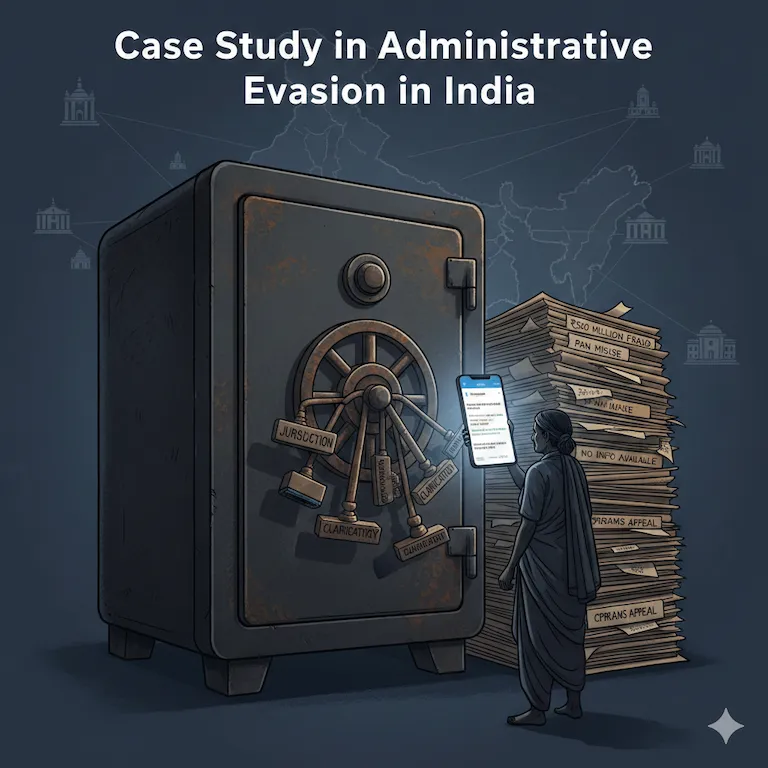
Key Takeaways (Case Study in Administrative Evasion)
- Yogi M. P. Singh’s case highlights a ₹500 million identity theft and the failures of India’s administrative systems.
- Multiple institutions misused Singh’s PAN, revealing incompetence and obstructive practices within the Income Tax Department.
- Singh’s struggle for accountability included filing an RTI request, which authorities dismissed, showcasing administrative evasion.
- The ongoing appeal questions the transparency of the ITD’s actions and the need for documented reasoning in financial crime cases.
- This case serves as a warning about the systemic issues allowing large-scale fraud while endangering public trust and financial security.
Case Study in Administrative Evasion: The ₹500 Million Identity Theft Crisis
The fight for transparency in India’s administrative systems is often a difficult and uphill struggle for the common citizen. Recently, Yogi M. P. Singh, a resident of Mirzapur, discovered a staggering ₹500 Million (Rs. 50 Crores) tax fraud involving the blatant misuse of his Permanent Account Number (PAN): GSWPS0850Q. This situation, therefore, serves as a critical Case Study in Administrative Evasion. Moreover, the very departments designed to protect the public interest appear, alarmingly, trapped in a cycle of jurisdictional buck-passing.
What began as a complaint against identity theft has, however, evolved into a disturbing saga. In response, the Department of Personnel & Training (DoPT) has taken action. Similarly, the Income Tax Department (ITD) has also responded. These responses, consequently, suggest a systemic reluctance to address high-value financial crimes.
1. The Core Issue: Massive Fraud via Identity Theft
This case stems from unknown entities fraudulently using a citizen’s financial identity to conduct sophisticated high-value transactions. They used Mr Singh’s PAN for these transactions, initially estimated at over ₹343 million.
Uttar Pradesh Police at Kotwali Katra, Mirzapur, recognized the severity of the crime and, consequently, registered FIR No. 291/23. However, the investigation has reached a standstill. This issue is primarily due to the Income Tax Department’s ongoing non-cooperation and systemic issues. Furthermore, this lack of cooperation plays a key role in this Case Study in Administrative Evasion. As a result, it effectively stalls a criminal investigation into a massive loss to the public exchequer.
2. Systemic Failure and ITD Obstruction
Contradictory reports from different arms of the tax department fuel the gridlock in this case. These reports create a fog of administrative confusion.
The “No Account” Myth
The ITD’s E-Filing Unit 2 in Bangalore reported that no bank accounts link to the complainant’s e-filing account. However, independent police investigations debunked this claim entirely. Law enforcement identified multiple accounts opened using this specific PAN at major institutions. These institutions include SBI, Kotak Mahindra Bank, Canara Bank, and DBS Bank. This discrepancy suggests gross technical incompetence. It might also be a deliberate effort by officials to shield the 200+ firms involved in this racket.+3
The 26AS Contradiction
The Principal Commissioner of Income Tax (PCIT) Allahabad claimed that no assessment or demand information was available in their database. They stated this clearly. Yet, in the same report, they admitted that Form 26AS reflects multiple transactions for TDS (Tax Deducted at Source). It also reflects multiple transactions for TCS (Tax Collected at Source). Every TDS entry is a digital footprint; it implies a counter-party, a transaction, and a deductor with a valid TAN. The ITD holds the names of these companies but has reportedly refused to share them with investigators.+3
3. The RTI Battle: Seeking Accountability (Case Study in Administrative Evasion)
Mr. Singh filed an RTI request with the Department of Personnel and Training (DoPT) on January 9, 2026. Specifically, he sought information on five particular points. Following the closure of his grievances through CPGRAMS due to jurisdictional issues, he expressed his frustration. Furthermore, he questioned the authorities for not referring a ₹50-crore fraud to the Central Bureau of Investigation (CBI). In addition, he emphasised the need for a detailed investigation into this matter. Ultimately, he insisted on a thorough investigation into the issue.
The CPIO’s Dismissive Response (Case Study in Administrative Evasion)
On February 10, 2026, CPIO Satyam Srivastava “disposed” of the request. The response furthered the Case Study in Administrative Evasion through several legalistic justifications:
- Point 1 (Administrative Reasons): The CPIO labeled the request for “documented reasons” as “clarificatory” and denied it under Section 2(f).
- Point 2 (File Notings): The CPIO directed the applicant to the PG Portal summary. They did not provide the requested internal file notings and correspondence.+1
- The CPIO asserted, “no information, information seeker has sought,” even though I clearly requested documents. These documents pertain to allegations of corruption under Section 24(1) proviso.+1
- Points 4 & 5 (SOPs and Authorities): The CPIO provided a blanket statement. It claimed that “no information is available” regarding CBI referral policies. The name of the officer who closed the previous appeal is also unavailable.+1
4. The Vigilance Angle and Section 24(1)
A central pillar of this case is the allegation that ITD officials are willfully obstructing justice. Mr. Singh specifically requested documents related to the “Vigilance Angle”. He cited the Section 24(1) proviso of the RTI Act.+1
The RTI Act contains a specific safeguard regarding allegations of corruption and human rights violations. Moreover, even for exempt organisations, information about corruption must be provided. By ignoring this, the public authority effectively bypasses a key constitutional check on administrative power. Consequently, this action allows potential misconduct to remain hidden behind a wall of “jurisdictional” excuses.
5. The Current Status: The First Appeal (Case Study in Administrative Evasion)
Refusing to accept the CPIO’s summary disposal, Mr. Singh filed a First Appeal (DOP&T/A/E/26/00228) on February 24, 2026. The appeal is now before Shri Sushil Kumar Patel, Joint Secretary (AVD-II).
The appeal argues that the “Right to Reason” is essential for a sound administrative process. When a department closes a grievance involving a major financial crime by claiming it is “outside scope,” it must provide documented reasoning. The department needs to explain why it closed the grievance. They must offer a clear, documented reason for shutting down such cases. This documentation is crucial to support their conclusion. A simple portal update cannot replace the transparency that the law requires.
6. Public Interest and the Road Ahead
This Case Study in Administrative Evasion impacts far more than just one individual. It highlights several vital issues for the Indian public:
- Public Exchequer Loss: Large-scale tax frauds of ₹500 million result in significant losses to national revenue.
- Companies can misuse a citizen’s PAN for years without detection, putting every citizen’s financial security at risk.
- Institutional Integrity: When departments avoid complex cases by citing “jurisdiction,” they effectively legitimize fraudulent activity.
The outcome of this appeal will serve as a litmus test for the effectiveness of the RTI Act in 2026. Will the First Appellate Authority compel the disclosure of internal files and vigilance documents? Or will the cycle of administrative evasion continue unabated?
Next Steps for Tracking:
- Monitor the Appeal: Stay updated on Registration No. DOP&T/A/E/26/00228.
- CPGRAMS Accountability: Follow the demand for a CVC inquiry into the CCIT Allahabad and E-Filing Unit Bangalore.
- Law Enforcement Pressure: Ensure the CBDT is held accountable for releasing TIS and AIS data to the Mirzapur Police investigator.
Would you like me to generate a summary of the First Appellate Authority’s legal duties regarding this specific appeal?
Based on the documents provided, here are the identification details, contact information, and web links for the public authorities and individuals involved in your RTI and grievance process:
🆔 Application & Registration IDs (Case Study in Administrative Evasion)
- RTI Request Registration Number: DOP&T/R/X/26/00054 +3
- RTI Appeal Registration Number: DOP&T/A/E/26/00228 (Current Appeal)
- CPGRAMS Grievance Number: DOPAT/E/2025/0012279 +2
- Income Tax Appeal Number: CBODT/E/A/25/0003925 +1
- Police FIR Number: 291/23 (Kotwali Katra, Mirzapur) +1
📧 Email & Contact Details (Case Study in Administrative Evasion)
Department of Personnel & Training (DoPT)
- First Appellate Authority: Sushil Kumar Patel, Joint Secretary (AVD-II)
- Email: dir-avd2[at]gov[dot]in
- Phone: 24010569
- CPIO: Satyam Srivastava, Under Secretary (AVD-IIA)
- Email: satyam[dot]srivastava[at]nic[dot]in
- Phone: 23092285
- Nodal Officer:
- Email: sorti-dopt[at]nic[dot]in
- Phone: 23040247
Income Tax Department (ITD) / CBDT (Case Study in Administrative Evasion)
- Chief Commissioner of Income Tax (CCIT), Allahabad: Mona Mohanty
- Email: allahabad.ccit[at]incometax[dot]gov[dot]in +1
- Phone: 0532-2408005
- Address: Aaykar Bhawan, I.T. Campus, 38, M G Marg, Civil Lines, Allahabad
🌐 Web Link Details (Case Study in Administrative Evasion)
- CPGRAMS Status Portal: https://pgportal.gov.in/Status/PrintDetail/EF87DFBB94049D246B9F54B6A59DF0EFFD5C418B3493AE81DBDD3E4AA59CCF16 +1
- RTI Online Portal: https://rtionline.gov.in/ (For tracking your appeal DOP&T/A/E/26/00228)
Your Registered Contact Details (Case Study in Administrative Evasion)
- Name: Yogi M. P. Singh +1
- Address: Surekapuram Colony, Shri Laxmi Narayan Baikunth Ma, Jabalpur Road, Mirzapur City, Uttar Pradesh – 231001
- Mobile: +91-7379105911
- Email: yogimpsingh[at]gmail[dot]com



Facing a similar challenge? Share the details in the box below, and our team of experts will do their best to help.