
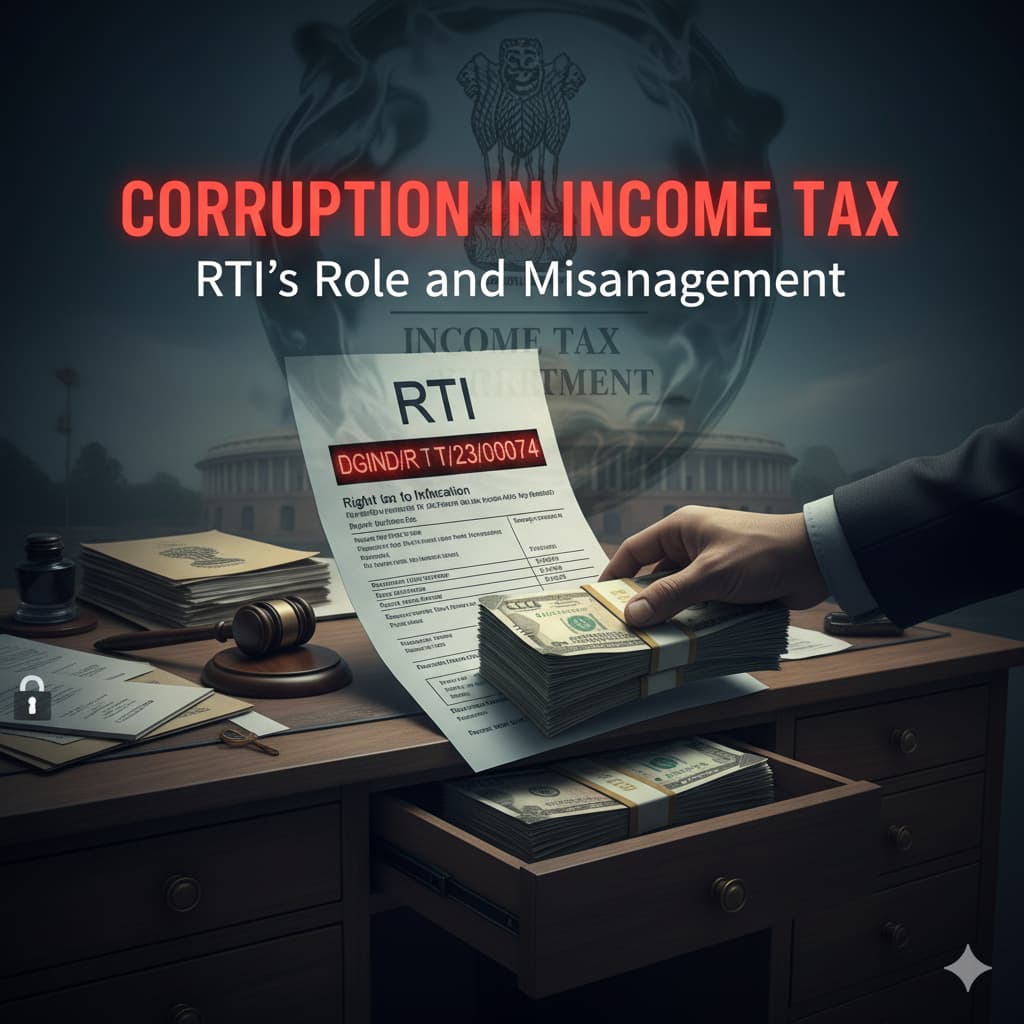
Corruption in income tax systems has emerged as a significant hurdle for nations seeking economic transparency and equity. Addressing the issue of corruption in income tax and RTI’s role is increasingly important in today’s push for good governance. This corruption not only undercuts government revenue but also fosters an environment of inequality, affecting the most vulnerable sectors of society. In this context, the Right to Information (RTI) plays a crucial role by empowering citizens to demand accountability from those in power. By facilitating access to pertinent information regarding tax collection and expenditure, RTI initiatives enable individuals to challenge corrupt practices. Increased public scrutiny through RTI can lead to more transparent governance and potentially reduce corruption in income tax processes, fostering trust between citizens and the government.
Key Takeaways
- Corruption in income tax systems undermines government revenue and increases inequality, impacting vulnerable communities.
- The Right to Information (RTI) empowers citizens to hold authorities accountable for tax-related corruption.
- A case involving Mr Yogi M.P. Singh highlights issues of registration and transparency within the Income Tax Department.
- Although the Central Public Information Officer cited exemptions, the RTI Act requires disclosure of corruption-related information.
- The Central Information Commission’s failure to address key corruption questions perpetuates a culture of administrative opacity.
🚨 Corruption in Income Tax & RTI’s Role: A Matter of Registration, Corruption, and Accountability in the Income Tax Department
Mr. Yogi M.P. Singh’s case against the Director General of Income Tax (Exemption) showcases ongoing tension as it highlights the struggle between citizens’ right to information and the state’s secretive apparatus. The investigation wing, also involved, sharply contrasts with the state’s apparatus for secrecy, particularly regarding allegations of deep-rooted corruption involving $350 million INR. This second appeal before the Central Information Commission (CIC), identified by File No. CIC/DGITE/A/2024/601981, ostensibly addresses a missing registration number, yet its core focuses on the alleged procrastination by the Department of Income Tax (DOIT). It also involves officials concealing information about tax fraud to protect their own implicated personnel. (Corruption in Income Tax & RTI’s Role)
The Conundrum of the Missing Registration Number
The appellant’s RTI application was filed online on November 7, 2023. It raised a fundamental administrative concern. The DoIT neglected to mention the online RTI application’s registration number in subsequent communications.
Appellant’s Core Argument
The appellant rightly asserts that the registration number is the identity of an online RTI application. It must be consistently mentioned. The appellant cited the principle that the ‘right to reason is an indispensable part of the sound administrative system. ‘He demanded that the CPIO give reasons for this omission (Point 1 of the RTI).
The CPIO’s Deflection and the Appellant’s Rebuttal (Corruption in Income Tax & RTI’s Role)
The Central Public Information Officer (CPIO) responded. They only allot a registration number to online applications. Since the appellant submitted an “offline” application, the previous order dated October 20, 2023, did not mention any number.
The appellant vehemently refuted this assertion. They stated they had filed an online RTI application. Registration Number DGIND/R/T/23/00074 was later mentioned in the CPIO’s formal reply. This contradicted the ‘offline’ claim. The appellant argued that the CPIO’s explanation was misleading and irrelevant to the online application in question. There was a suspicion that the public authority transferred the online RTI application offline. This was done to confuse the appellant. It also aimed to conceal the matter.
The main issue in point 1 shifted. Initially, it was about why the number wasn’t mentioned. Now, it’s about why the CPIO was providing misleading information and trying to reclassify an online application as offline. This administrative obfuscation, in the appellant’s view, was directly promoting corruption.
Unanswered Questions: The Battle Over Corruption Information
Beyond the administrative detail of the registration number, the RTI application sought crucial information directly challenging the department’s integrity and its selective use of the RTI Act:
- Point 3: Why isn’t the intelligence and criminal investigation wing of the Income Tax Department providing information? This information concerns corruption and human rights violations. Such information is not excluded under the Second Schedule of the RTI Act, 2005.
- Point 4: Offer guidelines, memos, or circulars. These should support the “illegal stand” of the intelligence wing. This stand involves withholding corruption-related information by taking recourse to the Second Schedule.
The CPIO’s Denial and Recourse to Section 24(1)
The appellant states that the CPIO did not entertain or provide information for Points 2, 3, and 4. This action resulted in incomplete and misleading disclosure.
In its written submission to the CIC, the CPIO-cum-ITO (Inv.) revealed the actual legal ground for denial: Section 24(1) of the RTI Act, 2005.
The respondent stated that the Directorate General of Income Tax (Investigation) is in the Second Schedule of the RTI Act. This inclusion is based on a notification dated March 27, 2008. It is classified as an intelligence and security organisation that is generally exempt from the Act’s operation.1
Crucially, while Section 24(1) exempts these organisations, it includes a proviso that states:
…information related to allegations of corruption and human rights violations shall not be excluded under this sub-section.
The CPIO’s submission cites the general exemption. Nonetheless, it fails to tackle the proviso directly. The requested information must be provided if it pertains to corruption. The CPIO upheld the denial and cited a Delhi High Court order. It suggests the office is exempt. The appellant’s specific query was tailored to circumvent this exemption by invoking the corruption proviso.
The Role of the Central Information Commission (CIC)
The matter reached the CIC in a second appeal. Unfortunately for the appellant, Mr Yogi M.P. Singh did not participate in the hearing on May 15, 2025. (Corruption in Income Tax & RTI’s Role)
The Information Commissioner, Mr Vinod Kumar Tiwari, in his decision on May 20, 2025, noted the appellant’s absence and concluded:
The Commission observes that the authorities have provided a suitable reply according to the RTI Act provisions. This information was given to the Appellant in a letter dated 16.11.2023. Moreover, the Appellant has not participated in the hearing to contest the Respondent’s submission. No intervention by the Commission is required in the instant case.
This ruling is the cryptic justification the appellant refers to. The CIC effectively sidestepped the core legal issue—whether the DoIT (Inv.) must release information concerning allegations of corruption under the proviso of Section 24(1)—and instead fell back on the CPIO’s initial response and the appellant’s non-appearance. The CPIO’s reply of November 16, 2023, which the CIC deemed “suitable,” only addressed the registration number. It left the substantive points 2, 3, and 4 regarding corruption unaddressed. The CIC’s decision did not intervene. This failure inadvertently appears to uphold the DoIT’s general exemption. It also remains silent on the corruption allegations.
The Call for Accountability: A Leadership Challenge (Corruption in Income Tax & RTI’s Role)
The appellant’s introductory remarks contextualise the RTI battle within a broader narrative of administrative decay and political accountability. The direct appeal to the leadership stresses a crucial point. If Modi Sir can’t tackle the corruption of the Department of income tax, then who will do it?” This question highlights the perceived failure of the governmental machinery. It does so even under the leadership of a prime minister with an “excellent track record of speaking… against corruption.” The alleged tax fraud is massive, at $350 million INR. DoIT personnel are implicated, which underscores the urgency.
The appellant’s plea is not just for information. It is a plea for the executive branch to enforce the laws. The Prime Minister and Finance Minister Nirmala Sitaraman are leading this effort to hold the administration accountable. The department’s perceived procrastination aggravates the public’s concern. Additionally, the CIC’s reluctance to apply the Section 24(1) proviso in this critical case strengthens this concern. People believe that high-level corruption continues to evade public scrutiny.
In conclusion, this case is a microcosm of the continuous struggle for transparency. The CIC closed the file. Still, the underlying allegations of $350 million fraud stand. The administrative evasion via the “offline” application claim persists. Additionally, there is a failure to fully consider the corruption proviso of the RTI Act’s Section 24(1). This situation means the core issue of accountability in the Income Tax Department remains unresolved.
Income tax exceeded every limit of corruption by updating my PAN Card in anonymous business
The National Human Rights Commission has diarised the matter of transactions amounting to Rs 161,206,667. Transactions of Rs 161206667 by misusing PAN of Yogi M. P. Singh is corruption


Facing a similar challenge? Share the details in the box below, and our team of experts will do their best to help.