
Battle for Transparency & DDA Mirzapur is a stark reflection of the ongoing insolence displayed by the DDA Mirzapur towards the provisions of the Right to Information Act of 2005. If you are looking for the latest developments about the Battle for Transparancy & DDA Mirzapur, this article explains why this issue matters. This blatant disregard for transparency underscores a significant gap between the expectations of the public and the actions of governmental bodies. Citizens, exercising their rights under this essential legislation, are met not with cooperation but with resistance, which raises serious questions about accountability and governance. In a democratic society, it is imperative for governmental organizations to operate transparently, allowing for public scrutiny and fostering trust. The struggle for access to information reveals broader issues regarding civic rights and the necessity for reform within the DDA Mirzapur to adhere to the law and serve the citizens effectively.
Key Takeaways
- The Battle for Transparency & DDA Mirzapur highlights ongoing challenges in accessing information under the Right to Information Act of 2005.
- Citizens like Mr. Yogi M P Singh face significant resistance when requesting details about public services, raising concerns about accountability.
- The DDA Mirzapur’s lack of transparency and reliance on flawed justifications reflect systemic weaknesses in governance.
- Discrepancies between manual records and digital databases suggest possible manipulation and hinder trust in public institutions.
- This case not only impacts one family’s quest for information but also serves as a crucial test for public administration accountability in Uttar Pradesh.
The Battle for Transparency: DDA Mirzapur and the Blocked Path to Accountability
When a citizen requests vital government information but meets complete silence or a questionable rejection, a larger systemic problem emerges. Indeed, it is never just about a single isolated application. Instead, it represents a crucial front in the larger Battle for Transparency within our public institutions.
A recent case in Uttar Pradesh has brought this internal democratic struggle into sharp focus. Specifically, the incident involves the District Deputy Director of Agriculture (DDA) Mirzapur. This public authority manages and approves crucial farmer welfare applications. Ultimately, this case illustrates individual citizen frustration. Furthermore, it exposes underlying structural weaknesses that consistently hinder public accountability and destroy institutional trust.
A Family’s Request is Blocked
Mr. Yogi M P Singh is a dedicated resident of Mirzapur. Initially, he began a simple quest for administrative information. However, this routine inquiry eventually spiraled into a massive legal challenge against the leadership of the DDA Mirzapur.
To begin with, in December 2025, Mr. Singh submitted an online request (Number: DRAGR/R/2025/60357) under the Right to Information (RTI) Act, 2005. His primary goal was entirely straightforward. In fact, he merely wanted to understand the exact processing status of three specific farmer registrations. Crucially, these registrations did not belong to strangers. On the contrary, they directly concerned himself, his elder brother, and his youngest brother, Keshav Pratap Singh.
In his official application, his request posed five fundamental questions to the DDA Mirzapur. For instance, he demanded detailed daily progress reports. He also requested physical copies of any official rejections. Furthermore, these targeted questions aimed to bring basic clarity to the applications. The department had already sat on these files for over ten months without sending a single communication.
Administrative Obstacles and Flawed Excuses
Instead of providing clarity, the DDA Mirzapur issued a written reply on June 20, 2026 (Number Pत्रांक-1480 / जन-सूचना/2026-27). However, this long-awaited response did not provide any direct answers to the citizen. Instead, the administrative office systematically raised a series of frustrating obstacles to block disclosure. Therefore, the office completely refused to answer Mr. Singh’s primary points. Specifically, it ignored his requests for progress tracking and the names of the handling officials.
As a defense, the DDA Mirzapur relied heavily on Section 8(1)(j) of the RTI Act. Historically, Parliament intended this specific clause to protect personal privacy when disclosure would serve no public interest. Nevertheless, Mr. Singh powerfully argued against this stance. Accordingly, he labeled the defense a fundamental and malicious misapplication of the law. After all, how can files belonging to an applicant’s own biological family be private from that specific applicant? As a result, this flawed argument by the DDA Mirzapur points directly to a lack of genuine effort toward proactive public disclosure.
Furthermore, the official responses regarding operational time limits were genuinely shocking. Specifically, Mr. Singh asked for documentation on how long an agricultural registration should legally take. In response, the DDA Mirzapur officially claimed “no knowledge” of such basic operational guidelines. Consequently, this remarkable admission from a major public authority highlights a deeply rooted systemic weakness in daily service delivery.
The Problem of Discrepancies and Possible Manipulation
The most critical turning point in this Battle for Transparency occurred during a routine data verification. Specifically, Mr. Singh carefully compared the manual physical statements from the DDA Mirzapur with the official state digital records.
On one hand, the written position of the DDA Mirzapur was completely unambiguous. The office explicitly claimed that the local authorities “Rejected the applications at the Tehsil level.” Naturally, this defensive statement would typically require support from formal, written rejection remarks, which Mr. Singh had originally requested.
On the other hand, a quick independent check on the state’s official digital DARSHAN Portal revealed a staggering contradiction. Incredibly, the public digital database did not list the applications as “Rejected” at all. Instead, the portal actively displayed all three family applications as “Vicharadheen” (Under Consideration).
Therefore, this massive data discrepancy cannot be explained away as a simple administrative error. Instead, it strongly indicates a fundamental, dangerous failure in digital record-keeping. Alternatively, it suggests that local officials deliberately manipulated the narrative. Because of this contradiction, Mr. Singh maintains that the DDA Mirzapur is intentionally withholding information. Ultimately, he believes they want to avoid creating documented evidence of systematic stalling and irregular processing.
The Struggle Goes Before the Commission
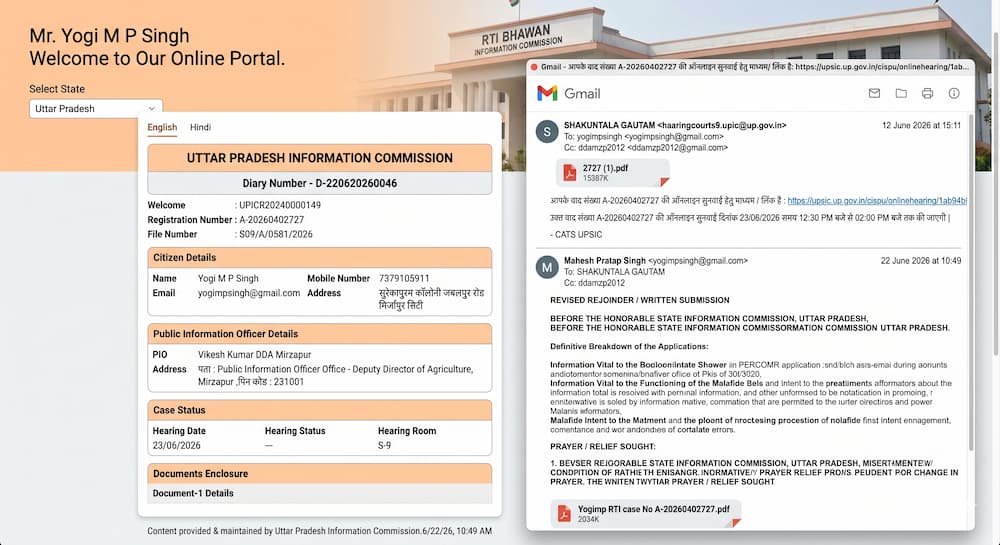
Because he faced conflicting statements and an absolute unwillingness to provide public documents, Mr. Yogi M P Singh has now taken his fight to a much higher level. Consequently, the Uttar Pradesh State Information Commission (UPSIC) will officially decide this Battle for Transparency. To support his case, Mr. Singh has already submitted highly detailed, point-by-point rejoinders to the Commission. These documents challenge the continuous evasions of the DDA Mirzapur.
In his appeal, his legal demands are entirely clear:
- Immediate Disclosure: He wants a direct, unappealable order to force the DDA Mirzapur to provide all requested information immediately.
- Legal Penalties: He formally seeks the maximum statutory financial penalties against the guilty officials for intentionally suppressing facts.
- Independent Investigation: He requests a comprehensive independent inquiry to investigate the apparent data manipulation between the manual claims and the digital DARSHAN portal.
The Broader Impact
In conclusion, the intense struggle for openness in this specific case is about far more than just the rights of one individual family. Additionally, the upcoming urgent hearing at the Commission on June 23, 2026, will serve as a major test case for public administration across the entire state.
Thus, the final decision will determine whether vital institutions like the DDA Mirzapur must follow basic statutory standards of accountability. Furthermore, it will decide if government agencies can continue to use data manipulation and legally flawed rejections as permanent roadblocks to the truth. Ultimately, democratic good governance relies entirely on absolute transparency, as this critical case so starkly illuminates to the public.ent roadblocks to the truth. Ultimately, democratic good governance relies entirely on absolute transparency, as this critical case so starkly illuminates to the public.on transparency, as this case so starkly illuminates.
. Digital Portals & Web Links (Battle for Transparancy & DDA Mirzapur)
- The DARSHAN Portal (Digital Agriculture Realtime Services, Hasslefree Assistance and New Initiatives): This is the official database tracker where application statuses (such as Vicharadheen) are logged.
- Official Website: upagriculture.com / agriwelfare.gov.in
- Uttar Pradesh State Information Commission (UPSIC): The appellate authority handling the ongoing dispute and the scheduled June 23, 2026 hearing.
- Official Website: upsic.gov.in
- Online RTI Gateway (Uttar Pradesh): The platform used by citizens to lodge, track, and appeal electronic RTI requests.
- Official Website: rtionline.up.gov.in
To ensure complete legal and administrative accuracy for your upcoming hearing before the Uttar Pradesh State Information Commission (UPSIC), here are the explicit identification numbers, tracking IDs, and target registration details for your second appeal:
This dispute is now part of a larger Directorate of Agriculture case file — see RTI Tools Against Directorate Agriculture Explained for the full, updated set of application IDs and the Second Appeal chronology.
1. Commission Appeal Registration & Base IDs (Battle for Transparancy & DDA Mirzapur)
- UPSIC Appeal Registration Number:
A-20260402727 - Original RTI Registration Number:
DRAGR/R/2025/60357(with linked crossfield requestDRAGR/R/2025/60325) - First Appeal Reference Number:
DRAGR/A/2025/60170(and later sequential trackingDRAGR/A/2026/60017) - First Appellate Authority (FAA) Contested Order: Letter No.
982/20-01-2026(Disposed on January 21, 2026, by the Joint Director of Agriculture, Vindhyachal Mandal, via non-reasoned template attachments).
2. Connected Central Government Reference IDs (Battle for Transparancy & DDA Mirzapur)
- Central Government Grievance ID (CPGRAMS):
DOAAC/E/2025/0045542(Dated December 10, 2025, from the Central Department of Agriculture and Farmers Welfare, on which the local DDA claimed engineered ignorance). - Central Grievance Appeal ID:
DOAAC/E/A/25/0001055 - Uttar Pradesh Chief Minister’s Office Grievance ID (IGRS):
GOVUP/E/2025/0146351
3. Specific Beneficiary / Farmer Registration IDs in Question (Battle for Transparancy & DDA Mirzapur)
These are the three precise registration records that the DDA Mirzapur manually reported as “Rejected at Tehsil level” while the state’s digital systems maintained them as Vicharadheen (Under Consideration):
20250119514266(Initiated January 19, 2025)20250119512524(Initiated January 19, 2025)20250119193467(Logged in alternative listings as20250119192467)
4. Key Respondent Contact Profiles (Battle for Transparancy & DDA Mirzapur)
These specific officials are the designated targets for the statutory penalties under Section 20(1) of the RTI Act for structural obstruction and data mismatch:
| Role / Authority | Official Name / Designation | Direct Contact Number | Official Email Address |
| Public Information Officer (PIO) | Vikesh Kumar, DDA Mirzapur | +91-7839882478 | ddamzp2012@gmail.com |
| First Appellate Authority (FAA) | Joint Director of Agriculture (JDA), Vindhyachal Mandal | +91-7668571373 | jdavindhyachal@gmail.com |
| State Nodal Officer (HQ) | Additional Director, Agriculture Directorate UP | +91-8081560096 | dirag@up.nic.in |


Facing a similar challenge? Share the details in the box below, and our team of experts will do their best to help.