
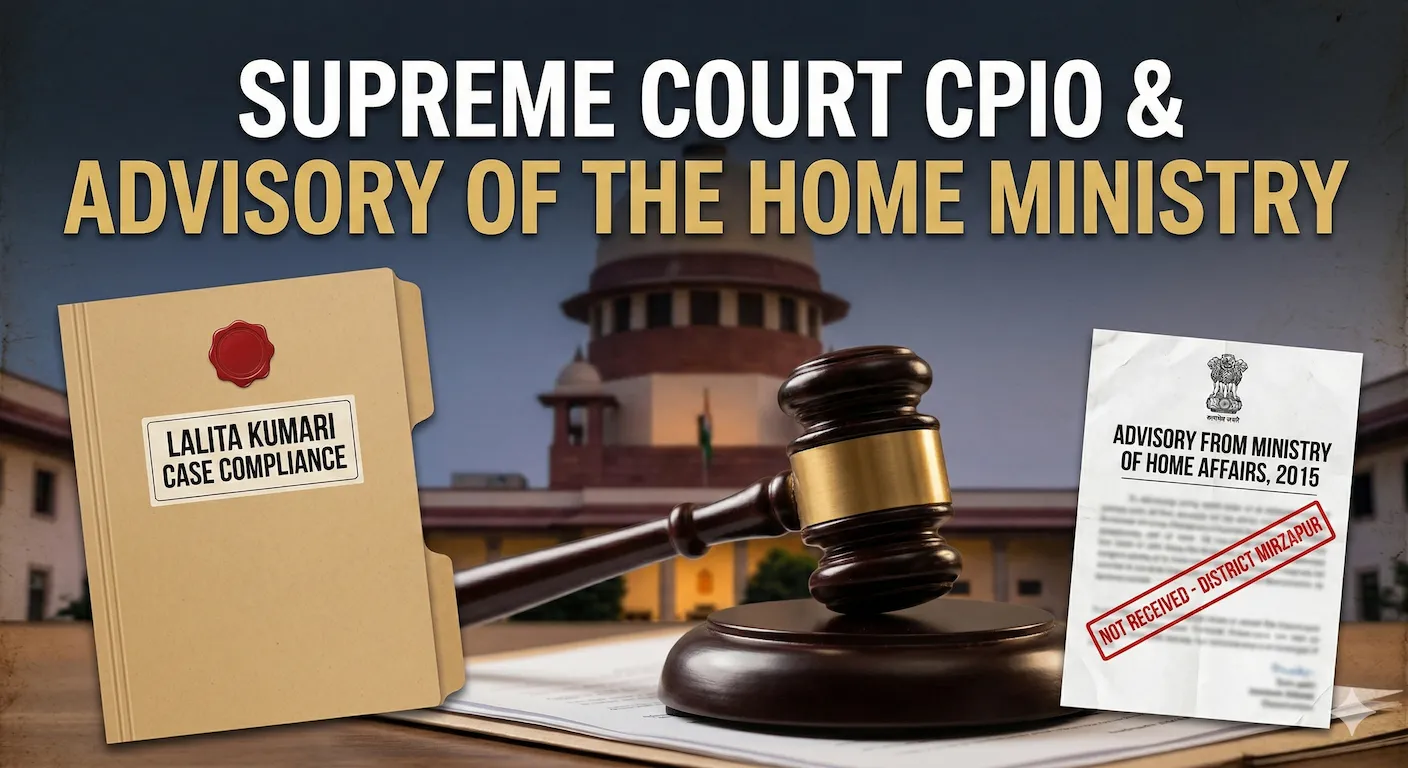
Here are the key takeaways from the blog post regarding your RTI challenge and the Supreme Court’s response. This includes matters related to Supreme Court CPIO & Advisory that may be relevant to your case.
The Core Conflict
- Mandate Implementation: You sought to verify how the Supreme Court ensures the Lalita Kumari mandate is followed. It pertains to mandatory FIR registration. This compliance is ensured during the transition to the BNSS, 2023.
- State Accountability: The request aimed to uncover Compliance Reports from Uttar Pradesh. It also sought information about the existence of monitoring committees for police non-compliance.
- The “Mirzapur Gap”: Your documents prove that the SSP Mirzapur admitted his office never received the 2015 MHA advisory. This highlights a breakdown in the compliance chain.
The Supreme Court CPIO’s Decision
- Procedural Denial: The CPIO, S.K. Kamesh Nookala, refused the RTI request. He argued that judicial records must be accessed via Supreme Court Rules, 2013. They should not be accessed through the RTI Act.
- Judicial vs. Administrative: The Court treats case-related documents (like compliance reports in Writ Petition No. 68 of 2008) as “judicial records” separate from standard administrative data.
- Jurisdictional Limits: The CPIO clarified that his office cannot interpret the law. It cannot provide legal opinions or direct other authorities to act under Section 2(f) of the RTI Act.
The Path Forward
- First Appeal Filed: You challenged the denial on February 28, 2026. You argued that administrative oversight records for finalized cases should be public.
- Finality Argument: The Lalita Kumari adjudication is over. You contend these records are no longer protected judicial files. Instead, they are tools for systemic transparency.
- Next Authority: The First Appellate Authority, Ms. Aarti Singh now has 30 to 45 days to make a decision. She can choose to uphold the CPIO’s refusal or order the release of the information.
Supreme Court CPIO & Advisory: Supreme Court CPIO Denies FIR Compliance Data
The shift marks a seismic change in Indian law. This involves moving from the Criminal Procedure Code (CrPC) to the Bharatiya Nagarik Suraksha Sanhita (BNSS), 2023. However, activists find the path to information obstructed by complex court rules and administrative silos. Notably, the Supreme Court CPIO & Advisory play a crucial role in guiding transparency for such data.
A recent RTI exchange with the Supreme Court of India reveals friction. This friction is between the RTI Act, 2005, and internal judicial regulations.
The Core Issue: Guarding the “Lalita Kumari” Mandate (Supreme Court CPIO & Advisory)
In February 2026, Yogi M.P. Singh filed an RTI application regarding mandatory FIR registrations. The landmark Lalita Kumari v. Govt. of U.P. (2014) judgment requires police to register an FIR for any cognisable offence. The Court’s Advisory and its CPIO serve as gatekeepers for these mandates. Their actions impact how Supreme Court CPIO & Advisory decisions are implemented in practice.
The applicant requested specific implementation details:
- BNSS Transition: New circulars ensuring the Lalita Kumari mandate remains strict under the 2023 framework.
- State Accountability: “Compliance Reports” from Uttar Pradesh regarding FIR mandates.
- Monitoring: Data on committees tracking police non-compliance, specifically in District Mirzapur.
The CPIO’s Decision: RTI vs. Court Rules (Supreme Court CPIO & Advisory)
On February 28, 2026, the Supreme Court CPIO, S.K. Kamesh Nookala, refused the request. His decision relied on two primary legal pillars. Thus, interactions with the CPIO and the judicial Advisory underscore the complexities within Supreme Court CPIO & Advisory frameworks.
1. The “Judicial Record” Barrier
The CPIO stated the information pertains to judicial matters like Writ Petition (Crl.) No. 68 of 2008. He asserted that the RTI Act does not cover these judicial records. It is essential to understand how Supreme Court CPIO & Advisory protocols classify records regarding transparency.
Instead, the CPIO directed the applicant to the Supreme Court Rules, 2013:
- Order XIII: Governs how parties and non-parties obtain certified copies.
- Order X: Sets the procedure for inspecting and searching judicial files.
The Court effectively treats these records as separate from administrative data. This approach is informed by guidance from the Supreme Court CPIO & Advisory when distinguishing record types.
2. Jurisdictional Limits (Supreme Court CPIO & Advisory)
The CPIO clarified that his office cannot interpret the law or opine on judgments. Under Section 2(f) of the RTI Act, “information” includes only existing records. It does not require a CPIO to create new legal explanations. In such matters, Supreme Court Advisory and CPIO guidelines reinforce the office’s jurisdictional limits.
Mirzapur: A Breakdown in Command
While the CPIO maintained his procedural stance, documents from District Mirzapur revealed a local failure. In 2025, the SSP Mirzapur admitted his office never received the 2015 MHA advisory on mandatory FIRs. These breakdowns highlight gaps in Supreme Court CPIO & Advisory communication that affect local compliance.
This administrative gap caused several issues:
- Local police stations never received the mandate.
- Authorities claim old CrPC provisions stopped applying on July 1, 2024, due to the BNSS transition.
The Path Forward: Challenging the Defense
Dissatisfied, the applicant filed a First Appeal (No. F.1/RTI/A.136/2026) on February 28, 2026. The appeal offers a sophisticated counter-argument. It claims the request seeks administrative oversight records, not private judicial files. For future reforms, Supreme Court Advisory & CPIO support is vital for facilitating appeal and transparency.
The appeal argues:
- Finalised Case: Since the Lalita Kumari case is over, records are now administrative.
- Systemic Transparency: Knowing if a monitoring committee exists constitutes an inquiry into the Registry’s setup.
Conclusion
This case highlights a persistent tension in the judiciary. When does a document stop being a “judicial record” and become “public information”? The First Appellate Authority, Ms. Aarti Singh, must now decide. This outcome will determine if the RTI Act can hold the Court’s administrative wing accountable for its mandates. In the end, Supreme Court CPIO & Advisory guidance is pivotal for public access and accountability.
The administrative wall still stands, but Mirzapur’s missing advisories show clear cracks. Looking ahead, Supreme Court CPIO & Advisory roles will be central to addressing such failures.
Based on your request and the official records provided, here are the contact details for the public authorities involved in your RTI and appeal process.
1. Supreme Court of India (Central Public Authorities)
The Supreme Court handles matters on both its administrative and judicial sides. Your RTI application and First Appeal are directed here.
| Designation | Name | Contact Number | Official Email |
| Central Public Information Officer (CPIO) | Sh. S.K. Kamesh Nookala | 011-23115632 / 23115932 | supremecourt@nic.in |
| First Appellate Authority (FAA) | Ms. Aarti Singh (Registrar) | 011-23112530 / 23387954 | supremecourt@nic.in |
| Transparency Officer | Sh. Mashroor Alam Khan | 011-23074211 / 23112535 | supremecourt@nic.in |
| General Registry Helpline | Registrar’s Office | 011-23116400 (Multiple lines) | supremecourt@nic.in |
- Web Link: Supreme Court RTI Portal
2. Uttar Pradesh Police (Mirzapur District Authorities)
These authorities provided the information regarding the non-receipt of the 2015 MHA advisory in District Mirzapur.
| Designation | Name / Rank | Mobile (CUG) | Official Email |
| Superintendent of Police (SP), Mirzapur | Smt. Aparna Rajat Kaushik (IPS) | 9454400299 | spmzr-up@nic.in |
| Addl. SP (Operations) / CPIO | Sh. Manish Kumar Mishra | 9454401105 | asp-op.mi@up.gov.in |
| IG Range, Mirzapur (First Appellate Officer) | Sh. Rakesh Prakash Singh (IPS) | 9454400215 | digrmir@nic.in |
| ADG Zone, Varanasi (Second Appellate Officer) | Sh. Piyush Mordia (IPS) | 9454400145 | igzonevns@nic.in |
- Web Link: U.P. Police Official Website (Supreme Court CPIO & Advisory)
3. Information Commissions (Higher Appeals) (Supreme Court CPIO & Advisory)
If the First Appellate Authority (FAA) at the Supreme Court upholds the CPIO’s denial, you must approach the Central Information Commission.
| Authority | Function | Help Desk / Phone | Web Link |
| Central Information Commission (CIC) | Second Appeal for Central Authorities (Supreme Court) | 011-24622461 | cic.gov.in |
| U.P. State Information Commission | Oversight for State Authorities (Mirzapur Police) | 0522-7118629 | rtionline.up.gov.in |
Application Details Reference (Supreme Court CPIO & Advisory)
- Supreme Court RTI ID: 4517/RTI/25-26/SCI
- Supreme Court First Appeal ID: F.1/RTI/A.136/2026
- Mirzapur Police Appeal ID: ज०सू०ऑन अपील-26/2025
- U.P. SIC Appeal ID: S09/A/1015/2025
Would you like me to draft a brief status inquiry email? You can send it to the Supreme Court’s FAA using these contact details.


Facing a similar challenge? Share the details in the box below, and our team of experts will do their best to help.