
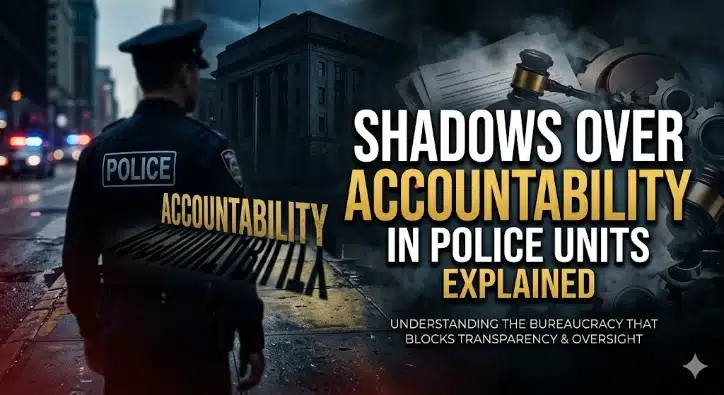
Shadows Over Accountability in Police
The ongoing discussion about police accountability has brought to light various systemic issues that create barriers to justice. Many communities feel marginalized by forces meant to protect them, leading to mistrust and fear. Instances of excessive use of force have raised questions about the integrity of law enforcement agencies. Furthermore, the lack of transparency in investigations often leaves the public in the dark, perpetuating a cycle of doubt and skepticism. As demands for reform grow louder, it is crucial to address these shadows and implement mechanisms that foster true accountability and community trust in police practices.
Key Takeaways
- The article discusses systemic issues affecting police accountability, highlighting community mistrust due to excessive force and lack of transparency.
- Specialized police units may complicate accountability by evading proper procedures and creating delays, as shown in a recent Uttar Pradesh State Information Commission hearing.
- Silence from specialized units during inquiries exposes failures in coordination, reinforcing a false sense of security among the public.
- Witnessing the consequences of inaction, public officials sometimes resort to coercive tactics, undermining transparency and legal protocols.
- For true accountability, citizens must document interactions with officials and leverage the law to demand justice, as the article encourages a proactive stance against misconduct.
Shadows Over Accountability in Police: How Specialization Shields Inaction
Governments often create special administrative cells and police units with great pomp. They promise swift and expert solutions to complex crimes. However, transparency laws often reveal a troubling pattern. Bureaucrats frequently weaponize these specialized units to stall progress and evade proper procedures. This structural failure casts long shadows over accountability in police departments.
A recent joint online hearing before the Uttar Pradesh State Information Commission proves this point. It shows how systemic laziness paralyzes special units. It also shows how public servants scramble when citizens force them to face accountability. When specialized units fail, the entire justice system suffers.
1. The Facade of Specialization: A Silent Defense
During a second-appeal hearing under the Right to Information (RTI) Act, the special cyber cell’s defense collapsed into absolute silence. The case involved major delays in a criminal fraud investigation. The applicant presented a crucial fact from the Income Tax Department. The department explicitly stated that the local police never officially requested the relevant files. When confronted with this fact, the Cyber Cell In-charge remained completely mute.
This silence speaks volumes about the shadows over accountability in police operations. It exposes a profound failure in police coordination:
- The applicant handed over clear, actionable data about 24 suspect firms to the police.
- The cyber cell failed to serve even a single legal notice to these companies.
- The investigating officers took no concrete steps to verify the financial fraud.
- Instead of investigating, a sub-inspector tried to dismiss the entire case as baseless.
When a special police unit goes mute because they skipped basic steps, it reveals a dark truth. The “specialized” label often just hides sheer inaction. It creates a false sense of security for the public while shielding lazy officers from oversight.
2. Commission Resentment: “What is the Need for This Cell?”
The police’s failure to act did not escape notice. The Hon’ble Chief Information Commissioner took a very strict view of the massive delays and lack of work. The Commission openly reprimanded the present officers with a stinging remark:
“If investigations are to be conducted in such an inefficient manner by the Cyber Cell, then what is the actual necessity or utility of maintaining such a specialized cell?”
This supreme transparency tribunal openly questioned why this special police department even exists. Their sharp remark underscores a dangerous reality. Administrative delays are not just logistical issues. They are a deliberate threat to justice. When specialized officers face no consequences for delay, it lengthens the shadows over accountability in police ranks.
Special cells receive extra funding, better technology, and specific training. When they perform worse than regular police stations, the public waste their tax money. The Commission’s anger shows that institutional patience with lazy police work is running out.
3. Shifting from Inaction to Coercion: The Digital Shortcut
Public officials pivot to dangerous shortcuts when they feel the heat of accountability. The Commission’s sharp words caught the investigators off guard. Within 24 hours of the hearing, the Investigating Officer tried to take a highly irregular shortcut. This step deepened the shadows over accountability in police methods.
The officer called the applicant’s phone. He demanded a sensitive One-Time Password (OTP) to log directly into the applicant’s private Income Tax portal.
This move highlights three core institutional issues:
- Bypassing the Law: Statutory laws require a formal, written legal notice for digital data access. Oral demands over a phone call have zero legal validity.
- No Audit Trail: Sharing security codes over a voice call leaves no official record. No one can prove who logged in or what data they changed.
- The “Non-Cooperation” Trap: The applicant rightly refused to share the secret OTP. He insisted on a standard written request instead. The officer expressed open resentment at this lawful stance.
This is a classic police tactic. They make an irregular verbal request, then try to frame the law-abiding citizen as “non-cooperative.” This behavior shows how easily police units switch from laziness to intimidation. They bypass digital safety rules to cover up their own past delays.
4. Institutional Resistance and the Fight for Transparency
The shadows over accountability in police grow longer when senior officers protect their juniors instead of enforcing the law. In many cases, regular supervision is completely missing. An investigating officer can keep a file pending for months without any internal review. It is only when an RTI applicant pushes the matter to the State Information Commission that the truth comes out.
This case exposes a deeper cultural problem within law enforcement:
- Fear of Written Records: Officers prefer phone calls because voice conversations leave no official paper trail. Written notices force them to be accountable.
- Arrogance of Power: The officer became angry when a citizen asked him to follow the law. This shows that many officers think they are above the rules.
- Protection of Suspects: Failing to send notices to 24 suspect firms points to a deeper issue. It raises questions about whether the delay is due to laziness or collusion.
Citizens must understand that special cells are not immune to corruption or inefficiency. Without constant public monitoring, these units quickly become safe havens for bad work.
Conclusion: The Path Forward for Human Rights Defenders
This case teaches a critical lesson to every whistleblower, RTI petitioner, and Human Rights Defender. Never mistake administrative pressure for legal authority.
When government offices fail to do their jobs, they try to take shortcuts. When they take shortcuts, they leave a trail. To clear the shadows over accountability in police systems, citizens must use the law as a shield and a weapon.
You must document every phone call, save call logs, and send immediate written proof back to the Information Commission. This is how you turn the bureaucratic trap back onto the faulty officials. True accountability is never given freely; citizens must systematically demand it through the strict and uncompromising application of the law.
Based on the provided documents and official correspondence records, here are the structured details regarding the application IDs, contact information, and public authorities concerned with this case:
1. Application and Case Identifiers (Shadows Over Accountability in Police)
- RTI Appeal Registration Number: A-20240100130
- UPIC Appeal File Number: S01/A/0061/2024
- UPIC Diary Number: D-040620260004
- UPIC Welcome ID: UPICR20240000149
- Police Case Crime Number (Related Investigation): Case Crime No. 291/2023 (Registered under Section 420 IPC and Sections 66C/66D of the IT Act at Police Station Katra, Mirzapur)
2. Concerned Public Authorities & Contact Details (Shadows Over Accountability in Police)
A. Uttar Pradesh State Information Commission (UPIC)
- Concerned Bench/Room: Hearing Court S-1 (Presided over by the Hon’ble State Chief Information Commissioner)
- Official Email Address:
hearingcourts1.upic@up.gov.in
B. Cyber Crime Police Headquarter / Public Information Officer (Shadows Over Accountability in Police)
- Public Information Officer (PIO) Authority: Office of the Superintendent of Police, Cyber Crime, Uttar Pradesh, Lucknow
- Co-Respondent Authority: Senior Superintendent of Police, District Mirzapur
C. Cyber Police Station, Mirzapur (Investigating Agency) (Shadows Over Accountability in Police)
- Investigating Officer (IO): Inspector Dhananajay Kumar Rai (विवेचक/निरीक्षक, साइबर थाना, मीरजापुर)
- IO Mobile Number:
088585 03070 - IO Personal/Official Email:
raidhananajaykumar92@gmail.com - Local RTI Cell Email (Mirzapur):
jansuchanacellmzr@gmail.com
3. Web and Portal Link Details (Shadows Over Accountability in Police)
- UPIC Internal Reference URL Structure:
(https://mail.google.com/mail/u/0/?ik=423f69194e&view=pt&search=all&permthid=thread-a:r-8243052412967176218)(Note: This is an internal technical link pointing to the specific digitized case record thread within the communication dashboard). - Official State Grievance & RTI Tracking Portals: (Shadows Over Accountability in Police)
- Right to Information requests and second appeals are monitored and tracked via the official portal of the Uttar Pradesh State Information Commission.
- Local administrative coordination is linked with the Jansunwai (IGRS) public grievance framework of Uttar Pradesh.


Facing a similar challenge? Share the details in the box below, and our team of experts will do their best to help.