
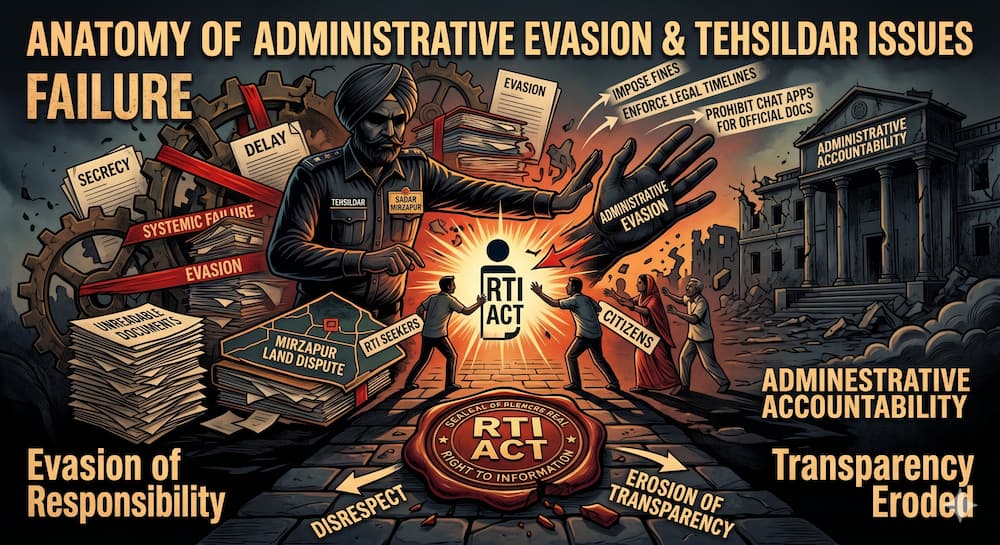
Anatomy of Administrative Evasion & Tehsildar is a true story of mockery of the RTI Act, illustrating the blatant disregard for transparency and accountability. Tehsildar Sadar not only ignored but openly flouted the directives of the Chief Information Commissioner of Uttar Pradesh, showcasing a systemic failure within the administrative framework. This incident reflects a troubling trend where officials sidestep their responsibilities, undermining the very essence of democracy and citizen empowerment. The lack of repercussions for such actions sends a message that those in power can operate above the law. As the struggle for information continues, the public is left grappling with the consequences of this evasion, raising serious questions about the integrity of governance in the region.
Key Takeaways
- The article highlights the Anatomy of Administrative Evasion & Tehsildar as a case of disrespect for the RTI Act, demonstrating a systemic failure in governance.
- Tehsildar Sadar ignored directives from the Chief Information Commissioner, showcasing a troubling trend in administrative accountability.
- A land boundary dispute in Mirzapur illustrates how officials evade responsibility by misdirecting inquiries and producing unreadable documents.
- Recommendations include imposing fines on non-compliant officials, prohibiting the use of chat apps for official documents, and enforcing legal timelines strictly.
- The case raises critical concerns about the integrity of administrative processes and the erosion of transparency in governance.
Anatomy of Administrative Evasion & Tehsildar: How the Tehsildar’s Evasion Mocks the RTI Act
The Right to Information (RTI) Act, 2005, was originally built to destroy bureaucratic secrecy in India. Furthermore, it promised absolute transparency and gave ordinary citizens the power to question lazy officials. Yet, two decades later, citizens still face deep institutional resistance. Consequently, Public Information Officers (PIOs) often use tricks, delays, and fake excuses to block valid inquiries.
A clear example of this problem has just unfolded before the Uttar Pradesh Information Commission (UPIC), Lucknow. Specifically, the case is Yogi M.P. Singh v. Public Information Officer / Tehsildar, Tehsil-Sadar, District-Mirzapur (Second Appeal No: S01/A/1390/2025). Therefore, this dispute perfectly highlights the Anatomy of Administrative Evasion & Tehsildar compliance failures. Ultimately, it shows the daily hurdles human rights defenders face when fighting for land transparency.
PDF+ 3
The Core Dispute: A Land Issue Shrouded in Lies
At the outset, a deep land boundary conflict in Village-Babura, Mirzapur, sits at the heart of this fight. For context, the dispute involves three specific plots: Arazi numbers 1012, 1271, and 1404. Because these are registered as transferable landholdings (Sankramaniya Bhumidhar), they require clear statutory handling. As a result, a formal partition suit under Section 116 of the U.P. Revenue Code was filed to mark these borders legally. (Anatomy of Administrative Evasion & Tehsildar)
PDF+ 4
However, regional officials chose to misdirect the case entirely. Initially, the applicant sought clear data about long delays on the ground. Instead of solving it as a land revenue issue, officials called the standoff a “police matter” to dodge their duties. Thus, this lie delayed justice for the landowners. In addition, it ruined the data sent to official portals like the Chief Minister’s Jan-Sunwai system.
PDF+ 3
Last-Minute WhatsApp Reports: Choking the Flow of Data
Public officials often shorten reply timelines to escape fines from courts. In this appeal, the U.P. Information Commission gave a clear judicial order via Notice No: 202606S01N200410. In particular, the Commission ordered the Respondent—specifically the Tehsildar acting as the PIO—to upload a clean, tabular compliance report onto the portal. Moreover, they had to do this at least two days before the hearing date of June 22, 2026.
*Anatomy of Administrative Evasion & Tehsildar)
Nevertheless, the Tehsildar completely ignored this timeline:
- First, the office uploaded zero documents to the portal forty-eight hours before the trial. PDF
- Second, the Tehsildar sent six blurry images of the report via a personal WhatsApp number (
+91 80054 94979). PDF+ 1 - Finally, this data dump happened on June 22, 2026, at 11:33 AM—just minutes before the hearing started. PDF+ 1
Official Deadline: June 20, 2026 (Portal Upload) ❌ [VIOLATED]Actual Delivery: June 22, 2026, 11:33 AM (WhatsApp) ⚠️ [TACTICAL DELAY]
Clearly, this timestamp proves a planned ambush. By keeping records secret until the very last hour, the authority effectively blocks the citizen’s ability to read and counter the claims before the commissioner.
The Void Defense: “Consensus” vs. “Command”
Subsequently, the Tehsildar Sadar of Mirzapur filed his written statement on June 21, 2026. However, his excuse for non-compliance showed a total ignorance of basic law. The Tehsildar claimed that staff could not complete Phaatbandi (marking boundaries) because the disputing parties did not agree with each other. (Anatomy of Administrative Evasion & Tehsildar)
In reality, this argument has no legal merit for three specific reasons:
- To begin with, a decree from a Revenue Court is a legal command, not an open invitation to a casual chat. Therefore, it holds the power of the state.
- In addition, if landowners resist a court-ordered survey, the revenue team (the Tehsildar, Inspector, and Lekhpal) must bring in the police to finish the work.
- Most importantly, claiming a lack of party agreement justifies a failure to act sets a dangerous trap. Consequently, it allows any lawbreaker to stop a court order simply by saying “no.”
Broken Grievance Portals and Blurry Pages
Beyond the courtroom, this land fight exposes a wider issue: how officials manipulate online grievance systems. For instance, the petitioner found that the files uploaded by the District Magistrate’s office to the Jan-Sunwai portal were completely unreadable. (Anatomy of Administrative Evasion & Tehsildar)
When agencies upload blurry pages to public portals, they create a silent denial of data. Meanwhile, the system marks the case as “Resolved,” which boosts government efficiency scores on paper. As a result, the actual citizen stays trapped on the ground with useless, dark images. Ultimately, this trick destroys the core purpose of digital transparency.
The Path to Fines: Enforcing Section 20(1) Sanctions
When public officers repeat their delays and ignore clear warnings, the Commission must stop being friendly. Instead, they must issue real fines. For example, in its interim order on May 14, 2026, the Commission warned the Tehsildar of Mirzapur that further failure would trigger an immediate Show-Cause notice. (Anatomy of Administrative Evasion & Tehsildar)
To protect the RTI Act, the Commission needs to take these three steps immediately:
- First, apply the full Section 20(1) fine of ₹25,000 against the PIO for blocking data without a good reason. PDF
- Second, ban the sloppy habit of sharing vital files on chat apps. Instead, force officials to send certified hard copies via Registered Post. PDF
- Third, write negative entries in the service books of local Lekhpals who skip legal timelines.
In conclusion, case file D-220620260103 is no longer just a minor land boundary fight. On the contrary, it is a major test for public sector truth. If a PIO can ignore a timeline and escape without a fine, the RTI Act becomes a dead law. Therefore, tracking the Anatomy of Administrative Evasion & Tehsildar failures is the only way to ensure officials follow the law instead of hiding from it.
Here is the organized, clean, and scannable list of all the Application IDs, Official Emails, Mobile Numbers, and Web Links involved in your case, documented strictly in English: (Anatomy of Administrative Evasion & Tehsildar)
🆔 1. Application & Tracking IDs (Anatomy of Administrative Evasion & Tehsildar)
- Latest Commission Diary Number:
D-220620260103(Registered on June 22, 2026) PDF - Previous Representation Diary Number:
D-210620260029(Registered on June 21, 2026) PDF+ 1 - RTI Appeal Registration Number:
A-20250902068 - Commission File / Appeal Number:
S01/A/1390/2025 - Commission Hearing Notice Number:
202606S01N200410 - UPIC Welcome Portal Tracking ID:
UPICR20240000149 - Revenue Court Computerized Case ID (Partition Suit):
T202216530107209 - Revenue Court Computerized Restoration ID:
D2026165300004931
📧 2. Official Email Addresses (Anatomy of Administrative Evasion & Tehsildar)
- UP Information Commission (Court Room S-1):
hearingcourts1.upic@up.gov.in - Office of the PIO / Tehsildar Sadar, Mirzapur:
shome.p11@up.gov.inPDF - District Magistrate (DM) Office, Mirzapur:
dmmir@nic.inPDF - Departmental Review Center (VRC), Mirzapur:
vrc396mirzapur@myogimpsingh - Appellant’s Registered Email (Yogi M.P. Singh):
yogimpsingh@gmail.comPDF+ 1
📱 3. Contact & Mobile Numbers (Anatomy of Administrative Evasion & Tehsildar)
- PIO / Tehsildar Sadar Mirzapur Office Helpline:
9454411960PDF - Unofficial Contact Number (Used by PIO for WhatsApp Transmission):
+91 80054 94979PDF+ 1 - Appellant’s Registered Mobile Number (Yogi M.P. Singh):
7379105911PDF+ 1
🌐 4. Official Web Links of Public Authorities (Anatomy of Administrative Evasion & Tehsildar)
- Uttar Pradesh Information Commission Official Portal:👉 https://upsic.up.gov.in/ PDF
- Chief Minister’s Grievance (Jan-Sunwai) Portal:👉 Jansunwai Portal (Relevant to the distorted/illegible compliance reports filed by the PIO) PDF+ 1
💡 Keep this index handy. Citing this consolidated dataset in any future counter-affidavits or tracking reminders will protect your case file from administrative mix-ups and keep the pressure firmly on the Tehsildar’s office.


Facing a similar challenge? Share the details in the box below, and our team of experts will do their best to help.