
Key Takeaways
- Tej Bahadur Singh alleges Tehsildar misconduct involving illegal constructions on government land in Phoolpur, Prayagraj.
- He claims revenue staff mishandled complaints, leading to arbitrary closures and failures in accountability.
- The complainant demands urgent intervention, including reopening grievances and conducting independent inspections.
- Strong actions against illegal encroachments and strict disciplinary measures against the Tehsildar are essential.
- This case underscores the need for rigorous oversight to prevent misuse of power and protect government property.
🚨 Tehsildar Misconduct: A Land Encroachment Saga in Phoolpur, Prayagraj
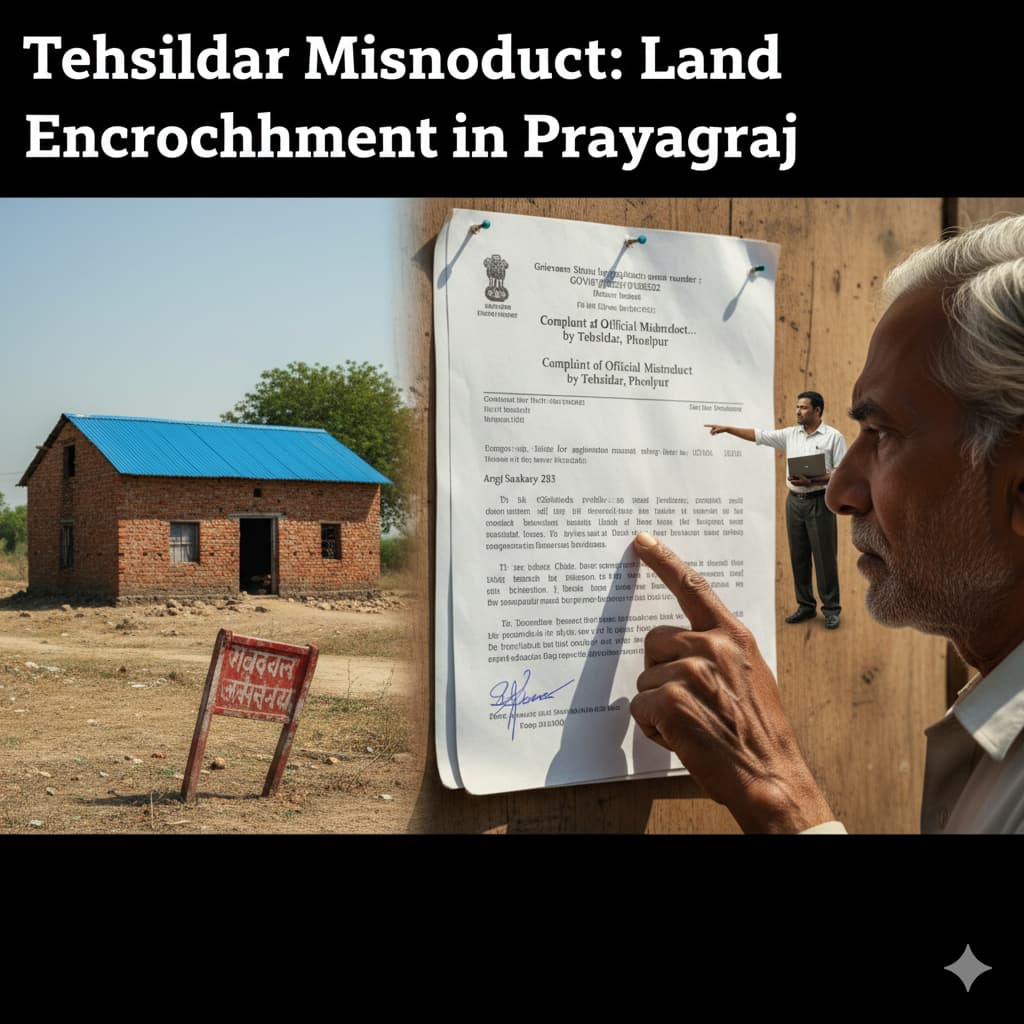
Tej Bahadur Singh filed a serious complaint through the UP government’s Jansunwai portal (GOVUP/E/2025/0128522), alleging a shocking failure of accountability that raises significant concerns about governance in the region.
In particular, he accuses revenue staff in Tehsil Phoolpur, Prayagraj, of potential official misconduct, which suggests a troubling pattern of disregard for ethical standards among those tasked with upholding the law.
Furthermore, he claims that the Tehsildar is involved in that misconduct, indicating that the very individuals responsible for maintaining order and facilitating transparency may be complicit in these actions.
Consequently, Singh raises an alarm about a deliberate closure of a crucial government land encroachment case that has long been a source of contention among local residents.
He argues that this action is arbitrary and, therefore, attempts to protect illegal builders, undermining the community’s trust in public institutions and allowing unlawful practices to flourish unchecked.
Such situations, if left unaddressed, could lead to escalated conflicts over land rights and property ownership, highlighting the need for immediate intervention and reform within the local governance framework.
The Core Issue is Tehsildar Misconduct: Existing Illegal Structures on Government Land
The grievance centers on the illegal construction of permanent residential structures on government land (Araji Sankhaya 283). This is a clear violation of Section 122 B of the U.P. Zamindari Abolition and Land Reforms Act, 1950. The act highlights misconduct by some involved, like the Tehsildar. It mandates the demolition of such encroachments and recovery of the land.
The named alleged encroachers are Balendra Singh, Baleshwar Singh, and Nirmala Singh, all reportedly protected by misconduct involving the Tehsildar.
Details of the Arbitrary Closures and False Reporting
The complainant suggests that the way subordinate staff closed two earlier grievances shows a deliberate pattern of behavior that raises significant concerns.
This pattern indicates not only obstruction but also a possible intent to undermine the legitimacy of the complaints.
Such behavior illustrates misconduct linked to certain Tehsildars, which not only reflects poorly on their individual integrity but also highlights a broader systemic issue within the administrative framework.
This situation calls into question the effectiveness of oversight mechanisms and raises alarms about the potential culture of complacency and neglect in handling grievances, ultimately affecting the trust placed in local governance and the protection of citizens’ rights.
Closure 1: Missed Phone Call Justification
- Grievance No.: GOVUP/E/2025/0073297
- Date of Action: 23/07/2025
- Complainant’s Feedback: Furthermore, the case was closed “arbitrarily,” citing the complainant missed a phone call from the Lekhpal (Village Accountant). Consequently, closing a serious public land matter solely on a missed call hurts the integrity of the process. This is especially true amidst allegations of Tehsildar misconduct.
Closure 2: Ignoring Existing Construction
- Grievance No.: GOVUP/E/2025/0100242
- Date of Action: 30/09/2025
- Official Remark (Translated): “No construction is now happening on Araji Sankhaya 283.”
- Complainant’s Feedback: This report is factually misleading and allegedly “forged.” The complaint is not about new construction. It is about taking mandatory action (demolition) against the existing, permanent illegal residential structures. The Tehsildar’s report avoids mandatory action under Section 122B(1) by focusing on “current” construction. This further illustrates how Tehsildar misconduct is implicated.
The crucial point: The closure reports fail to handle the fundamental violation—the existing illegal buildings. They are an effort to circumvent the law and protect the encroachers.
Prayer for Justice and Urgent Action
The complainant, Tej Bahadur Singh, has escalated the matter directly to the District Magistrate, Prayagraj. He is highlighting the seriousness of his concerns about the alleged irregularities within the administrative framework of Tehsil Phoolpur Prayagraj. He has also sent a copy to the Chief Minister Secretariat (Shri Arvind Mohan, Joint Secretary). By doing this, he ensures that the issue is brought to the attention of higher authorities. This action emphasizes the need for accountability. He is thus demanding urgent intervention to fix the issues raised, reflecting the deep-seated frustrations of the local populace. This intervention is mandatory to restore faith in the institution. It is also vital for maintaining the integrity and transparency of governance. The situation is crucial because mounting accusations of misconduct surround the Tehsildar. These accusations threaten to undermine public trust in the administrative system. They can lead to further civil unrest if not promptly addressed.
The key demands are fourfold:
- Reopening and Reassignment: Instantly reopen the earlier closed grievances and reassign the investigation.
- Impartial Inspection: Therefore, mandate a fresh, independent field inspector to conduct the inspection. This inspector should be a senior, unbiased officer. Notably, suitable officers include the Sub-Divisional Magistrate (SDM) or an Additional District Magistrate (ADM).
- Strict Action on Encroachment: Therefore, make sure that authorities promptly start formal proceedings under Section 122B. Additionally, they should focus on demolishing illegal structures and recovering government land. Moreover, it is crucial to handle Tehsildar misconduct to uphold fairness.
- Disciplinary Action: Start strict disciplinary action against the Tehsildar. Also, hold the Lekhpal accountable for submitting the false and misleading reports on the official government portal.
Conclusion
This case highlights a critical challenge in local governance; thus, it demonstrates the need for rigorous oversight. This oversight is crucial to prevent subordinate officials from misusing their power.
Furthermore, they risk submitting false reports and colluding with illegal elements to bypass the law.
Moreover, the new grievance status shows that the portal has received the grievance. It has been forwarded to Shri Arvind Mohan, Joint Secretary, in the Chief Minister Secretariat. Thus, all eyes will focus on the senior administration. The public wants to see if they will take the necessary steps to uphold the law.
They are expected to protect government property. Ultimately, Tehsildar misconduct remains the key issue, and the government should teach a lesson to Tehsildar Phoolpur Prayagraj.
Would you like me to track the progress of this new grievance (GOVUP/E/2025/0128522) or research the implications of Section 122B?
Yogi government claims to take action against Land mafia
Yogi government is supporting OM Sai Kripa (OPC) Pvt. Ltd. and Om Sai kripa Infrabuild Pvt.
Maharashtra government did not entertain matter concerning cheating by real state Mafia


Facing a similar challenge? Share the details in the box below, and our team of experts will do their best to help.