
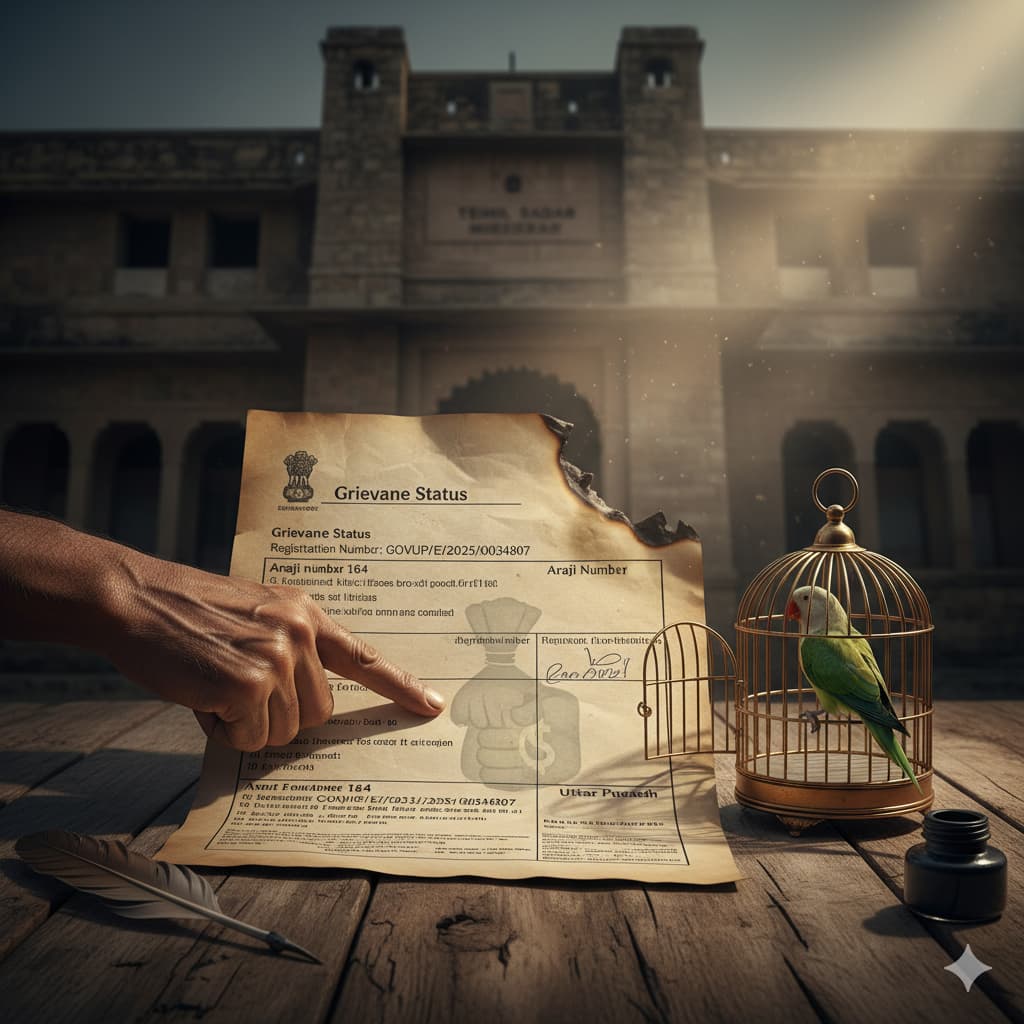
The documents detail serious allegations of corruption and manipulation of government land records concerning Araji number 164 (originally 175, 183, 191) in Tehsil Sadar, District Mirzapur, Uttar Pradesh. The complainant, Ashok Kumar Maurya, alleges that non-agricultural government land was illegally divided (into 164K and 164Kh) and sold to “muscle men” by Tehsil Sadar staff. The grievances also express dissatisfaction with the reports submitted by the Lekhpal (Pranjal Upadhyay), calling them “corruption-oriented” and attempts to conceal predecessor’s wrongdoings. The complainant highlights the responsibilities of the land custodians (District Magistrate, Chief Revenue Officer, Sub-Divisional Magistrate, and Tehsildar Sadar) under The Uttar Pradesh Revenue Code, 2006, specifically Section 32 (Correction of records), and requests them to initiate litigation for correction.
Given the depth and nature of the allegations, a comprehensive blog post would cover the following sections:
- Introduction: Setting the scene—a conflict over public land in Mirzapur.
- The Core Allegation: A Case of Land Record Manipulation: Detailed breakdown of the land’s history and the alleged illegal sale.
- The Legal Framework and the Custodians’ Duty: Discussing The UP Revenue Code, 2006, Section 32 and the roles of the officers.
- The Role of the Lekhpal: “Parrot Report” Controversy: Analyzing the complainant’s dissatisfaction with the official inquiry.
- The Call for Transparent and Accountable Enquiry: Emphasizing the need for systemic change.
- Public Interest and the Threat of Anarchy: Broader implications for governance and public trust.
- Conclusion: A Plea for Justice and Immediate Action.
🚨 The Mirzapur Land Scandal: A Citizen’s Battle Against Corruption in Revenue Records 🏛️
The government machinery, particularly at the local level, is meant to be the custodian of public trust and public property. Yet, a deep-seated grievance emanating from Tehsil Sadar, District Mirzapur, Uttar Pradesh, casts a harsh light on alleged corruption, manipulation of official records, and the shocking disregard for public land. The case, brought forward by Ashok Kumar Maurya through multiple formal grievances (GOVUP/E/2025/0021969 and GOVUP/E/2025/0034807), represents more than just a localized dispute; it is a potent example of how systemic failures in governance—specifically within the revenue department—can undermine the rule of law and facilitate the illegal enrichment of a few at the expense of the state and the public.
🗺️ The Core Allegation: A Case of Land Record Manipulation
At the heart of this controversy lies Araji number 164, described by the complainant as non-agricultural government land. The documented history of this land parcel is a labyrinth of changes that, according to the grievance, ultimately served to facilitate its illegal sale.
The sequence of alleged modifications, as detailed by the complainant, is telling:
- Initial Identity: The land was initially known as Araji number 175.
- Subsequent Changes: It was then modified to Araji number 183, and later still, to Araji number 191.
- The Final Manipulation: Eventually, it was re-designated as Araji number 164.
The critical step in the alleged corruption was the bifurcation of this government land into two new parcels: Araji number 164 K and Araji number 164 Kh. The central and most damning accusation is that, following this manipulation of the official records, one of these government plots was allegedly sold to “muscle men” by the staff of Tehsil Sadar. The grievance explicitly names Ramraj / Mewa / Residential Village Bihasara Khurd, among others, as recipients of Araji number 164a (presumably 164 K or Kh), citing attached revenue records as proof.
This process—a rapid succession of Araji number changes followed by a division and an alleged sale—paints a clear picture of intentional, systematic land grabbing achieved through the manipulation of public records. The non-agricultural nature of the land should have rendered it unalienable from the government’s possession, making its alleged sale a direct breach of public trust and legal statutes.
⚖️ The Legal Framework and the Custodians’ Duty
The complainant astutely anchors his request for action in the very legislation designed to protect these records: The Uttar Pradesh Revenue Code, 2006.
The Mandate of Section 32
Specifically, Section 32 (Correction of records) of the Code outlines the mechanism for fixing errors in official documents like the Khatauni (record of rights), Khasra (field book), and the map. Subsection (1) makes it the obligated duty of the revenue officials—including the Sub-Divisional Officer, Tahsildar, and Revenue Inspector—to record all changes and to “correct therein any errors proved to have been made in the records previously prepared.”
The complainant argues that the manipulation of Araji number 164 constitutes a provable error in the records, necessitating a correction. Crucially, the complainant makes an elevated legal argument: the responsible officers, the custodians of public land, are not merely to adjudicate a dispute but must themselves submit the plaint before the competent court of District Magistrate for the correction of the revenue record under Section 32/38 of the Revenue Code 2006.
The Role of Custodians
The complaint meticulously identifies the four key officers who serve as the custodians of this public land and, therefore, who bear the primary responsibility for its safeguard:
- District Magistrate, Mirzapur
- Chief Revenue Officer, Mirzapur
- Sub-Divisional Magistrate, Sadar, District Mirzapur
- Tehsildar, Sadar, District Mirzapur
The complainant’s logic is unimpeachable: since the land belongs to the Government of Uttar Pradesh, its highest-ranking local representatives must be directed to safeguard it and initiate the necessary legal steps to reclaim it from the alleged land grabbers. The request is not for the complainant to undertake the lengthy and complex legal battle, but for the state’s own functionaries—whose failure to prevent the sale is implicitly alleged—to fulfill their fiduciary duty to the public.
🐦 The Role of the Lekhpal: “Parrot Report” Controversy
A significant point of contention across both grievances is the nature of the official inquiry reports. The complainant expresses profound dissatisfaction with the report submitted by Lekhpal Pranjal Upadhyay, labeling it a “parrot report” and alleging it is “corruption oriented” and an attempt to “conceal the corruption done by his predecessors.”
This phrase, “parrot report,” suggests a report that merely repeats official jargon or provides a superficial, pre-determined conclusion without genuine investigation or accountability. In a subsequent follow-up, the complainant notes that the Lekhpal has again advised him to submit a plaint before the competent court.
This highlights a common bureaucratic tactic: shifting the burden of litigation onto the citizen even when the core issue is the correction of a corrupted public record and the recovery of state property. By recommending the citizen file a private suit, the officials effectively deflect their own responsibility to initiate corrective action under Section 32 and investigate the misconduct of their own staff. This defensive posture is precisely what the complainant sees as an attempt to conceal the truth and perpetuate the “tyranny and arbitrariness” that opens the door to corruption.
📢 The Call for Transparent and Accountable Enquiry
The grievances unequivocally demand a “transparent and accountable enquiry in the matter of corruption.” The complainant argues that such practices—the manipulation of records and the illegal sale of government land—are “quite common in the working of tehsil Sadar district Mirzapur.”
This is an accusation of systemic, rather than isolated, corruption. It implies that a culture of misconduct has taken root where revenue records are treated as commodities to be traded, rather than sacred documents of state ownership and citizen rights.
The matter has been forwarded to Shri Arvind Mohan (Joint Secretary) in the Uttar Pradesh Secretariat, indicating that the complaint has reached a high level of government. The onus is now on the state machinery to demonstrate that it can investigate itself fairly and effectively.
The requested “cogent approach” means more than a simple file review; it demands:
- A forensic audit of the revenue record (Khatauni, Khasra, and Map) for Araji numbers 175, 183, 191, and 164.
- An investigation into the staff responsible for the modifications and bifurcation that led to the alleged sale.
- The immediate initiation of litigation by the designated custodians (DM, CRO, SDM, Tehsildar) to cancel the illegal entries and reclaim the government land.
🌍 Public Interest and the Threat of Anarchy
The grievance transcends the specific piece of land, touching upon the very principles of good governance. The complainant emphasizes that the matter concerns “wide public interest” and that the “tyranny and arbitrariness” allowed in the public authorities’ working must be stopped.
- Erosion of Trust: When public officials act as facilitators for land grabbers through record manipulation, the faith of “law abiding citizens” in the administration is completely shattered.
- Legal Anarchy: Allowing officials to escape their duty to correct corrupted records creates an “anarchy in the working of the tehsil Sadar,” which, as the complainant notes, is “creating problems to not only applicants but entire villagers.” This anarchy allows the powerful to co-opt state institutions for private gain, leaving the ordinary citizen powerless.
The complaint is a powerful appeal to the highest authorities to restore order, accountability, and the sanctity of the public record. It is a direct challenge to the notion that corruption can simply be swept under the rug with a perfunctory, “parrot” report.
🎯 Conclusion: A Plea for Justice and Immediate Action
The case of Araji number 164 in Mirzapur is a litmus test for the commitment of the Uttar Pradesh government to its anti-corruption mandate. The documentary evidence, alluded to in the complaint, must be thoroughly examined.
The most respected Sir must heed the humble request of the applicant: to direct the concerned custodians of the land to stop deflecting responsibility and instead submit litigation before the competent court for the correction of Revenue records under the clear mandate of the UP Revenue Code, 2006.
Justice in this matter is not a favor; it is an obligated duty of the district and revenue administration. Upholding the law and protecting public property must override any attempts to conceal the actions of corrupt officials. Only a swift, transparent, and corrective action by the District Magistrate, Mirzapur, and the Chief Revenue Officer, Mirzapur, will address the core problem and restore the rule of law to Tehsil Sadar. The citizens of Mirzapur are waiting.


Facing a similar challenge? Share the details in the box below, and our team of experts will do their best to help.