
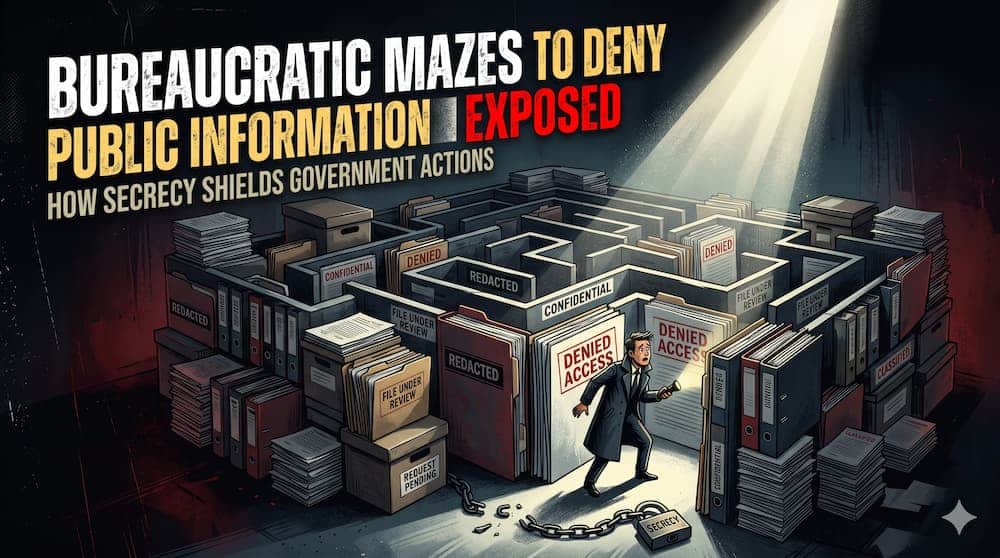
Bureaucratic Mazes to Deny Public Information Exposed
The intricate layers of bureaucracy often serve to obscure and deny access to information that should be readily available to the public. Through convoluted processes, endless forms, and vague regulations, citizens can find themselves lost in an overwhelming maze designed more to frustrate than facilitate. These barriers not only hinder transparency but also erode public trust in governmental systems. Recent investigations have revealed the extent of these obstructions, illuminating the necessity for reform. It’s imperative that we streamline processes and prioritize open communication to ensure that citizens can access the information that affects their lives and communities.
Key Takeaways
- Bureaucratic mazes often obscure access to public information, causing frustration and eroding trust in government.
- The Mirzapur Police case exemplifies how procedural shifting and evasive responses obstruct transparency under the RTI Act.
- Authorities used bureaucratic processes to deny information about a family land dispute, escalating to the State Commission for resolution.
- Legal exemptions, like Section 8(1)(j), are misapplied to withhold vital information from complainants.
- Key takeaways include that complainants are not third parties to their own cases and that internal desks should not evade responsibility.
Shifting Accountability: How the Mirzapur Police Used Bureaucratic Mazes to Deny Public Information
When a citizen uses the Right to Information (RTI) Act, 2005, they expect absolute transparency. However, the administrative trail of Naresh Kumar Jaiswal vs. The Public Authority of the Superintendent of Police Office, Mirzapur exposes a disappointing pattern. Specifically, it reveals procedural shifting, evasive responses, and the clear misapplication of legal exemption clauses.
PDF+ 4
Consequently, this post tears down the core issues of the case. We will highlight how the authorities constructed bureaucratic mazes to deny public information and created massive contradictions between local police station logs and higher supervisory offices.
PDF+ 4
1. The Core Dispute: A Clash Over Ancestral Property and Civil Restraints
At the root of this matter is an ongoing family dispute over undivided ancestral land. This involves a family house located in Village Bhatevra, which falls under Police Station Chilh, Mirzapur.
PDF+ 3
- The Police Conclusion: According to the official inquiry report by Circle Officer (CO) Amar Bahadur, the dispute stems entirely from land partitioning between a father and a son. PDF
- The Father’s Statement: In fact, the father explicitly stated on record that the property remains undivided with his brother. Furthermore, he promised that a share would eventually be given post-partition. PDF+ 1
- The Refusal to Act: Because they labeled the scenario as strictly civil, the police officially closed the complaints. Therefore, they refused to register a First Information Report (FIR) for cheating under Section 318(4) of the Bharatiya Nyaya Sanhita (BNS). Instead, they summarily directed the parties to seek remedy in a competent civil court. PDF+ 4
2. General Diary No. 057 and the Jurisdiction Dilemma
Subsequently, the structural complications deepened when the local police initiated preventive action. They acted under Section 126/135 of the Bharatiya Nagarik Suraksha Sanhita (BNSS) on June 18, 2025. This was done because they asserted a visible breach of peace over a temple situated inside the property’s boundary wall.
PDF+ 4
- The Presence Contradiction: Sub-Inspector Badri Prasad recorded in General Diary (GD) Entry No. 057 that the applicant was physically present at the site. He placed him in Village Bhatevra at 17:59 hours. PDF+ 3
- The Territorial Question: On the other hand, the applicant permanently resides at Surekapuram Colony. This residential area falls under the separate territorial jurisdiction of PS Kotwali Katra. PDF+ 3
- The Missing Evidence: For this reason, the applicant filed an RTI query requesting the verifiable source data. He specifically asked for mobile tower location logs or physical visitor signatures. However, the department completely suppressed these source records, utilizing these complex bureaucratic mazes to deny public information. PDF+ 4
3. The “Circle Officer’s Desk” Excuse: Shifting Responsibility
When the initial RTI application was filed under Registration No. SPMZR/R/2026/60057, the authorities deflected the queries. Both the Public Information Officer (PIO) and the local station terminal avoided direct answers.
PDF+ 3
- Structural Shifting: For multiple items regarding the investigation and official statements, the local station deflected accountability. Their response stated that the queries were “not related to the local police station”. Instead, they claimed the files “pertained to the Office of the Circle Officer (CO) Sadar”. PDF+ 2
- The Legal Flaw: However, this excuse violates Sections 5(4) and 5(5) of the RTI Act. A PIO cannot force an applicant to chase different desks. After all, the Circle Officer’s desk and the local police station operate under the exact same public authority. Hence, the PIO is statutorily mandated to internally retrieve that information rather than navigating bureaucratic mazes to deny public information. PDF+ 4
4. Weaponizing Section 8(1)(j) to Hide Public Records
Most importantly, the most blatant violation of the RTI Act occurred during the information denial. The PIO flatly refused to provide a certified copy of the complete investigation report authored by CO Amar Bahadur. To do this, they incorrectly invoked Section 8(1)(j), which protects personal or third-party privacy.
PDF+ 4
- The Reality: In reality, this investigation report was directly triggered by a formal IGRS complaint. Crucially, that complaint was lodged by the applicant himself. PDF+ 1
- The Abuse of Law: Therefore, it is legally impossible to classify a primary complainant as a “third party” to their own case. Using a privacy clause to withhold a report that decides the legal fate of the applicant’s fundamental property rights is an arbitrary application of the law. PDF+ 3
The Path Forward: Escalation to the State Commission
Ultimately, the applicant was unsatisfied with the superficial point-wise report forwarded during the First Appeal disposal. Because of this administrative failure, the matter has formally escalated.
PDF+ 3
The applicant has successfully lodged a formal Second Appeal before the Hon’ble Uttar Pradesh Information Commission, Lucknow. The case is registered under Appeal Registration Number: A-20260600685. As a result, the upcoming online hearing will force the Public Information Officer to answer for these systemic contradictions, shifting stances, and the tactical use of bureaucratic mazes to deny public information.
PDF+ 3
Key Takeaways for RTI Activists
You Are Not a Third Party to Your Own Complaint: Any report generated from your custom grievance belongs to you. Consequently, Section 8(1)(j) cannot be invoked to shield police actions from the actual complainant. PDF+ 2
Internal Desks Are Not Separate Authorities: A PIO cannot deny information by claiming the file sits with a supervisory officer within the same department. PDF
Based on the official records provided across the case history, here are the point-wise contact details, application identification numbers, emails, mobile numbers, and web link details of the public authorities involved in your matters:
PDF+ 2
1. Application and Grievance Identification Numbers (Bureaucratic Mazes to Deny Public Information)
- Initial RTI Registration Number:
SPMZR/R/2026/60057(Filed: 06/02/2026) PDF - Initial RTI Transaction ID:
SPMZRR20260000000071PDF - First Appeal Registration Number:
SPMZR/A/2026/60025(Filed: 06/04/2026) PDF - Second Appeal Registration Number (UPSIC):
A-20260600685(Filed: 07/06/2026) PDF - State Information Commission Welcome ID:
UPICR20250006190PDF - Connected IGRS Grievance Numbers:
GOVUP/E/2025/0083834,GOVUP/E/2025/0055717,GOVUP/E/2025/0089753, and Reference Number60000250184560. PDF+ 3
2. Public Information Officer (PIO) Details (Bureaucratic Mazes to Deny Public Information)
- Designated PIO: Sri Omprakash Singh (ASP Operation Desk Placeholder) / Rajkumar Meena (ASP Operation) PDF
- Office Address: Public Information Officer Office, Superintendent of Police Office, Mirzapur, Uttar Pradesh, Pincode: 231001 PDF
- Mobile Numbers:
9454401105/9473567333PDF+ 1 - Email Addresses:
asp-op.mi@up.gov.in/aspopmzp@gmail.comPDF+ 1
3. First Appellate Authority (FAA) Details (Bureaucratic Mazes to Deny Public Information)
- Designated FAA: Aparna Rajat Kaushik, Superintendent of Police, Mirzapur PDF
- Office Address: First Appellate Authority Office, Superintendent of Police Office, Mirzapur, Uttar Pradesh, Pincode: 231001 PDF
- Mobile Number:
9473567333PDF - Email Address:
spmzr-up@nic.inPDF
4. Nodal Officer Details (SP Office Mirzapur) (Bureaucratic Mazes to Deny Public Information)
- Name: Rajkumar Meena PDF
- Mobile Number:
9473567333PDF - Email Addresses:
addlspopmzr@gmail.com/aspopmzp@gmail.comPDF+ 1
5. Investigating & Internal Reporting Officers (Bureaucratic Mazes to Deny Public Information)
- Circle Officer Sadar (Current Appeal Report Author): Munendra Pal Singh PDF+ 1
- Circle Officer Sadar (Initial IGRS Inquiry Author): Amar Bahadur PDF+ 1
- Sub-Inspector (PS Chilh Field Tester): Badri Prasad PDF+ 1
- Station Terminal Verifier / Inspector: Vijay Shankar Singh (No.
072390115) PDF+ 1
6. Higher Grievance Cell Authorities (Lucknow Secretariat) (Bureaucratic Mazes to Deny Public Information)
- Officer Name: Shri Arvind Mohan (Joint Secretary) PDF
- Organization: Government of Uttar Pradesh, Chief Minister Secretariat, Lok Shikayat Anubhag-3 PDF
- Office Address: Room No. 321, U.P. Secretariat, Lucknow, Uttar Pradesh PDF
- Contact Number:
05222226350PDF - Email Address:
arvind.12574@gov.inPDF
7. Core Portal Web Links (Bureaucratic Mazes to Deny Public Information)
- Centralized Public Grievance Redress and Monitoring System (CPGRAMS): https://pgportal.gov.in PDF
- Specific Grievance Print & Status Terminal: https://pgportal.gov.in/Status/PrintDetail/ PDF


Facing a similar challenge? Share the details in the box below, and our team of experts will do their best to help.