
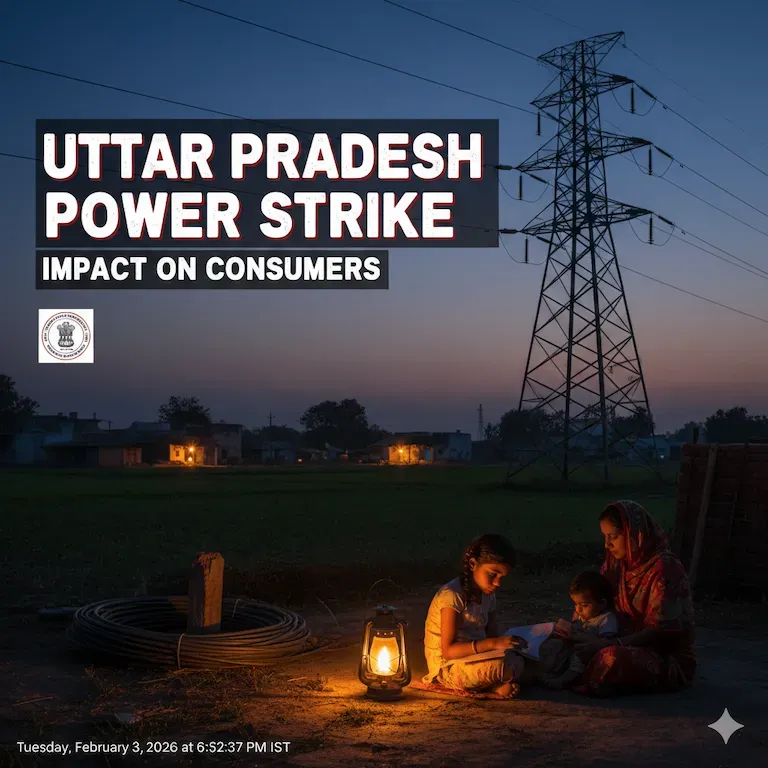
The following are key takeaways from the grievance analysis regarding the UPPCL. These insights also pertain to the current state of public service delivery in Uttar Pradesh. The recent Uttar Pradesh Power Strike has also had a significant impact on both service delivery and public sentiment in the region:
1. The Gap Between Hardware and Service
The private sector (smart meter company) fulfilled the technical requirement by providing the armoured cable. However, the public utility (UPPCL) failed at the final “last-mile” integration. This highlights a lack of coordination between private vendors and departmental linemen.
2. The Ineffectiveness of ESMA as Uttar Pradesh Power Strike could not stop
The Essential Services Maintenance Act (ESMA) was invoked to legally prohibit strikes in the power sector. This was meant to protect the public interest. However, field operations were still paralyzed. This suggests a disconnect between high-level policy enforcement and ground-level labor discipline.
3. “Paper Redressal” vs. Actual Resolution
A critical flaw identified is the premature closure of grievances. The portal marked the case as “Closed” based on an officer’s promise to finish the work in the future. It did not verify whether the connection was actually live. This inflates performance statistics without solving the citizen’s problem.
4. Violation of “No Work, No Pay” (Uttar Pradesh Power Strike)
The post raises a significant legal question regarding accountability. Under Indian labor law, employees on strike are generally not entitled to wages. The complainant argues that drawing a salary from the public exchequer while defying ESMA is misuse of public funds. Neglecting duties also contributes to this misuse.
5. Erosion of Trust in Digital Governance
High-ranking officials, including Executive and Junior Engineers, frequently fail to respond to calls. They also often do not follow through on assurances. This undermines the credibility of the Chief Minister’s governance portals. It transforms a tool for justice into a source of administrative harassment.
Uttar Pradesh Power Strike: ESMA, Strikes, and the Crisis of Accountability in UPPCL
The pursuit of “Good Governance” often showcases digital portals and grievance redressal systems. However, for citizens like Yogi M. P. Singh, these platforms increasingly symbolise bureaucratic apathy rather than provide solutions. A recent grievance (Registration No: GOVUP/E/2025/0064200) highlights a systemic failure, evident during the wide-scale power strike in Uttar Pradesh. Authorities ignore legal mandates like ESMA. Officials deliver “resolutions” that amount to merely empty promises, just as the Uttar Pradesh Power Strike demonstrated.
The Core Dispute: Infrastructure Without Integration (Uttar Pradesh Power Strike)
The grievance began with a simple necessity: the installation of an armoured cable for two electricity accounts in Uttar Pradesh. The private smart meter company fulfilled its role by providing the cable. However, the final step was connecting the cable to the distribution pole. This task remained the responsibility of the Uttar Pradesh Power Corporation Limited (UPPCL). The recent Uttar Pradesh Power Strike affected operations.
Despite numerous attempts to contact Executive Engineer Mr. Manish Kumar Srivastava and Junior Engineer Mr. Vinay Kumar Gupta, the connection remained unexecuted. The reason? A strike by department employees left consumers caught in a vacuum. They were between private hardware delivery and public service failure. This situation highlights the impact of the Uttar Pradesh Power Strike on daily life.
ESMA: A Law Without Teeth?
The Uttar Pradesh government sought to prevent exactly this kind of public hardship. It invoked the Essential Services Maintenance Act (ESMA). This action prohibited strikes in the power sector for six months. The ban aimed to ensure uninterrupted supply during extreme heat. It followed the disruption of the Uttar Pradesh Power Strike.
The complainant raises a poignant legal and ethical question:
If ESMA is in effect, how can a strike continue to paralyze essential services?
Under Indian labour law, employees do not receive wages during strike periods. The Supreme Court upholds the “No Work, No Pay” principle. However, when the UPPCL staff prioritizes “speech-making” over “service-delivery,” the public exchequer bears the financial burden. The heat-stricken consumer continues to bear the physical burden. This situation became evident in the wake of the recent Uttar Pradesh Power Strike events.
The “Paper Closure” of Grievances (Uttar Pradesh Power Strike)
Perhaps the most frustrating aspect of this case is the disposal of the grievance on July 4, 2025. The authorities marked the case as “Closed.” However, the actual work remained unfinished. This echoes the inefficiencies that became clear during the Uttar Pradesh Power Strike.
- The Reality: 23 days passed without a connection.
- The Official Response: The team closed the case. They promised to complete the work within one week of the disposal date.
This practice involves closing grievances based on future intent rather than actual completion. This approach directly impacts the credibility of the Jan Sunwai (IGRS) and affects similar portals. When an officer marks a case “Resolved,” they do not govern. The applicant’s wires still lie in a bundle on the floor. In reality, this action represents statistical manipulation that displays a low pendency rate. Conditions like the Uttar Pradesh Power Strike further exacerbate this trend.
Where is the “Good Governance”?
The complainant feels dissatisfied not only because of the lack of electricity but also due to a loss of faith. The Joint Secretary’s office indicates that the subordinate level disposed of the matter. This phrase often serves as a euphemism for passing the buck. During the Uttar Pradesh Power Strike, accountability became a rare commodity.
If the government stakes its reputation on digital transparency, it must ensure that:
- Field verification occurs before a grievance is closed.
- ESMA violations result in immediate departmental accountability, especially following major events like the Uttar Pradesh Power Strike.
- Promises of future work are not equated with “Resolution.”
Conclusion
The case of Yogi M. P. Singh is a microcosm of the struggle between the common man and a rigid bureaucracy. “Good Governance” needs to go beyond the computer screen. It must reach the utility pole. Otherwise, the citizen will continue to feel harassed by the system that should protect them. This reality was highlighted during the Uttar Pradesh Power Strike.
Key Takeaways (Uttar Pradesh Power Strike)
- The Uttar Pradesh Power Strike reveals gaps in hardware and service integration between private vendors and UPPCL.
- ESMA’s invocation did not prevent paralysis in field operations, indicating a disconnect in policy enforcement and labour discipline.
- Grievances often face ‘premature closure’ without proper verification, distorting performance statistics and failing citizen needs.
- The ‘No Work, No Pay’ principle raises concerns about salary payments to UPPCL employees on strike. This situation leads to misuse of public funds.
- Trust in digital governance erodes as officials fail to respond and follow through, turning grievance redressal into administrative harassment.
Based on your grievance details, here are the structured contact details and web links. These are relevant to the public authorities in Uttar Pradesh. You need them for further follow-up or legal escalation.
1. Central Grievance Authority (CM Secretariat)
The Jansunwai (IGRS) portal serves as the primary channel for submitting your grievance. Since authorities closed your case prematurely, here are the direct contacts for the monitoring officers.
- Primary Contact: Shri Arvind Mohan (Joint Secretary & Web Information Manager)
- Office Address: Room No. 321, U.P. Secretariat (Lok Bhawan), Lucknow – 226001
- Contact Number: 0522-2226350 / 0522-2226354
- Official Email: jansunwai-up@gov.in / cmup@nic.in
- Web Portal: Jansunwai-Samadhan Portal
2. UPPCL Distribution Authorities (Executive Level)
These are the departmental heads responsible for the Electricity Distribution Division-II and the enforcement of services under ESMA.
- Executive Engineer (EDD-II): Mr. Manish Kumar Srivastava
- Direct Office Number: 0522-2287525 (Shakti Bhawan Central)
- Departmental Mobile: 9455491111 (As per UPPCL HQ list for Executive Engineers)
- Corporate Email: mdeeuppcl@gmail.com / ee.edd2@uppcl.org
- Junior Engineer (JE): Mr. Vinay Kumar Gupta
- Mobile Number: 8808875601 (Verified against JE lists for the Lucknow/Azamgarh zones)
- Email: mauryav590@gmail.com (Note: Official communications should be CC’d to the EE)
3. RTI & Accountability Officers (Uttar Pradesh Power Strike)
If you wish to file a formal Right to Information (RTI) request regarding the “promise-based closure” of your grievance or the strike’s impact despite ESMA, use these details:
- Public Information Officer (PIO): Shri Deepak Srivastava
- Address: Shakti Bhawan, 14-Ashok Marg, Lucknow – 226001
- Alternate PIO (Accounts/Admin): Shri P.C. Gupta (General Manager)
- Phone: 0522-2287704
- Mobile: 9450019068
4. Web & Digital Resource Links
| Resource | Link/Details |
| Track Grievance Status | Jansunwai Tracking |
| UPPCL Official Website | uppcl.org |
| Consumer Helpline | 1912 (Toll-Free, 24/7 for all DISCOMs) |
| Email for Escalation | helpdesk@uppclonline.com |
Key Actionable IDs for Your Next Email:
To ensure your follow-up is noticed, I recommend sending a combined email to:
arvind.12574@gov.in, jansunwai-up@gov.in, cmup@nic.in, mdeeuppcl@gmail.com
Would you like me to generate a formal legal notice? Alternatively, I can draft a “Reminder/Re-appeal” using these specific email addresses and application IDs.


Facing a similar challenge? Share the details in the box below, and our team of experts will do their best to help.