
Key takeaways
Corruption and Delays in Tehsil can have a significant impact on administrative efficiency and access to public services. This article examines why Corruption and Delays in Tehsil remain pressing issues for local governance.
1. Systemic Administrative Malpractice (Corruption and Delays in Tehsil)
Corruption and Delays in Tehsil
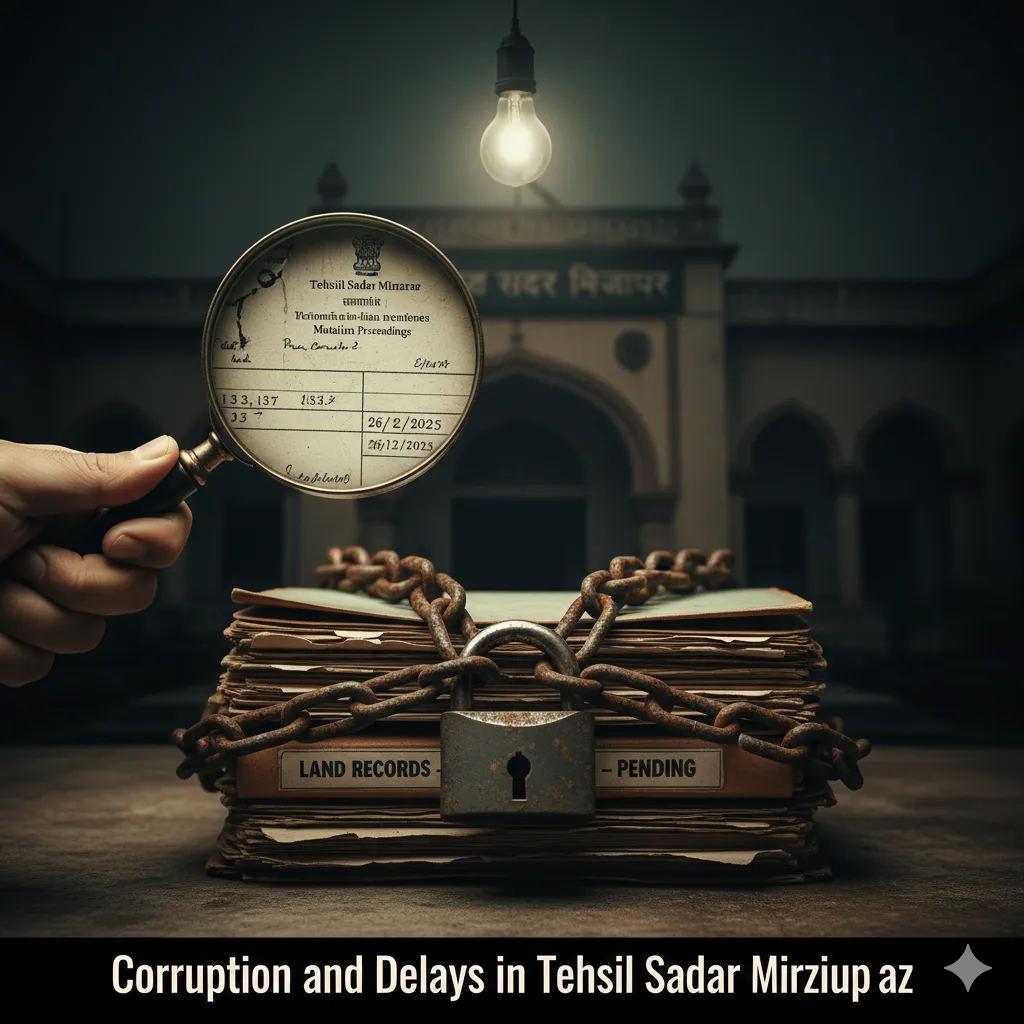
- Deliberate Delays: For instance, the administration has stalled mutation proceedings for Araji Nos. 133 and 137 for over a year, thus violating the statutory 45–90 day mandate.
- The “Tacit Nexus”: There are allegations that a “tacit understanding” between Tehsil staff (Lekhpals) and professional objectors triggers “quasi-judicial” delays for illicit gratification. Consequently, this leads to the next point.
Misleading Reporting: Lower-level officials submit inconsistent and non-factual reports to protect illegal land interests.
2. Jurisdictional Confusion as a Tactic
- Routing Errors and Delays: Although the grievance explicitly names Tehsil Sadar, the administration forwarded the matter to SDM Madihan. This misrouting is a common tactic, often indicative of systemic Corruption and Delays in Tehsil Sadar, which introduce a Risk of Arbitrary Closure. This mismatch, in effect, creates a “procedural trap” where the SDM Madihan could close the grievance simply by stating that it is outside his geographical jurisdiction, thus contributing to the deliberate delay.
3. Strategic Use of RTI for Accountability against Corruption
- Legal Paper Trail: Consequently, the filing of RTI DMOMR/R/2026/60014 forces the administration to document its actions or lack thereof, which is crucial for exposing the Corruption and Delays in Tehsil Sadar.
- Individual Responsibility: Furthermore, the RTI specifically demands the names of officials responsible for the “Pending” status, thereby stripping away administrative anonymity and targeting those responsible for the Corruption and Delays.
Correction of Routing: Therefore, by addressing the RTI to the District Magistrate’s office, the matter is now correctly assigned to the Tehsildar of Sadar, Vishal Kumar Sharma, circumventing the initial attempt to delay and misdirect.
4. Demand for Independent Oversight
- Special Inquiry: Because the standard hierarchy is allegedly compromised, therefore the grievance seeks the constitution of an independent committee to investigate the “land-mafia nexus”.
Restoring Sanctity: Ultimately, the core goal is to restore the “sanctity of the revenue court” and protect the rights of legitimate landowners from predatory administrative environments.
The “Procedural Trap”: Unmasking Systemic Corruption and Delays in Tehsil Local Revenue Administration
The dream of a transparent, digital-first India often hits a brick wall at the gates of the local Tehsil office. However, for citizens like Smt. Anarkali Devi, the reality of “tacit understandings,” professional objectors, and deliberate administrative malpractice overshadows the promise of swift, online governance. For example, a recent grievance filed by Shivam Gupta (Assistant Professor) reveals a disturbing blueprint of how corruption has evolved from simple bribery into a sophisticated “systemic nexus” designed to paralyze the rule of law.
Corruption and Delays in TehsilThe Anatomy of the Mutation Nexus
At the heart of the issue is the mutation process (the transfer of title in land records). For instance, under the U.P. Revenue Code, the authorities should dispose of undisputed mutation within 45 to 90 days. However, in Tehsil Sadar, Mirzapur, proceedings for Araji Nos. 133 and 137 have stalled for over a year, even though the registered sale deeds were submitted.
This delay is rarely accidental. Instead, the grievance highlights a “land-mafia nexus” where lower-level staff, specifically Lekhpals, allegedly play a pivotal role. Lekhpals create a legal fog by submitting “arbitrary and inconsistent” reports to higher authorities. Consequently, professional objectors trigger “quasi-judicial” delays, effectively holding a citizen’s property rights hostage.
The Strategy of “Deliberate Confusion”
One of the most insidious forms of corruption, in this case, is administrative misdirection. For instance, while the grievance explicitly concerns the “Revenue Department of Tehsil Sadar,” the official tracking system, however, shows the matter was forwarded to the “Sub-Divisional Magistrate-Madihan.
Consequently, this creates a “Jurisdictional Trap” stemming from Corruption and Delays in Tehsil:
- The Runaround: A complainant follows the trail to one office, only to find the matter belongs to another.
- The Technical Closure: Officials may close a grievance on the public portal simply by stating, “This office does not relate to this matter,” without actually resolving the underlying corruption.
The State of Terror: Crucially, as the grievance notes, these delays allow the land mafia to “manipulate records” and create an environment of fear where the rightful landowner feels powerless against the machine.Using the Right to Information (RTI) as a Scalpel
When the internal grievance system fails due to “misleading reports,” consequently, the Right to Information Act (2005) becomes the citizen’s primary weapon. By filing RTI request DMOMR/R/2026/60014, the applicant has shifted the burden of proof back onto the state.
Specifically, theRTI focuses on three critical areas of accountability:
- The Paper Trail: Demanding certified copies of daily progress reports and “Action Taken Reports” (ATR) forces officials to document their inaction.
- Identifying the Actors: By asking for the names and designations of those responsible for the “Pending” status, the RTI strips away the anonymity that usually protects corrupt subordinates.
- Jurisdictional Accountability: If the DMO forwarded a Sadar issue to Madihan, therefore, theRTI demands the legal basis for that transfer under Section 6(3). Consequently, this prevents officials from using the “Madihan will say it’s not his office” excuse to bury the complaint.
The Failure of the Quasi-Judicial Process: Corruption and Delays in Tehsil
The most dangerous aspect of this systemic corruption is, specifically, the erosion of the “Sanctity of the Revenue Court.” When a court mandated to protect property rights becomes a tool for “soliciting illicit gratification,” the rule of law is irrevocably compromised.
Consequently, the grievance calls for a Special Inquiry Committee—an admission that the standard hierarchy is too compromised to investigate itself. Furthermore, when the very system designed to monitor grievances (like the Jansunwai/Public Grievance portal) Lekhpals bypass through “misleading reports,” the corruption is no longer just about money; instead, it signifies the total subversion of democratic institutions.
Conclusion: The Path to Restoration
Restoring the rule of law in Mirzapur, therefore, requires more than just processing a single mutation file; it demands Accountability for Staff in the face of Corruption and Delays in Tehsil. To this end, we must take disciplinary action against those providing “tacit support” to land interests.
As this case moves toward the January 19, 2026, deadline for the SDM Madihan and the 30-day RTI deadline for Tehsildar Sadar, consequently, it serves as a litmus test for the Uttar Pradesh government’s “Zero Tolerance” policy toward corruption. Only by shining a light on these “reserved” files and procedural traps can the Uttar Pradesh government protect the rights of legitimate landowners like Smt. Anarkali Devi.
Based on the documents provided and your successful RTI filing, here, finally, are the structured details for the concerned public authorities and your specific application identifiers.1. Your Application & Grievance Identifiers
- Grievance Reference Number: 60000250299848
- RTI Registration Number: DMOMR/R/2026/60014
- Online RTI Reference Number: CPAGDTTAN5
- Date of Filing (RTI): 11-01-2026
2. Concerned Public Authority: Tehsil Sadar (The Subject Area) (Corruption and Delays in Tehsil)
Since your grievance explicitly concerns Tehsil Sadar, these are the primary contact details for accountability.
| Role | Name | Contact Number | Email ID |
| Public Information Officer (PIO) | Vishal Kumar Sharma (Tehsildar) | 9454416823 | teh-sadar.mi@up.gov.in |
| District Magistrate Office (Nodal) | Shakti (Nodal Officer) | 8756844195 | shakti.3916@up.gov.in |
3. Concerned Public Authority: Tehsil Madihan (Current Routing) – Marked by Corruption and Delays
Your grievance was routed here by the system on 29-12-2025, and consequently, the office currently has it pending, which has been exacerbated by significant institutional delays and suspected corruption.
- For example, the Public Authority is the Office of the Sub-Divisional Magistrate (SDM), Madihan, Mirzapur.
- Therefore, the designation is Sub-Divisional Magistrate-Madihan.
Status: The office is still reviewing the case (कार्यालय स्तर पर लंबित), reflecting a typical pattern of prolonged delays often associated with seeking unauthorized inducements.
Web Link Details
To track the progress of your grievance and RTI, use the following official portals:
- Jansunwai (Public Grievance Portal):https://jansunwai.up.nic.in/
- Check the status of Reference No. 60000250299848 here.
- RTI Online Uttar Pradesh:https://rtionline.up.gov.in/
- Track your RTI Registration No. DMOMR/R/2026/60014 here.
- Mirzapur District Official Website:https://mirzapur.nic.in/
- Use this for general contact directories of the District Magistrate and Divisional Commissioner.
- Corruption and Delays in Tehsil: Report any instances of corruption or undue delays faced at the Tehsil level, which often hinder citizen services.
5. Summary of the Corruption Allegations in the Grievance
- Core Issue: Alleged systemic Corruption and Delays in Tehsil and a land-mafia nexus involve the Revenue Department.
- Specific Officers Named: Lekhpals and Tehsil staff of Sadar.
- Procedural Delay: Mutation proceedings for Araji Nos. 133 and 137 stalled for over a year, despite the law mandating a 45–90 day completion.
Would you like me to help you draft a formal letter to the Divisional Commissioner of Mirzapur to report the specific jurisdictional error where they sent a Sadar-based grievance to Madihan?


Facing a similar challenge? Share the details in the box below, and our team of experts will do their best to help.