
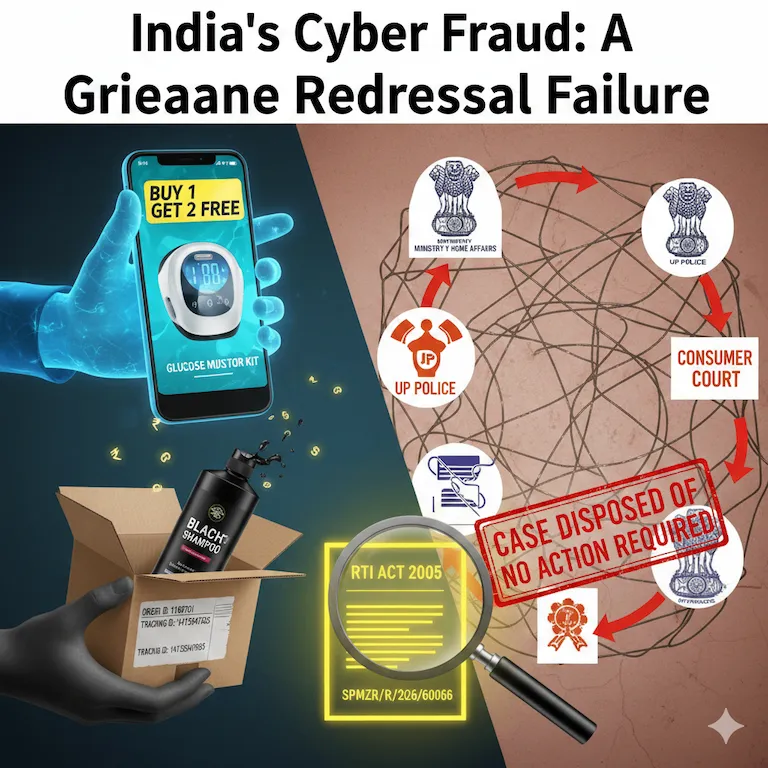
Here are the key takeaways from the structured analysis of your case. This report examines important aspects related to India’s Cyber Fraud. It also considers its implications.
The Incident and Fraud (India’s Cyber Fraud)
- The Bait: You ordered a high-precision, non-invasive glucose monitoring device from
CAREBUDDYO.MYSHOPIFY.COMfor ₹679 via a Facebook ad. - The Switch: Instead of the medical device, you received a bottle of “Bejoy” Black Hair Dye Shampoo delivered through Xpressbees/Shiprocket.
- The Intent: This was not a logistical error. It was a criminal act of cheating. A spurious item was sent to steal money from unsuspecting consumers.
Administrative Failures
- MHA Apathy: The Ministry of Home Affairs closed your first grievance with an unreasoned remark: “Case disposed of”.
- Police Evasion: The Mirzapur Police acknowledged you received the wrong item. They concluded “no police action is required,” claiming no charges were proven.
- The Wrong Direction: Police suggested seeking relief in Consumer Court. This is impossible because you lack the seller’s legal name and physical address.
The Path to Accountability
- The RTI Weapon: You successfully filed RTI SPMZR/R/2026/60066. This forced the police to disclose the seller’s KYC details and bank account trail.
- Identifying Personnel: Your RTI demands the names and designations of the officers who conducted and approved the inconsistent investigation.
- Core Issue: The case highlights how authorities misclassify cyber fraud as a civil dispute. This misclassification allows anonymous scammers to escape the “money trail” that only police can trace.
India’s Cyber Fraud: How India’s Grievance Redressal System Fails Victims of Cyber Fraud
In the age of Digital India, sophisticated cybercrime often shadows the promise of convenience. The rise of India’s Cyber Fraud has made the search for justice even more complex for ordinary people. For many citizens, seeking justice becomes a frustrating cycle of buck-passing between government agencies. A recent case in Mirzapur highlights a systemic failure where authorities misclassify criminal cyber fraud as a mere consumer dispute.
The Anatomy of the Fraud: From Life-Saving Device to Hair Dye
The issue began with a high-tech medical promise. An entity called Toytingle ran a sponsored ad on Facebook promoting a non-invasive blood sugar monitoring kit. For a diabetic patient, a pain-free test offers a life-changing prospect. The website CAREBUDDYO.MYSHOPIFY.COM and a cheap offer of ₹679 lured the victim into a Cash on Delivery (COD) order. Crucially, in this scenario, India and cyber fraud converge to create a new landscape of digital deception.
When Xpressbees Surface delivered the package, the deception came to light. Instead of a medical instrument, the box contained “Bejoy” Black Hair Dye Shampoo. This was no error; the seller committed Cheating by Personation and Criminal Cheating by intentionally sending a spurious product.
The Administrative Loop: A Masterclass in Apathy (India’s Cyber Fraud)
The victim, Yogi M. P. Singh, approached the Ministry of Home Affairs (MHA) expecting a rigorous Cyber Cell investigation. Instead, a sequence of administrative failures occurred: This is yet another instance where India’s approach to cyber fraud exposes gaps in institutional accountability.
- The MHA Dismissal: The MHA closed the grievance with the vague remark “Case disposed of”. They provided no “Speaking Order” or logical reasoning for the closure.
- The State Referral: Upon appeal, the MHA forwarded the matter to the Uttar Pradesh Police.
- The Inconsistent Report: Mirzapur Police admitted the victim ordered a glucose monitor but received hair dye. However, they concluded that no other police action is required, effectively ending the criminal inquiry.
The “Consumer Court” Trap: A Dead End for Victims
The police report failed by directing the victim to seek remedy from the Consumer Court. This path is nearly impossible. Notably, trying to resolve India’s cyber fraud cases through civil channels rarely leads to justice.
- Anonymous Fraudsters: Consumer Courts require a legal name and physical address of the seller. The police report only identified a Shopify URL and a Facebook handle, which are insufficient for legal notices.
- The Missing Money Trail: In a COD transaction, only police have authority to trace the funds. They must identify the bank account linked to the merchant Shiva Agrawal/Velocity Drop.
- Criminal Intent: Sending shampoo instead of a medical device demonstrates criminal intent to defraud. This falls squarely under the jurisdiction of the Cyber Police, not a civil forum.
The Core Issue: Incompetence or Complicity?
The victim’s protest strikes at the heart of the matter. Police are avoiding the issue on flimsy grounds. When police state charges are zero despite physical evidence of cheating, they signal a dangerous trend. This administrative anarchy allows cybercriminals to operate with impunity. Authorities must stop overlooking organised India’s cyber fraud because it targets gullible citizens and threatens digital integrity.
Breaking the Cycle: The RTI Weapon
The victim refused to accept the closure and turned to the RTI Act, 2005. By filing RTI registration SPMZR/R/2026/60066, the victim forces the Mirzapur Police to disclose:
- KYC details of the merchant behind “Velocity Drop”. In matters related to India’s cyber fraud, transparency is a key tool for accountability.
- The Bank Account where the fraudsters transferred the gains.
- The Names and Designations of officers who approved the report.
This strategic move changes the victim from a complainant into an information seeker. The victim demands transparency from the ASP Operation and the Superintendent of Police.
Conclusion (India’s Cyber Fraud)
Cybercrime evolves faster than our administrative responses. When the government promotes Digital India, it must ensure a Safe Digital India. Directing a scam victim to Consumer Court represents a tactical retreat by the state. Authorities must treat digital fraud with the same criminal gravity as a traditional bank robbery. In this digital world, every citizen with a smartphone is a potential victim. This is especially true with the constant threat posed by India’s cyber fraud.
Based on the documents and the successful filing of your request, here are the essential IDs, contact details, and web links for the public authorities involved in your case:
Application & Registration IDs (India’s Cyber Fraud)
- Original Grievance (MHA): MINHA/E/2025/0018101.
- Appeal Grievance (MHA): MINHA/E/2025/0030992.
- Police/IGRS Reference: 60000260000007.
- RTI Registration Number: SPMZR/R/2026/60066.
- Order ID (Fraudulent Transaction): 11967201.
- Courier Tracking ID: 14112354479025.
Public Information Officer (PIO) – RTI Inquiry
- Name: Manish Kumar Mishra.
- Designation: ASP Operation, Mirzapur.
- Mobile/Phone: 9473567333.
- Email ID: aspopmzp@gmail.com.
- Nodal Officer Email: addlspopmzr@gmail.com.
State & Central Authorities (Grievance Chain)
- Ministry of Home Affairs (DS Coord): * Phone: 011-23438002.
- Email: dircoord-mha@nic.in.
- UP Chief Minister Secretariat (Joint Secretary):
- Name: Shri Arvind Mohan.
- Phone: 0522-2226350.
- Email: arvind.12574@gov.in.
- Additional SP (City), Mirzapur: Conducted the investigation concluding no police action was required.
Web Links for Tracking & Action
- PG Portal (Status Check): https://pgportal.gov.in.
- National Cyber Crime Portal: https://www.cybercrime.gov.in.
- UP Online RTI Portal: https://rtionline.up.gov.in.
- National Consumer Helpline: https://consumerhelpline.gov.in.
- Merchant Interface (Fraudulent Source): https://www.google.com/search?q=carebuddyo.myshopify.com.
Would you like me to draft a follow-up email to the ASP Operation to ensure they have received the PDF attachment for your RTI?


Facing a similar challenge? Share the details in the box below, and our team of experts will do their best to help.