
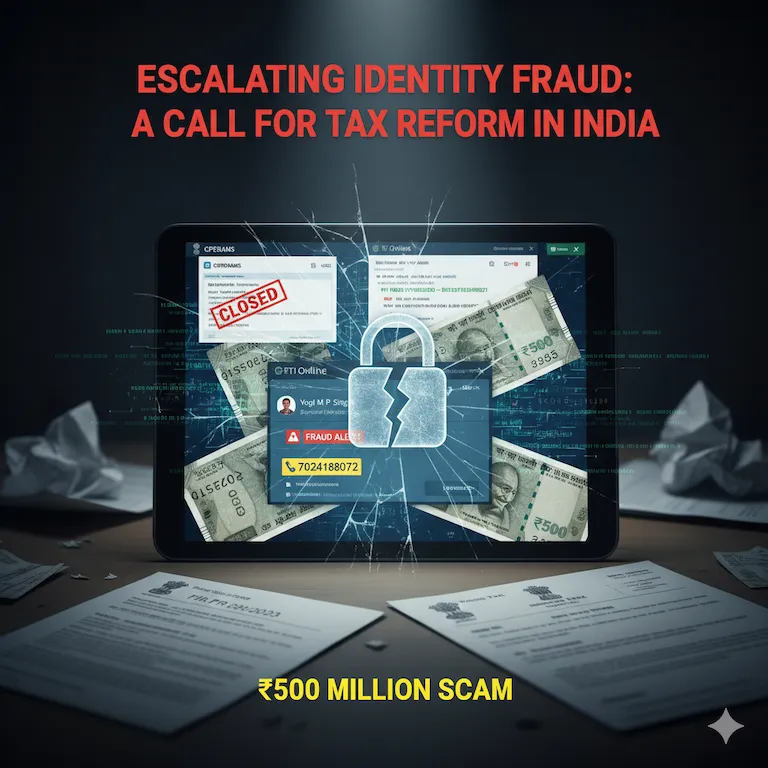
Identity Fraud Is rising alarmingly in the working of income tax India. It is one of the lucrative source of back door income of the corrupt public functionaries in the Department of income tax.
Key takeaways from the blog post are as follows
Here are the key takeaways from the blog post regarding the identity theft and administrative deadlock surrounding PAN GSWPS0850Q:
1. Massive Financial Identity Theft
- The victim, Mahesh Pratap Singh, is facing a systematic fraud estimated at ₹500 Million (₹50 Crore).
- Fraudsters have used his PAN to report a GST turnover of over ₹21 Crore and ₹4.3 Crore in fictitious rent from major corporations like HCL and Wipro.
- Additional fraudulent business receipts totaling nearly ₹6 Crore have credited to linked accounts.
2. Systematic Administrative Failure
- The Income Tax Department has repeatedly closed appeals on “jurisdictional grounds,” claiming that they lack the authority to handle the matter, even though the ward has registered the victim’s PAN.
- A “jurisdictional loop” exists where the local Mirzapur ITO lacks the technical power to stop data feeding, while higher offices in Allahabad and Lucknow refuse to intervene.
- The department’s automated systems have ignored the victim’s formal denials of 24 distinct “poisoned” data entries on the Compliance Portal.
3. Allegations of Official Misconduct
- Pr. DGIT Amitav allegedly provided false remarks to a government portal by claiming that the police never requisitioned any bank details.
- Official Police Case Diaries (Parcha 16 & 18) and an SP Office report contradict these claims, proving that the department indeed sent requisitions.
- The victim alleges these false statements are a deliberate attempt to shield high-ranking officials and obstruct FIR No. 0291/2023.
4. Security Compromise of the Taxpayer Profile
- Criminals successfully hijacked the taxpayer’s profile by linking a fraudulent mobile number (7024188072) and email (dngoldraipur18@gmail.com).
- This allowed unauthorized parties to intercept official communications and potentially facilitate further money laundering.
5. Escalation via the RTI Act
- Following the closure of multiple CPGRAMS appeals, the DGIT (Investigation), Lucknow has registered a formal RTI (DGTLK/R/E/26/00021).
- The RTI invokes the proviso to Section 24(1), demanding transparency on grounds of corruption and human rights violations to break the department’s “Second Schedule” secrecy.
The ₹500 Million Identity Theft Crisis: A Citizen’s Battle Against Tax Fraud and Bureaucratic Denial
In an era where digital identity is the cornerstone of financial existence, the case of Mahesh Pratap Singh (alias Yogi M. P. Singh) from Mirzapur, Uttar Pradesh, serves as a harrowing case study of systemic failure. What began as a local instance of identity theft has spiraled into a ₹500 Million (₹50 Crore) financial nightmare, exposing critical vulnerabilities in the Income Tax Department’s automated systems and a startling lack of accountability among high-ranking officials.
The Genesis of a ₹50 Crore Fraud
The core of this issue lies in the sophisticated hijacking of PAN GSWPS0850Q. For the Assessment Years 2021-22 through 2025-26, criminal syndicates have utilized this PAN to facilitate massive, unauthorized transactions. The scale of the data “poisoning” is staggering:
- GST Fraud: The authorities recorded a turnover exceeding ₹21 Crore under the victim’s identity.
- Fictitious Rent: Major corporate entities, including HCL, Wipro, and Maruti Suzuki, claimed over ₹4.3 Crore in “Rent Paid,” despite the victim having no connection to these payments.
- Contractual Siphoning: The hijackers credited nearly ₹6 Crore in business receipts to accounts linked to the stolen PAN.
The fraud reached a fever pitch in late December 2025, when the department flooded the Annual Information Statement (AIS) with ₹6.6 Million in fake rent entries within a mere 13-day window.
The “Jurisdictional Loop”: A Shield for Inaction
Despite a formal Police FIR (No. 0291/2023) registered at PS Kotwali Katra, Mirzapur, the Income Tax Department has repeatedly closed grievances on “jurisdictional grounds.
The Income Tax Officer (ITO) in Mirzapur and the PCIT Allahabad consistently claim that they are “outside the scope and jurisdiction” of their offices because the PAN is technically registered in Mirzapur. This administrative stance creates a dangerous “deadlock”:
- Local Ward Limitations: A local ITO lacks the technical tools to lock an AIS feed or flag a PAN as “Vulnerable” across the national database.
- Centralized Negligence: Higher offices, such as the DGIT (Systems), have refused to intervene, violating CPGRAMS guidelines that mandate the transfer of grievances to the competent authority rather than arbitrary closure.
Official Misrepresentation and the CVC Escalation
One of the most alarming aspects of this case is the alleged false reporting by senior leadership. Amitav, Pr. DGIT (I&CI), stated in official compliance reports that “no bank details have ever been requisitioned by any investigation agency.
However, verifiable police records tell a different story:
- Police Case Diary Parcha 16 and 18 prove that formal requisitions were sent.
- Letter 32/2025/SPMZR from the SP Office Mirzapur was sent directly to the Commissioner of Income Tax in Prayagraj.
- A response was even received from the e-Filing Unit in Bengaluru, proving the department was fully aware of the fraudulent accounts.
Providing false information to a government portal is a criminal offense under Section 182 of the IPC, yet the department has ignored these contradictions to protect high-ranking officials from accountability.
The Technical Trap: Automated Persecution
The case highlights a terrifying reality of modern governance: Automated Persecution. Between December 15 and December 28, 2025, the victim used the Compliance Portal to mark 24 entries as “Information is denied”.
Instead of freezing the account for investigation, the system ignored the victim’s feedback and generated automated reminders, forcing a documented crime victim to file returns for ₹500 Million in fictitious income. The fraudsters even hijacked the profile credentials, linking a fraudulent mobile (7024188072) and email (dngoldraipur18@gmail.com) to intercept all official correspondence.
Breaking the Silence: The RTI Strategy
Facing a total shutdown of grievance channels, the victim has now turned to the Right to Information (RTI) Act, 2005. On January 28, 2026, a formal RTI (Registration: DGTLK/R/E/26/00021) was successfully registered with the Director General of Income Tax (Investigation), Lucknow.
This RTI explicitly invokes the proviso to Section 24(1), which strips away the “Second Schedule” exemptions for investigative wings when the matter involves corruption and human rights violations. The information sought includes:
- Certified copies of Note Sheets explaining the arbitrary closure of previous appeals.
- The identity of the officer responsible for the false remarks regarding police requisitions.
- The justification for continued automated data feeding despite official denials.
Conclusion: A Call for Systemic Reform
The case of Yogi M. P. Singh is not just about one man’s struggle; it is a warning for every Indian taxpayer. When a citizen proactively reports a ₹50 Crore fraud and the department responds with jurisdictional excuses and false statements, the integrity of the entire tax system is at stake.
The demand is simple:
- Immediate Inquiry into the false reporting by the Pr. DGIT.
- Centralized Protection to stop the “poisoned” data feeding into the victim’s AIS.
- Compliance with Police FIR 291/23 to identify the beneficiaries of the laundered millions.
Until the Income Tax Department prioritizes victim protection over bureaucratic self-preservation, digital identity in India remains a high-stakes gamble.
Based on the documents and communications provided, here are the essential identifiers and contact details for the authorities involved in your case.
1. Core Application Identifiers
These IDs are critical for tracking your case across different government portals:
- RTI Registration Number:
DGTLK/R/E/26/00021(Filed with DGIT Investigation, Lucknow). - CPGRAMS Appeal Numbers (Closed):
CBODT/E/A/26/0000294(Regarding Pr. DGIT false remarks).CBODT/E/A/26/0000246(Regarding systemic identity theft and ₹500 Million fraud).CBODT/E/A/26/0000245(Regarding AIS data poisoning and fake rent entries).
- Original Grievance Numbers:
CBODT/E/2026/0002314.CBODT/E/2025/0058082.CBODT/E/2025/0058077.
- Police Record: FIR No.
0291/2023, Kotwali Katra, Mirzapur.
2. Official Contact Directory
Use these details for direct correspondence or to follow up on the registered RTI:
| Authority | Email Address | Contact Number |
| Pr. CCIT (UP East), Lucknow | lucknow.pccit@incometax.gov.in | 0522-2233316 / 0522-22466013 |
| DGIT (Investigation), Lucknow | Lucknow.ito.inv.hq.dgit@incometax.gov.in | 0522-2233316 |
| CCIT Allahabad (Prayagraj) | allahabad.ccit@incometax.gov.in | Not Provided |
| PCIT Allahabad (Prayagraj) | allahabad.pcit@incometax.gov.in | Not Provided |
| RTI Online Help Desk | helprtionline-dopt@nic.in | 011-24622461 |
| DoPT Under Secretary (IR-1) | usir-dopt@nic.in | Not Provided |
3. Mobile Numbers Involved
- Applicant (Yogi M. P. Singh):
7379105911or93xxxxxxx31. - Fraudulent Hijacked Number:
7024188072(linked to your PAN profile by unauthorized parties).
4. Relevant Web Links
- RTI Online Portal (Status/New Request): rtionline.gov.in
- CPGRAMS Portal (Grievance/Appeal): pgportal.gov.in
- Income Tax Compliance Portal: compliance.insight.gov.in (To manage AIS/TIS feedback).
Would you like me to draft a specific “Urgency Petition” to the DGIT (Investigation) Lucknow using the new RTI registration number?


Facing a similar challenge? Share the details in the box below, and our team of experts will do their best to help.