
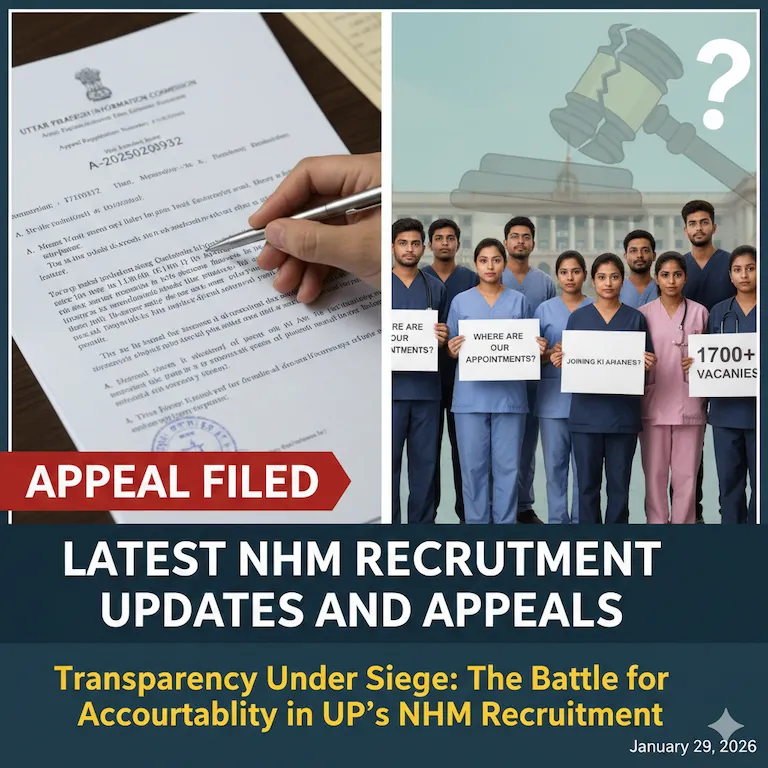
The case of Yogi M.P. Singh vs. UP NHM serves as a significant case study on the friction between citizen rights and bureaucratic resistance. For those following the Latest NHM Recruitment, here are the key takeaways from the blog post:
1. The Conflict of “Termination vs. Accountability”
The primary takeaway is the legal tension regarding the status of information. The NHM argues that because the recruitment process was terminated, the requested information is no longer relevant. The appellant argues that the termination does not absolve the department of its duty to disclose who was in charge. It also must be disclosed what mechanisms were in place while the process was active.
2. Specificity of Information Sought
The appellant’s request was not for general data, but for structural accountability. The focus was on:
- Identifying the “Competent Level” (the specific individuals/positions with decision-making power).
- Understanding the Posting Mechanism (the rules governing how the waitlist is utilized).
- Uncovering the Reason for Delay (why a federal directive from the Ministry of Health was not acted upon promptly).
3. Allegations of “Cryptic Denial”
A major theme is the tactic of the PIO providing a “response” that does not actually answer the “questions.” By providing a link to a termination notice instead of naming the officials involved, the PIO is accused of making a mockery of the RTI Act, effectively using a valid document to provide an invalid answer.
4. The Demand for Section 20 Penalties
The blog highlights a push for the Information Commission to move beyond mere “orders for disclosure” and toward punitive action. Under Section 20, the appellant is seeking:
- Financial penalties against the PIO.
- Disciplinary action against the First Appellate Authority (FAA) for negligence.
5. Systematic Implications for 17,000+ Aspirants
The core issue affects more than just the appellant; it impacts the 17,291 candidates who applied for contractual positions. The lack of transparency suggests a deeper systemic failure where “termination” of a drive might be used as a shield to hide irregularities or corruption in the selection process.
Here is a structured blog post. It describes the ongoing legal battle. There is also an administrative battle. Both concern transparency in the National Health Mission (NHM) recruitment process in Uttar Pradesh.
Transparency Under Siege: The Battle for Accountability in UP’s NHM Recruitment
The Right to Information (RTI) Act of 2005 was envisioned as the “sunlight” that would disinfect the corridors of power. However, for activists like Yogi M. P. Singh and thousands of job aspirants in Uttar Pradesh, that light is currently being blocked by a wall of administrative silence and “cryptic” denials.
A recent filing with the Uttar Pradesh Information Commission (UPIC) has brought to the forefront a major controversy involving the recruitment of over 17,000 contractual healthcare workers. The case—File Number S02/A/0406/2025—highlights a growing trend: the use of bureaucratic technicalities to bypass the fundamental right to information.
The Core of the Dispute: The 17,000+ Vacancy Mystery
In late 2022, the State Program Management Unit (SPMU) of the National Health Mission, Uttar Pradesh, advertised 17,291 contractual positions for ANMs, Staff Nurses, Lab Technicians, and Pharmacists. Under the recruitment guidelines, a “Waitlist” was to remain valid for six months following the declaration of results to fill any emerging gaps.
The appellant, Yogi M. P. Singh, sought specific, granular details regarding the “Competent Level” authority responsible for approving these waitlists. Instead of receiving names, designations, or procedural mechanisms, he was met with a generic statement: The recruitment process has been terminated.
The RTI Queries: Seeking Names, Not Excuses
The appellant’s information request was not vague. It focused on five critical points of administrative accountability:
- Identification of Authority: Who exactly constitutes the “Competent Level” that approves the waiting list?
- Procedural Mechanism: What is the specific process for moving a candidate from the waitlist to a posting?
- Personnel Details: The names and designations of the staff involved in this decision-making body.
- Reason for Delay: An explanation for why recruitment from the waiting list was stalled, despite a directive from the Ministry of Health & Family Welfare (Government of India).
- Leadership Accountability: The details of the Chairman or Monitoring Head of the authority in question.
The “Cryptic Denial”: A Mockery of the Act?
On July 17, 2025, the Public Information Officer (PIO) responded with what the appellant describes as a “cryptic denial.” The PIO stated that because the recruitment process was terminated, the information sought was essentially moot.
However, from a legal standpoint, the termination of a process does not erase the historical record. It retains details of who was in charge and what the procedures were while the process was active. The appellant argues that this response is a strategic move to avoid accountability. It aims to sidestep allegations of corruption and to circumvent court orders.
“It is most unfortunate that whatever information has been provided… is not sought in any of the five points… the rampant corruption in the government machinery itself diluted the provisions of the RTI Act 2005.” — Yogi M. P. Singh
The Legal Implications: Section 20 and Beyond
Under Section 20 of the RTI Act 2005, the Information Commission has the power to impose penalties on PIOs who “malafidely” deny requests or provide incorrect/misleading information.
In this case, the appellant is calling for:
- Monetary Penalties: Against the PIO for failing to address the specific queries.
- Disciplinary Action: Against the First Appellate Authority (FAA) for failing to oversee the PIO’s compliance.
- Judicial Intervention: Ensuring that the “termination” of a recruitment drive is not used as a blanket excuse to hide administrative irregularities.
The Human Cost of Administrative Silence
Behind these file numbers and diary entries are thousands of qualified healthcare professionals—nurses, lab techs, and pharmacists—who waited for years for a fair shot at employment. When a recruitment process involving 17,000+ seats is terminated abruptly and without transparent reasoning, it breeds a culture of distrust.
The appellant alleges that the termination was a reactionary measure to avoid the consequences of various corruption allegations. By refusing to name the officials in charge of the waitlist, the department effectively prevents any specific individual from being held responsible for the delay or the eventual cancellation.
The Road Ahead: September 4th Hearing
The eyes of transparency activists are now on Court S-2 and the presiding officer, Shri Sudhir Kumar Singh. The next hearing, scheduled for September 4, 2025, will be a litmus test for the Uttar Pradesh Information Commission.
Will the Commission allow “process termination” to serve as a valid reason for withholding the names of public officials? Or will it uphold the spirit of the RTI Act, which mandates that every citizen has the right to know how their government functions—especially regarding public employment?
Conclusion: A Call for Transparency
The case of Yogi M. P. Singh vs. UP NHM is more than just a personal grievance; it is a battle for the integrity of public institutions. If the “Competent Level” remains a nameless, faceless entity, then accountability in the state of Uttar Pradesh remains a distant dream.
For the RTI Act to survive, the Commission must ensure that “information” is not treated as a gift from the government, but as a right of the people.
Based on the official filings and the current administrative directory for the National Health Mission (NHM), Uttar Pradesh, here are the specific identification and contact details for the authorities concerned in your case.
1. Key Application & Case Identifiers
These numbers are essential for all future correspondence with the Commission to ensure your filings are correctly tracked:
- Appeal Registration Number:
A-20250200932 - File Number:
S02/A/0406/2025 - Commission Diary Number:
D-180720250124 - Primary Reference ID:
UPICR20240000149
2. Concerned Public Authorities & Contact Details
The following individuals and offices are the designated respondents in your ongoing appeal:
| Entity | Public Information Officer (PIO) | Address / Contact Details |
| National Health Mission (NHM), U.P. | S.V.P. Pankaj (Deputy General Manager) | Email: jansuchnaadhikariupnhm@gmail.comAddress: SPMU, NHM, Vishal Complex, 19-A, Vidhan Sabha Marg, Lucknow – 226001 |
| UP Health System Strengthening Project | Upmahaprabandhak NDC NHM | Address: PIN Code: 226001, Lucknow. |
| Information Commission (Court S-2) | Shri Sudhir Kumar Singh (Presiding Officer) | Email: hearingcourts2.upic@up.gov.in |
| NHM General Inquiry | General Manager (HR) | Recruitment Query Helpline: 0522-2630555 Toll-Free Helpline: 1800-180-1900 |
3. Official Web Resources
For monitoring notifications or submitting electronic updates, use the following official portals:
- NHM UP Official Website: upnrhm.gov.in
- Recruitment/Opportunities Page: upnrhm.gov.in/Home/Opportunities
- UP RTI Online Portal: rtionline.up.gov.in
4. Summary of Key Staff Involved (SPMU-NHM)
As per the latest 2024-2025 staff directory, the following officers lead the departments you are questioning:
- Mission Director (NHM, UP): Dr. Pinky Jowel, I.A.S.
- General Manager (HR): Ms. Sudha Yadav (Responsible for the recruitment termination notification).
- General Manager (M&E/RTI): Dr. Anamika Mishra (Overall supervisor for RTI compliance).
Note on “Competent Level”: Your current appeal specifically challenges the PIO’s failure to name the individuals behind this term. In your September 4th hearing, you should specifically cite the General Manager (HR) and the Mission Director as the likely constituents of this “Competent Level” based on the NHM’s internal implementation framework.
Would you like me to draft a specific “Notice of Non-Compliance” to send to the Mission Director regarding the PIO’s cryptic response?
Key Takeaways
- The case of Yogi M.P. Singh vs. UP NHM exposes conflicts between citizen rights and bureaucracy in the nhm up recruitment drive.
- Disputes arise over the Public Information Officer’s ‘cryptic denial’ of information regarding the recruitment process.
- The appellant seeks accountability for officials involved in the recruitment drive, emphasizing structural accountability.
- A demand for penalties against the PIO highlights the need for transparency in the recruitment process affecting over 17,000 candidates.
- The upcoming hearing on September 4, 2025, will test the commitment to the Right to Information Act and accountability in public institutions.


Facing a similar challenge? Share the details in the box below, and our team of experts will do their best to help.