
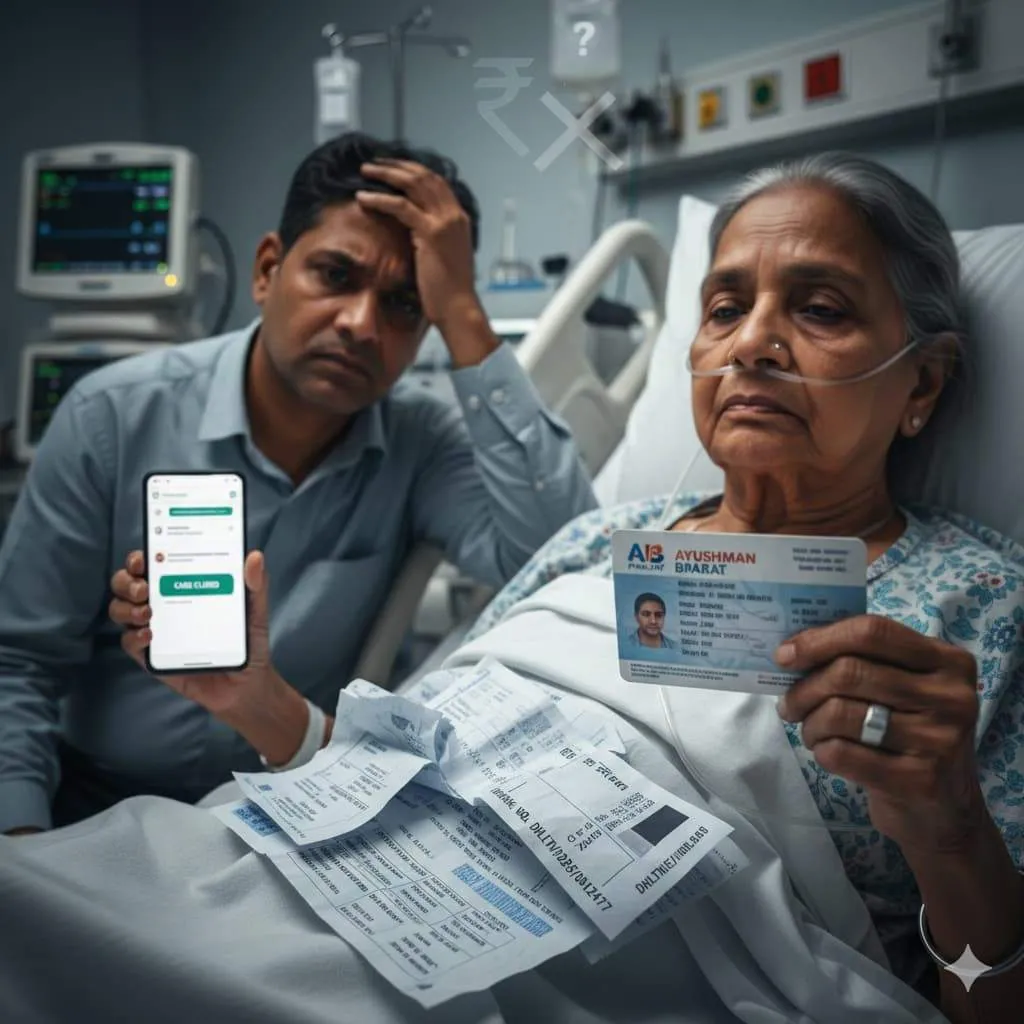
The Ayushman Scheme, designed to provide affordable healthcare to millions, suffers from significant mismanagement. Issues such as inadequate resource allocation, lack of beneficiary awareness, and bureaucratic delays have hindered its effectiveness. These shortcomings not only undermine the program’s objectives but also leave vulnerable populations without essential medical support.
The patient’s admission date is 3rd June 2025 at 5:00 PM. According to a government report, the patient’s admission date is 4th June 2025 at 5:00 PM. The report states that they did not charge the patient the next day, and the government paid the treatment expenses. On the 3rd day of treatment, the hospital charged the applicant for the treatment, even though the older citizen’s Ayushman card was ready.
Key Takeaways
- The article outlines the mismanagement in Ayushman Scheme, highlighting the case of Vidya Devi, a senior citizen denied proper treatment.
- Discrepancies in admission dates illustrate systemic failures, with accusations of hospitals charging patients despite government coverage.
- The article stresses the need for immediate corrective action and oversight to protect vulnerable citizens under the Ayushman Scheme.
- Corruption and bureaucratic incompetence have led to a lack of accountability, impacting the scheme’s intended benefits.
- The author calls for urgent reforms to ensure that the grievance redressal mechanism truly serves the public.
💔 Mismanagement in Ayushman Scheme: The Anguish of Denial for a Older Citizen
The Prime Minister’s Ayushman Bharat Pradhan Mantri Jan Arogya Yojana(AB PM-JAY) promises free, quality treatment for the nation’s most vulnerable. In reality, however, bureaucratic corruption undermines that promise— a glaring example of mismanagement in the Ayushman Scheme. As a result, eligible citizens, especially older citizens, are left struggling and financially burdened. Consider the case of Vidya Devi, a 75-year-old ICU patient in Mirzapur. Her ordeal exposes how deeply rooted systemic failures and institutional negligencebetray the spirit of this landmark government initiative.
Mismanagement in Ayushman Scheme: A Tale of Two Dates and Denied Care
The core of the grievance, filed by her son, Yogi M. P. Singh, revolves around a fundamental and suspicious discrepancy: the admission date.
- Factual Position: Vidya Devi was admitted on June 3, 2025, at 5:00 PM.
- Hospital/Government Report: The admission date was falsely reported as June 4, 2025, at 5:00 PM.
This single-day shift, highlighted in Grievance Registration Number DHLTH/E/2025/0012477, is no mere clerical error. Rather, it points to a deliberate attempt to obscure the hospital’s billing practices. The hospital claimed it did not charge the patient on June 5th, arguing that the government covered her treatment expenses. The complainant, however, tells the opposite story. The hospital charged the family on June 3rd — the very first day of admission. Furthermore, it continued charging them even after the Ayushman card was ready on the third day of treatment. “The Hospital has charged more than Rs.30,000 in two days,” the complaint painfully notes.
Clearly, this manipulation of the admission date is a textbook case of mismanagement in Ayushman Scheme. The hospital used it to justify delays in activating scheme benefits and to legitimise charges before the alleged “government coverage” applied. Consequently, the complainant rightfully calls out the hospital’s “cryptic and mysterious dealings.”
💳 Ayushman Card Blockade: A Questionable Integrity
The immediate failure began when the staff failed to activate Vidya Devi’s card, despite her being an older citizen (DOB: 01/01/1950) who is entitled to priority access. Notably, the Ayushman office on the hospital premises — Ramakrishna Sevashram Hospital — is directly responsible for this failure.
Yogi Singh provided his mother’s Aadhaar card, but the office bearer allegedly “could not download the biometrics. Even so, the office bearer allegedly failed to download the patient’s biometric data. This raises serious questions about the integrity of the Ayushman office staff. Moreover, a nurse attending the patient reportedly confirmed that a staff member had already completed biometric verification and promised to deliver the card the previous day.he continued charging of an eligible patient—points to a profound bureaucratic inertia, or worse, a deliberate withholding of services.
The complainant argues that the “working style of the Ayushmann office facilitating the services of the Ayushman scheme…is against the spirit of the scheme. This is the root cause of the failure of the Ayushman scheme…” Indeed, this is not merely a localised issue. Rather, it reflects systemic mismanagement in the Ayushman Scheme at the ground level. In practice, officials weaponise bureaucratic hurdles to deny free treatment, ultimately forcing vulnerable families into financial distress.
🚨 Mismanagement in Ayushman Scheme: Allegations of Corruption and Prior Blocklisting
The backdrop to this grievance is deeply concerning. Ramakrishna Sevashram Hospital — where Vidya Devi currently receives ICU care — carries a troubling history of alleged financial misconduct related to the Ayushman scheme.
An attached news report from January 19, 2022, reveals shocking details:
- The hospital had previously been suspended from the Ayushman TMS portal and blocklisted following a complaint from an RTI activist.
- Acting on a District Magistrate’s directive, investigators found that the hospital was “allegedly extorting money from patients in the name of treatment and embezzling government funds through forged documents.”
- Allegations included extorting money for ultrasounds and medications from patients who were supposed to be fully covered.
- The hospital’s surgery department had also been blocklisted earlier after a patient died following an operation based on an outdated ultrasound scan.
Given this history, the current actions — falsifying the admission date and charging an older citizen despite Ayushman card eligibility — further confirm ongoing mismanagement in the Ayushman Scheme. They also raise immediate suspicions of continued corruption. As a result, the complainant poses a pointed question to the authorities: “How can you justify the corrupt stance of the hospital?”
⚖️ The Closed Case: Harassment and Dissatisfaction
The official response to the second grievance (DHLTH/E/2025/0012307) is perhaps the most frustrating element of all. On June 17, 2025, authorities closed the case with a generic remark — simply stating that the concerned officer had submitted a report: “AKHYA SANLAGN HAI सम्बन्धित अधिकारी द्वारा लगायी गयी आख्या प्रेषित है” (Report attached, the report submitted by the concerned officer).
Crucially, the complainant marked the resolution status as “No” and cited “Harassment by an official” as the reason for dissatisfaction. This reveals that the redressal officer failed to examine the key evidence in the attached documents. This includes discrepancies between the admission date and the hospital’s prior history. The complainant directly addresses this gap: “It seems that the officer who was monitoring the redressal of the grievance did not take perusal of the attic document to the grievance.” The fraudulent date is one aspect of the issue. The continued illegal charging of an older citizen is yet another dimension of mismanagement in the Ayushman Scheme. This situation demonstrates a lack of accountability and a grievance mechanism that prioritises closing files over delivering justice and relief.
💡 A Call for Urgent Recalibration
The case of Vidya Devi is a microcosm of the failures plaguing the implementation of a genuinely noble scheme. Taken together, these failures underscore several critical needs:
- Immediate Corrective Action: The hospital must take accountability for the false admission date and the illegal charges imposed on an eligible older citizen. They must immediately refund the funds.
- Strict Oversight of Ayushman Facilitation: The Ayushman office on the hospital premises requires an urgent inspection and disciplinary action for the alleged deliberate failure to facilitate card activation.
- Prioritisation of Older Citizens: The government must strictly enforce its own announcements about New Unique Cards and Top-up Coverage for older citizens aged 70 and above under AB PM-JAY. “Why are these facilities not available to Vidya Devi, who is 78 years old?” remains the central unanswered question. Transparency and Integrity in Grievance Redressal: Authorities must investigate the officer. The officer closed the case without addressing the complainant’s documented claims. Above all, the grievance mechanism must serve the public — not shield negligent officials.
Ultimately, Prime Minister Narendra Modi’s scheme promises a safety net. Yet for patients like Vidya Devi, that net is riddled with holes woven by corruption and bureaucratic indifference. The mismanagement in the Ayushman Scheme is not an isolated incident — it is a systemic crisis. Authorities need to address these fundamental issues. Until they do, the scheme’s vision will remain tragically distant. This distance affects the very people it was created to protect.


Facing a similar challenge? Share the details in the box below, and our team of experts will do their best to help.