
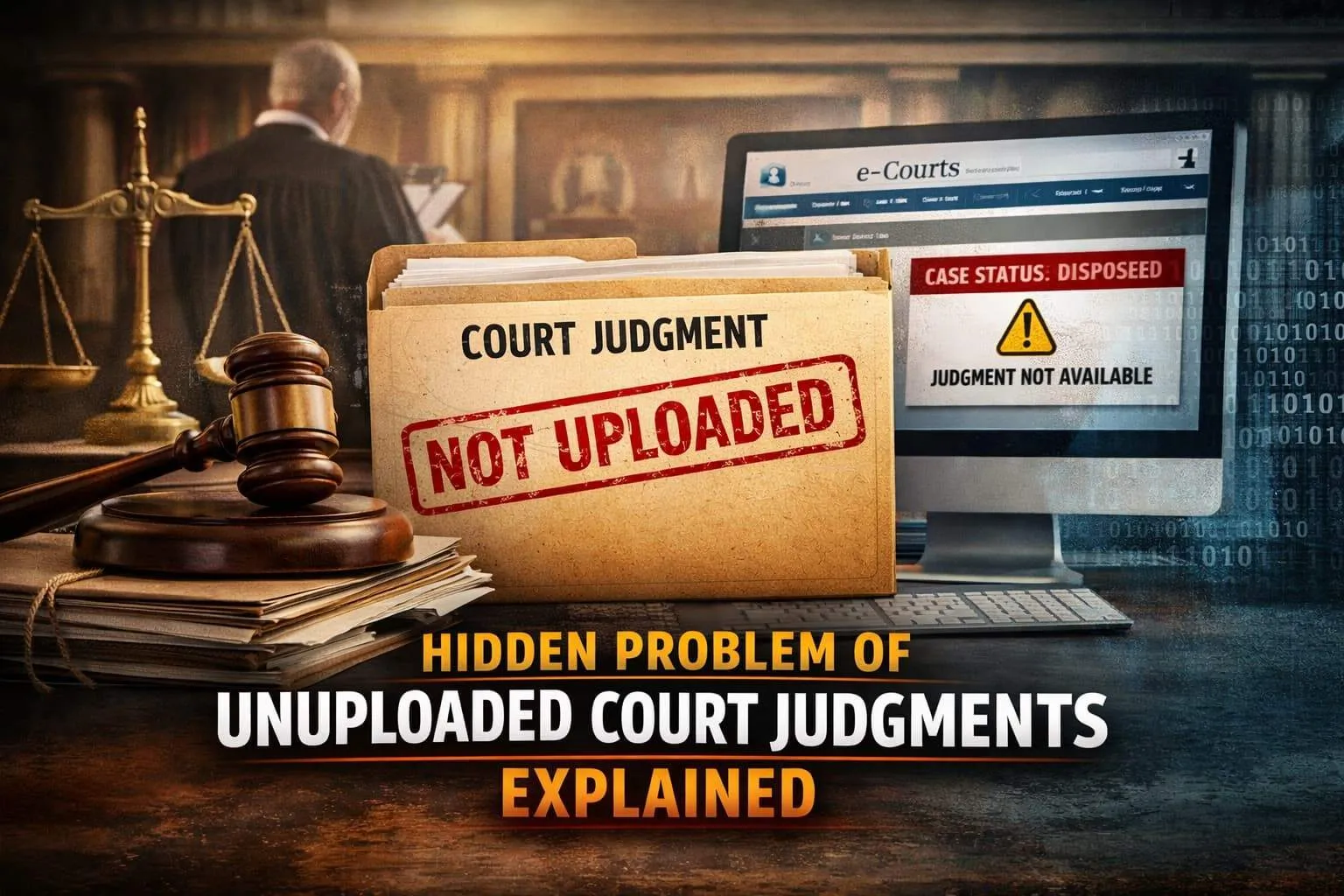
Hidden Problem of Unuploaded Court Judgments refers to the growing gap between judicial decisions and their public accessibility, where courts deliver judgments but fail to upload them on official digital platforms in a timely manner. This issue undermines transparency, delays access to justice, and prevents litigants from exercising their legal rights such as filing appeals or enforcing orders. Despite initiatives like the eCourts system, administrative delays and lack of accountability continue to persist. Consequently, this hidden problem highlights a serious flaw in the justice delivery mechanism, where justice exists in records but remains inaccessible to those who need it most.
Key Takeaways
- The Hidden Problem of Unuploaded Court Judgments creates a gap between judicial decisions and public access, undermining transparency and justice.
- Despite initiatives like the eCourts system, delays in uploading judgments hinder litigants‘ ability to exercise their legal rights.
- This problem has significant implications, preventing access to legal remedies and decreasing public trust in the judicial system.
- Addressing the Hidden Problem requires systemic reforms, including strict timelines for uploads, automated processes, and clearer accountability mechanisms.
- Citizens can use the Right to Information Act to challenge delays, but incomplete responses from authorities often create further obstacles.
The Hidden Problem of Unuploaded Court Judgments: When Justice Exists but Remains Inaccessible
Introduction: Understanding the Hidden Problem of Unuploaded Court Judgments
The Hidden Problem of Unuploaded Court Judgments continues to affect the transparency and effectiveness of the Indian judicial system. While courts regularly deliver judgments, many of these decisions never reach the public domain in a timely manner. As a result, litigants struggle to access outcomes that directly affect their rights.
In theory, digital platforms like the eCourts Mission Mode Project aim to eliminate such barriers. However, in practice, delays in uploading judgments create a serious disconnect between judicial decisions and public accessibility. Therefore, this hidden problem raises a fundamental concern: can justice truly serve people if they cannot access it?
The Core Issue Behind the Hidden Problem of Unuploaded Court Judgments
At the heart of the Hidden Problem of Unuploaded Court Judgments lies a simple contradiction. Courts deliver decisions, but those decisions often remain unavailable online for months.
For example, a family court case may show a “disposed” status with a confirmed judgment date. However, the actual judgment document may still be missing from the system long after the decision. Consequently, litigants cannot verify, use, or challenge the outcome.
Moreover, this issue does not arise from a single failure. Instead, it reflects a broader systemic gap between judicial functioning and digital implementation. As a result, the problem remains largely unnoticed, even though it directly affects access to justice.
Why the Hidden Problem of Unuploaded Court Judgments Matters
The Hidden Problem of Unuploaded Court Judgments has far-reaching consequences that go beyond administrative inconvenience.
1. Impact on Legal Remedies
First, litigants need access to judgments to file appeals or pursue further legal action. Without the document, they cannot move forward. Therefore, delays effectively block legal remedies.
2. Lack of Transparency
Second, transparency suffers when judgments remain inaccessible. Courts must not only deliver justice but also demonstrate it openly. However, when judgments are missing, public trust declines.
3. Risk of Misuse
Furthermore, in disputes involving family or property matters, one party may exploit the absence of a publicly available judgment. Consequently, delays can create opportunities for unfair advantage.
Digital Systems and the Hidden Problem of Unuploaded Court Judgments
India introduced digital reforms to address precisely such issues. The eCourts Mission Mode Project aims to ensure timely access to case information and judgments.
However, despite these efforts, the Hidden Problem of Unuploaded Court Judgments persists. Several factors contribute to this gap. For instance, administrative backlogs slow down uploads. Additionally, limited technical resources and coordination issues further delay the process.
Nevertheless, these challenges do not justify prolonged inaccessibility. If the judiciary adopts digital systems, it must also ensure their effective implementation. Otherwise, the gap between promise and reality continues to widen.
Legal Perspective: Addressing the Hidden Problem Through RTI
Citizens often use the Right to Information Act, 2005 to challenge the Hidden Problem of Unuploaded Court Judgments. By filing an RTI application, individuals can demand explanations for delays and seek accountability.
For example, an applicant may ask:
- Why has the judgment not been uploaded?
- What guidelines govern upload timelines?
- Who is responsible for ensuring compliance?
Therefore, RTI becomes a crucial tool in exposing administrative inefficiencies.
However, authorities sometimes provide incomplete responses or transfer responsibility to other departments. As a result, applicants may face additional hurdles. Even so, RTI plays an essential role in highlighting systemic issues and pushing for accountability.
Human Consequences of the Hidden Problem of Unuploaded Court Judgments
The Hidden Problem of Unuploaded Court Judgments is not merely a technical issue—it has real human consequences.
In family court matters, judgments often determine maintenance, custody, and financial rights. When litigants cannot access these decisions, they face uncertainty and hardship. For instance, a person may not receive financial support simply because they cannot produce the judgment.
Moreover, delays increase emotional stress. Individuals already dealing with legal disputes must also struggle to obtain basic information. Consequently, the justice system becomes more burdensome rather than supportive.
In some cases, this problem may even lead to indirect injustice. Therefore, addressing it becomes not just an administrative necessity but a moral obligation.
Accountability Gap in the Hidden Problem of Unuploaded Court Judgments
A major reason why the Hidden Problem of Unuploaded Court Judgments persists is the lack of clear accountability.
Different authorities share responsibility:
- Courts deliver judgments
- Administrative bodies manage processes
- Technical systems handle uploads
Because of this fragmented structure, no single authority takes full responsibility. Consequently, delays continue without resolution.
This accountability gap weakens the system. If authorities do not clearly define responsibility, the problem remains unresolved.
Solutions to the Hidden Problem of Unuploaded Court Judgments
To resolve the Hidden Problem of Unuploaded Court Judgments, systemic reforms are essential.
1. Enforcing Strict Timelines
Authorities must set and enforce clear deadlines for uploading judgments.
2. Automating Upload Processes
Automated systems can reduce dependency on manual intervention and minimize delays.
3. Establishing Clear Grievance Channels
Citizens should have a dedicated platform to report delays and seek resolution.
4. Improving Accountability
Authorities must clearly define responsibility and ensure compliance.
5. Enhancing Awareness
Litigants should know their rights and available remedies, including obtaining certified copies directly from courts.
Conclusion: Solving the Hidden Problem of Unuploaded Court Judgments
The Hidden Problem of Unuploaded Court Judgments highlights a critical gap in the justice delivery system. While courts continue to deliver decisions, failure to make them accessible undermines their impact.
Therefore, the judiciary must prioritize not only delivering judgments but also ensuring their timely availability. Transparency, accountability, and accessibility must go hand in hand.
Ultimately, justice must not remain hidden. Only when people can access and use court judgments can the legal system truly fulfill its purpose.
📌 RTI Application Details
- RTI Registration No.: DPLAW/R/2026/60044
- Date of Filing: 04/03/2026
- Public Authority: Law Department (Nyaya Vibhag), Uttar Pradesh
📌 First Appeal Details
(Hidden Problem of Unuploaded Court Judgments)
- Appeal Registration No.: DPLAW/A/2026/60034
- Date of Filing: 20/04/2026
- Status: RTI Appeal Received
👩💼 Public Information Officer (PIO)
- Name: Bhawana Rajpoot
- Designation: Section Officer
- Mobile: 9454413289
- Email: nyayanubhag6@gmail.com
👨💼 First Appellate Authority (FAA)
(Hidden Problem of Unuploaded Court Judgments)
- Name: Dr. Satyavan Singh
- Designation: Special Secretary
- Mobile: 8874239610
- Email: lanushravanprakosthalaw@gmail.com
👨💼 Nodal Officer
- Name: Shri Kripa Shankar
- Mobile: 9454413887
- Email: kripa.13887@gov.in
🌐 Relevant Official Web Links (Hidden Problem of Unuploaded Court Judgments)
- UP RTI Online Portal: https://rtionline.up.gov.in
- District Court Gorakhpur (Case Status): https://gorakhpur.dcourts.gov.in
- eCourts Services Portal: https://ecourts.gov.in


Facing a similar challenge? Share the details in the box below, and our team of experts will do their best to help.