
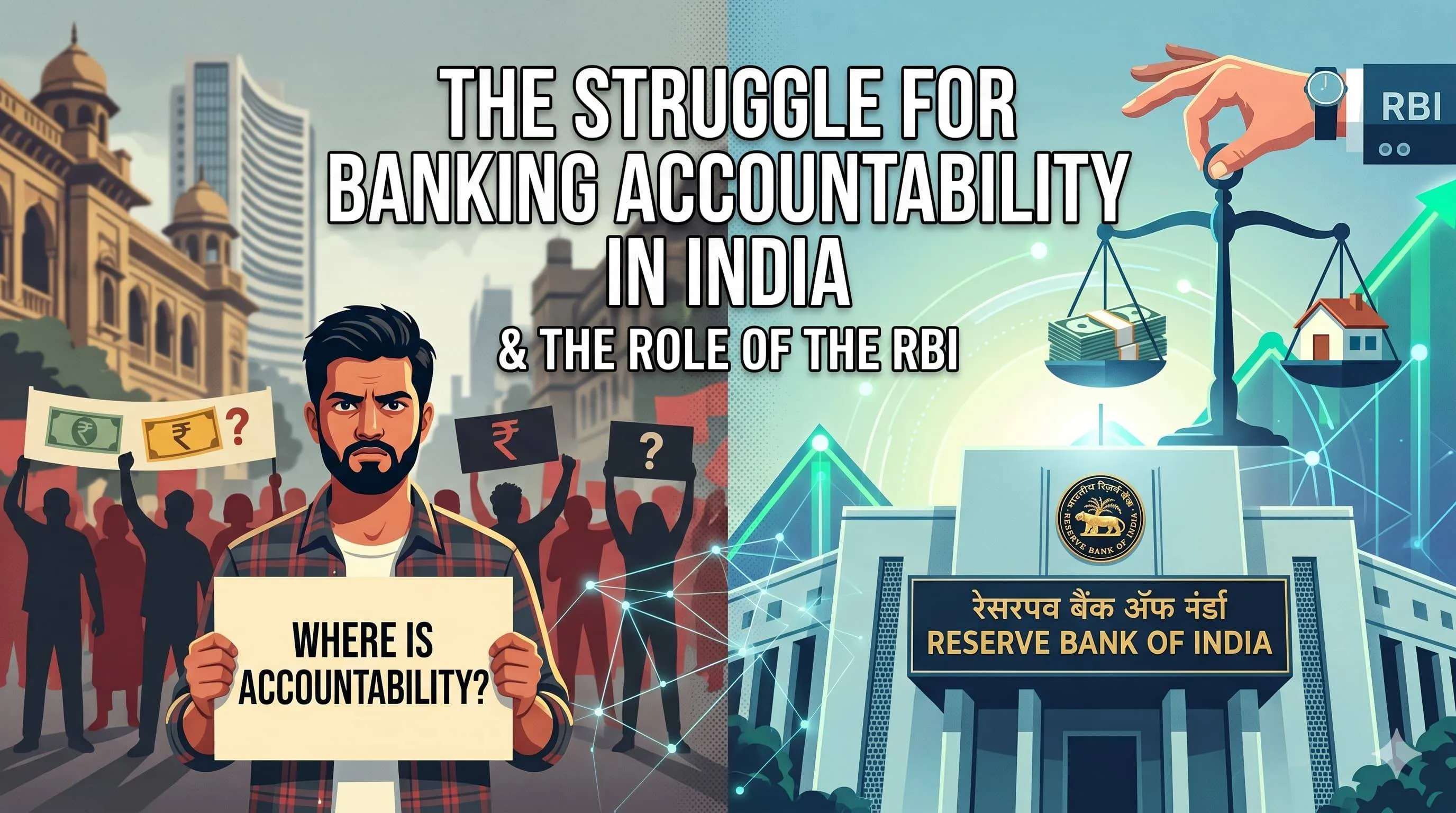
The struggle for banking accountability and the role of the Reserve Bank of India (RBI) are crucial in ensuring the financial system’s integrity. As the central bank, the RBI is tasked with regulating and supervising banks to uphold transparency and ethical practices. However, incidents of financial irregularities often raise concerns about accountability within the banking sector. Civil society movements and various stakeholders advocate for stronger regulations and reforms to hold banks accountable for their actions. By enhancing oversight and promoting responsible banking, we can foster public trust, protect consumers, and contribute to a more stable economy. The fight for accountability remains an essential discourse in India’s financial landscape.
Key Takeaways
- The Struggle for Banking Accountability & RBI is critical for ensuring the integrity of India’s financial system.
- Banking irregularities often lead to customer frustration, evidenced by the case of Yogi M. P. Singh vs. State Bank of India regarding a missing refund.
- Despite RBI guidelines, banks often close complaints prematurely, prioritising their performance metrics over customer satisfaction.
- To seek resolution, customers should secure transaction reference numbers, document communications, and use RTI to hold banks accountable.
- There is a pressing need for stricter regulations to ensure banks cannot close grievances without actual resolution, fostering greater digital accountability.
The Missing Refund Trap: A Struggle for Banking Accountability & RBI Guidelines
Digital transactions in India often lead to a bureaucratic nightmare for the average customer. While a simple automated refund should be easy, it frequently turns into a long saga of broken promises and premature grievance closures.
The case of Yogi M. P. Singh vs. State Bank of India (SBI) serves as a perfect case study in the struggle for banking accountability. It shows how the system fails a citizen over a small ₹2,400 refund. Specifically, it highlights the friction between a customer’s need for money and a bank’s desire for clean performance statistics.
1. The Genesis of the Dispute: The ARN and the Unseen Credit
On January 27, 2026, the merchant AIOSEO initiated a refund for an order worth ₹2,400. Consequently, the merchant provided the definitive proof of payment: the Acquirer Reference Number (ARN) 82305096028500012763392.
In the digital banking world, an ARN acts as the “passport” of a transaction. Once a merchant generates it, the funds enter the banking ecosystem. However, these funds failed to reflect in the customer’s account at the SBI City Branch, Mirzapur, despite the bank having this number.
2. The CPGRAMS Illusion: Resolution vs. Disposal
The customer filed a grievance (DEABD/E/2026/0021712) on the CPGRAMS portal on February 13, 2026. Although the bank responded quickly, they acted in a mechanical way to improve their internal data.
The “Future Promise” Tactic
On February 17, 2026, the Chief Manager (Operations) sent an email promising credit within 7 days. Curiously, the bank marked the grievance as “Case Closed” the very next morning on February 18.
This sequence highlights a major systemic flaw in the struggle for banking accountability:
- The Bank’s View: We told the customer we would pay him; therefore, the complaint is handled.
- The Customer’s View: The money is not in my account; therefore, the complaint remains active.
Banks often close files based on a promise rather than an actual financial resolution. As a result, they artificially improve their metrics while leaving the customer in limbo.
3. Seeking Clarity: RTI and RBI Guidelines
Seeking clarity, the customer filed an RTI application with the RBI. He wanted to understand the RBI guidelines for delays and premature closures. However, the response revealed a gap between oversight and execution.
Failed Transactions vs. Successful Refunds
The RBI pointed to a 2019 circular regarding the “Harmonisation of Turn Around Time (TAT)”. Nevertheless, this circular primarily addresses failed transactions where a network fails. It does not explicitly mandate a timeline for a merchant-initiated refund supported by a valid ARN.
The “Opinion” Shield
When the customer asked if banks could close grievances based on promises, the RBI declined to answer. The CPIO claimed the query sought an “opinion” rather than “information” under the RTI Act. This leaves a “grey area” where banks continue to dispose of cases prematurely.
4. The Data Vacuum in Local Banking
Furthermore, the RBI stated that “no information is available” regarding specific branch complaint statistics. They could not provide the number of complaints against the SBI City Branch Mirzapur for the last 12 months.
A regulator should ideally monitor the financial health of local branches. Without accessible branch-specific data from the RBI, citizens cannot easily assess the service quality of their banks.
5. Escalation: The Only Way Forward
The 7-day promise expired on February 24, 2026, without the money appearing. Consequently, the customer filed a First Appeal (RBIND/A/E/26/00882) to challenge the bank’s inaction.
The Integrated Ombudsman Scheme (RB-IOS) 2021
The RBI recommends using the Reserve Bank Integrated Ombudsman Scheme for “deficiencies in service”. This scheme allows a neutral party to investigate broken commitments. It can determine why a manager’s written timeline was ignored.
6. Lessons for the Modern Bank Customer
Customers facing a struggle for banking accountability can follow this roadmap based on RBI procedures:
- Secure the ARN: Always obtain the Acquirer Reference Number from the merchant.
- Document Everything: Save every email from bank officials, especially those with specific timelines.
- Don’t Settle for “Closed”: If a bank marks a grievance “Disposed” without paying you, use the “Appeal” function immediately.
- Leverage RTI: Use RTI to request the specific RBI guidelines the bank is ignoring.
Conclusion: A Call for Stricter Rules (Struggle for Banking Accountability & RBI)
The core issue is not just a missing ₹2,400. It is a persistent culture of premature closure. Regulatory bodies must mandate that banks provide a transaction reference number before they can mark a case “Resolved.” Until “Disposed” means “Money Received,” digital accountability will remain a dream.
Based on the uploaded documents and registration details, here are the application IDs, contact emails, mobile numbers, and web links for the public authorities involved in your case:
1. Case Registration & Application IDs (Struggle for Banking Accountability & RBI)
- RTI Request Registration Number: RBIND/R/E/26/01761.
- RTI Appeal Registration Number: RBIND/A/E/26/00882.
- CPGRAMS Grievance Number: DEABD/E/2026/0021712.
- CPGRAMS Appeal Number: DEABD/E/A/26/0002688.
- Acquirer Reference Number (ARN): 82305096028500012763392.
2. Concerned Public Authorities & Contact Details (Struggle for Banking Accountability & RBI)
| Authority / Department | Contact Person / Designation | Email Address | Mobile / Telephone |
| RBI – Consumer Education and Protection Dept (CEPD) | Shri Gopala Jashwantha Raju (CPIO) | cpiocepd@rbi.org.in | 022-22222559 |
| RBI – First Appellate Authority (FAA) | Shri Sanjay Kumar (Chief General Manager) | cpiorbi@rbi.org.in | 022-22642678 |
| SBI – Regional Business Office-7 (Robertsganj) | Binod Prasad (Chief Manager Operations) | CMCOMP7.ZOVAR@sbi.co.in | +91 9672148295 |
| SBI – Corporate Centre (Mumbai) | General Manager (Customer Service) | gm.customer@sbi.co.in | 022-22740970 |
| RBI – Dept. of Regulation (DOR) | Shri Manoj Mathur (CPIO) | cpiodor@rbi.org.in | 022-22705672 |
| RBI – Foreign Exchange Dept (FED) | Shri Kamal Kumar Bhagat (CPIO) | cpiofed@rbi.org.in | 022-22222556 |
3. Relevant Web Links (Struggle for Banking Accountability & RBI)
- RTI Online Portal (Status/Appeal): https://rtionline.gov.in/.
- CPGRAMS (PG Portal): https://pgportal.gov.in/.
- RBI Master Circular (TAT for Failed Transactions):
- RBI Integrated Ombudsman Scheme (RB-IOS) 2021:


Facing a similar challenge? Share the details in the box below, and our team of experts will do their best to help.