
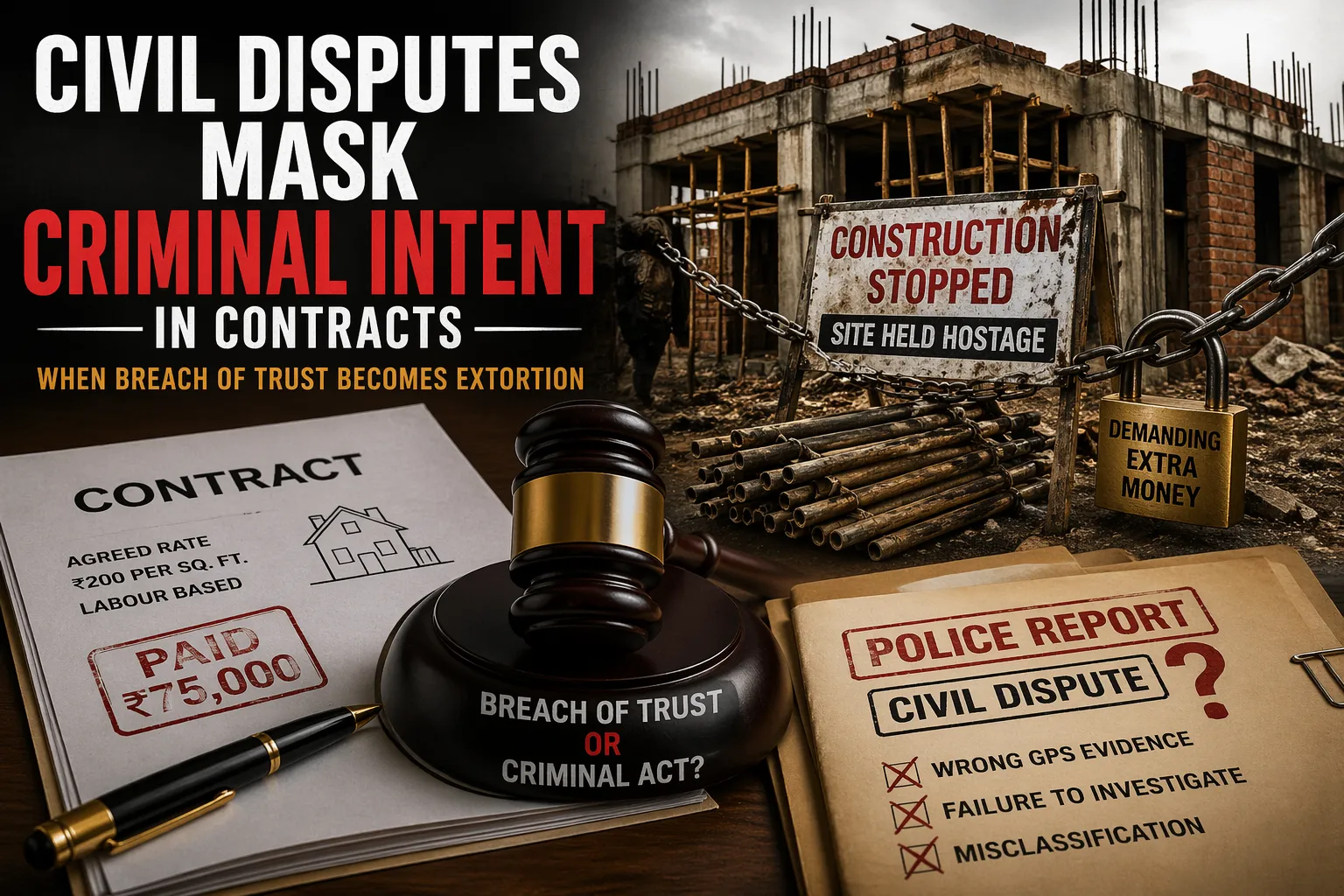
The legal strategy where Civil Disputes Mask Criminal Intent occurs when a party uses a breach of contract as a shield to hide coercive or fraudulent actions. In construction, a contractor might accept substantial payments, halt work, and then refuse to clear the site by claiming unpaid “tool rentals” or material dues. By framing the deadlock as a financial disagreement over accounts, the accused exploits the slow pace of civil courts to avoid criminal prosecution for Criminal Breach of Trust or Extortion. This tactic effectively holds the victim’s property “ransom” under the guise of a civil lien.
Key Takeaways
- The strategy of Civil Disputes Mask Criminal Intent allows contractors to hide criminal behaviour behind civil disagreements, often leading to financial loss for homeowners.
- The case of Keshav Pratap Singh illustrates how flawed investigations can protect dishonest contractors using extortion tactics.
- Contractor Pritesh Kumar halted construction and demanded ‘tool rental fees,’ despite having no basis in the original agreement.
- Police investigations failed to address critical evidence and misclassified the contractor’s actions as civil disputes instead of criminal breaches.
- The homeowner seeks re-investigation to hold the contractor accountable for extortion and breach of trust, highlighting systemic issues in these cases.
Why Civil Disputes Mask Criminal Intent: The Case of the Mirzapur Construction Deadlock
The line between a failed contract and a criminal act is often thin. For a homeowner, this difference can mean losing life savings while a rogue contractor occupies their property. This is why many legal experts argue that Civil Disputes Mask Criminal Intent. The case of Keshav Pratap Singh (Registration No. GOVUP/E/2026/0038451 and GOVUP/E/2026/0050810) serves as a cautionary tale. It shows how administrative “leniency” and flawed police investigations can protect contractors who use cunning tactics to extort money.
The Anatomy of the Agreement
In October 2025, an agreement was reached for a house in Gram Nibi Gaharwar, Mirzapur. The terms were straightforward. The parties agreed to a labor-based contract at a rate of 200 Rupees per square foot. This rate followed the standards of the Mirzapur Bhawan Nirman Karta Samiti.
Between October 2025 and February 2026, the homeowner fulfilled his financial obligations with total transparency. Signed receipts prove that he paid a total of 75,000 Rupees. This total included:
- An initial advance of 25,000 Rupees.
- Multiple installments of 10,000 and 15,000 Rupees.
- A significant final payment of 23,600 Rupees on February 12, 2026.
Despite this consistent financial support, contractor Pritesh Kumar halted construction entirely. He left the building in disarray. Consequently, the homeowner now suffers from significant financial and mental distress.
The “Cunning Trick”: From Labor to Ransom
The core issue involves more than just a work stoppage. It centers on the tactical use of materials to halt the homeowner’s progress. Specifically, the contractor refused to clear the site of shuttering poles (bally) and other tools.
The Tool Rental Trap
Pritesh Kumar alleged to investigators that his materials remained at the site for two months. Therefore, he claimed he deserved a “rental fee”. However, this claim is a classic example of how Civil Disputes Mask Criminal Intent for several reasons:
- Contractual Scope: The original agreement set a flat labor rate of 200 Rupees per square foot. It never mentioned tool rental.
- Contractor Responsibility: In labor contracts, the contractor usually manages his own tools. Using their presence to demand extra money is not a civil disagreement. Instead, it functions as a form of coercive ransom.
- Site Hostage-Taking: By refusing to move the poles, the contractor prevents a new team from finishing the roof. Thus, he holds the property hostage until he receives a “settlement”.
Failures in the Official Investigation
Officer Ganesh Pandey led the police investigation. However, the complainant criticizes the report for lacking depth and integrity. The official report concluded the matter was purely civil. Finally, the officer instructed the homeowner to seek relief in a court of law.
1. The GPS Evidence Discrepancy
The report relies on physical verification evidence. It includes a GPS Map Camera photo with coordinates Lat 25.162851 Long 82.509361. Nevertheless, the homeowner formally alleges that this photo does not show the actual construction site. If the officer visited the wrong site, then the entire basis of the investigation is fraudulent.
2. Failure to Interrogate
Furthermore, the police failed to interrogate the contractor regarding the source of the tools. If the contractor rented these materials from a third party, that is his own private dispute. The homeowner should not suffer for the contractor’s external debts.
3. Misclassification of the Crime
Moreover, the authorities labeled this a “Civil Dispute”. In doing so, they ignored elements of Criminal Breach of Trust. Taking 75,000 Rupees and then intentionally obstructing a property to extort funds meets the threshold for criminal coercion.
The Path to Justice: Demand for Re-Investigation
On April 21, 2026, the complainant filed a new grievance (No. GOVUP/E/2026/0050810). This appeal demands a high-level review of the case. It focuses specifically on official harassment and the submission of incorrect evidence.
The homeowner’s prayer for relief includes:
- Re-opening the original case.
- Assigning a law expert to identify criminal liability.
- Conducting a fresh site inspection to verify coordinates.
- Registering an FIR against Pritesh Kumar for extortion and breach of trust.
Conclusion
This case highlights a systemic issue. Contractors often use the slow pace of the civil court system to their advantage. When a contractor receives most of the payment and then obstructs the property, a crime occurs.
Therefore, the authorities must look past the “civil” label. They must investigate the intent behind the contractor’s actions. Without a rigorous investigation into the fraudulent GPS evidence, the homeowner remains without a house. Justice in Mirzapur depends on identifying when Civil Disputes Mask Criminal Intent and holding both rogue contractors and negligent investigators accountable.
Based on the provided grievance documents, here are the details for the public authorities and registration IDs associated with case:
1. Core Grievance Identifiers (Civil Disputes Mask Criminal Intent)
- Original Application ID: GOVUP/E/2026/0038451
- Re-investigation ID: GOVUP/E/2026/0050810
- Date of Re-investigation Filing: 21/04/2026
2. Public Authority Contact Information (Civil Disputes Mask Criminal Intent)
These details correspond to the Chief Minister Secretariat of Uttar Pradesh, which is currently reviewing the appeal.
- Official Name: Shri Arvind Mohan
- Designation: Joint Secretary, Government of Uttar Pradesh
- Office Address: Room No. 321, U.P. Secretariat, Lucknow
- Phone Number: 05222226350
- Email: arvind.12574[at]gov[dot]in
3. Recommended Outbound Links (Civil Disputes Mask Criminal Intent)
For a professional website post, you should hyperlink the following official portals:
- Jansunwai (IGRS) Portal: https://jansunwai.up.nic.in/ – Use this for checking the current status of the grievance.
- UP Police Official Site: https://uppolice.gov.in/ – Relevant for reporting officer misconduct or verifying local station details.
- Chief Minister’s Office (CMO) UP: https://upcmo.up.nic.in/ – Direct link to the oversight department managing the secretariat.
4. Local Investigation Contacts (Civil Disputes Mask Criminal Intent)
- Investigating Officer: Ganesh Pandey
- Police Unit: Vindhyachal Police Station, Mirzapur
- Recorded Officer Mobile: 9839101665
By including these links, you ensure that the claim regarding Civil Disputes Mask Criminal Intent is backed by verifiable government records and accessible public officials.


Facing a similar challenge? Share the details in the box below, and our team of experts will do their best to help.