
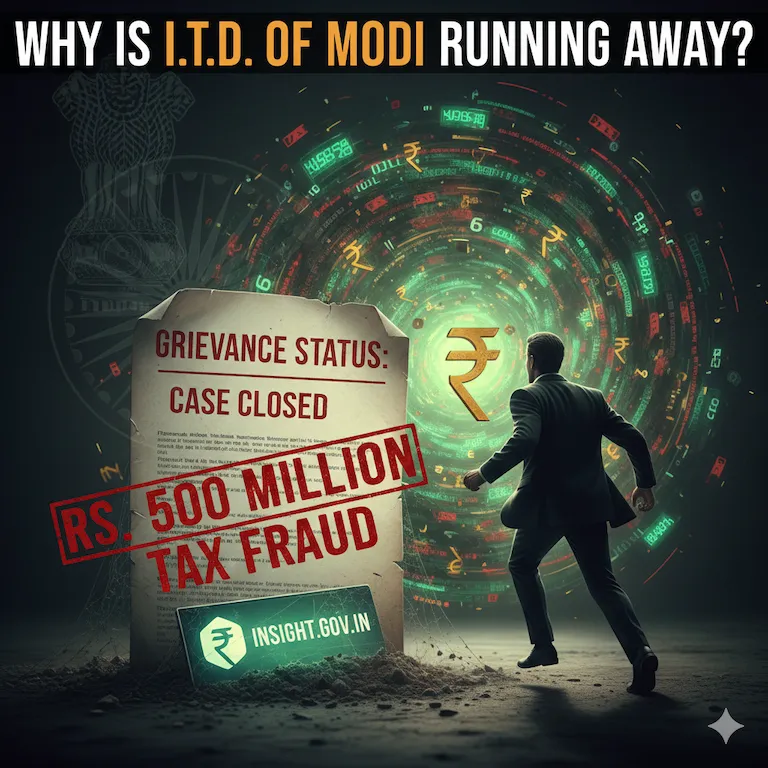
The key takeaway from the blog post and related case documentation:
The 500 million tax fraud is a warning against the systemic failure. It also highlights the administrative apathy within the Income Tax Department concerning high-value identity theft and tax fraud.
The primary points are as follows:
1. Massive Scale of Identity Theft (500 million tax fraud)
The core issue involves fraudulently misusing a single Permanent Account Number (PAN: GSWPS0850Q). This misuse facilitates astronomical transactions totaling approximately ₹370 million to ₹500 million. This scale of fraud shows how easily someone’s financial identity can be hijacked. Multi-million rupee laundering schemes can occur without the individual’s knowledge.
2. Departmental Denial and Falsification
A critical point of the post is the allegation that high-ranking officials, specifically the Pr. DGIT (I&CI), provided misleading remarks in official grievance responses by denying that any police requisitions were made. In reality, official records such as Police Case Diary Parcha 16 and 18 prove that law enforcement requested transaction data. The department claimed this data did not exist.
3. Obstruction of Criminal Justice (500 million tax fraud)
The department’s refusal to provide “money trail” data has effectively stalled the police investigation into the criminal syndicate. This data includes source and destination bank accounts. This refusal has effectively stalled the police investigation (FIR 291/23) into the criminal syndicate. By citing “lack of jurisdiction,” the department is accused of protecting fraudsters. They are also treating the matter as a mere “PAN centralization” issue. The accusation is that they protect fraudsters rather than the victim.
4. Systemic Vulnerabilities
The case highlights major flaws in the Indian financial infrastructure:
- Validation Gaps: Entities can report massive payments (like ₹1.27 Crore in bogus rent) to any PAN without requiring multi-factor verification from the actual PAN holder.
- The “Two Poles” Problem: A disconnect exists. The Income Tax Department treats the matter as tax evasion by the victim. Meanwhile, the Police treat it as identity theft. This situation leaves the individual trapped between two uncoordinated agencies.
5. Call for Institutional Integrity (500 million tax fraud)
The blog post serves as a “clarion call” for better coordination between state police and federal tax authorities. It argues that using an identity to move such vast sums is a significant threat. This cannot be dismissed on minor technicalities. It poses a threat to national financial security.
The Shadow of Rs 500 Million: How the Income Tax Department Paves the Way for Systemic Fraud
In the digital age, transparency is often touted as the ultimate cure for corruption. Yet, when transparency reveals a Rs 500 million (Rs 50 Crore) tax fraud, the department tasked with investigation avoids action. They choose to “run away” through jurisdictional technicalities. We must ask: Who is the system really protecting?
The case of Yogi M. P. Singh and the misuse of PAN GSWPS0850Q is not just an individual’s struggle. It shows how systemic tax evasion is facilitated by administrative silence.
The “Dustbin” Approach to High-Value Corruption
When a citizen reports identity theft involving transactions of hundreds of millions, the expected response is a rigorous audit of the source and destination of funds. Instead, the Income Tax Department’s response has been a masterclass in bureaucratic avoidance. By labeling a grievance as “outside the scope and jurisdiction,” officials effectively categorize a massive criminal enterprise. They place it into a “dustbin” of untraced elements.
This avoidance is not merely a procedural lapse; it is a calculated “escape” from accountability. If the department acknowledges the fraud, they must explain how their automated “Insight” portal failed. This is the very system that processed a GST Turnover of Rs 163 million in a single year. It did not trigger internal red flags.
Falsification of Records: A Criminal Offense (500 million tax fraud)
The core of this grievance lies in a direct contradiction of facts. The Pr. DGIT (I&CI) stated in official records that “no bank details have ever been requisitioned by any investigation agency.” This statement is a verifiable falsehood. Official police Case Diaries (Parcha 16 and 18) show the police requested the data linked to the fraudulent accounts involving a 500 million tax fraud. There is also a formal requisition from the SP Office in Mirzapur proving this request.
Under Section 182 of the Indian Penal Code (IPC), providing false information to a public servant is a punishable offense. This applies when there is intent to cause them to use their lawful power to injure another. When a high-ranking official like a Pr. DGIT provides misleading remarks on a government portal, they block an investigation into a Rs 500 million fraud. They are not just protecting a “non-factual remark”. They are potentially committing a crime against public justice.
The Whistleblower’s Shield: Why Blogging Matters
The department’s claim that such disclosures “tarnish its image” is a common defense used to suppress transparency. Under the Whistle Blowers Protection Act, 2014, individuals who disclose corruption in the public interest are protected. They are entitled to legal safeguards against victimization.
Blogging serves as a powerful tool for government accountability. The complainant moves these transactions from a closed file to a public blog. This action prevents the matter from being quietly settled behind closed doors. Social media and independent reporting play a crucial role in anti-corruption movements. They have historically been the single biggest factors in their success in India. These forces create a “moral awakening” and lead to policy changes or lawsuits.
Systematic Evasion or Administrative Failure? (500 million tax fraud)
The pattern is clear:
- Targeting the Vulnerable: Fraudsters use the identities of people like Mahesh Pratap Singh to move massive sums.
- Fabricated Documentation: The department’s own system (TIS/AIS) processes these transactions, yet officials claim no role in their verification.
- Escaping Accountability: When caught, the department uses jurisdictional technicalities to avoid complying with police requisitions.
This cycle does more than just deny justice to a victim of identity theft. It also paves the way for a large-scale tax evasion racket to thrive. Every time an official closes a file on “jurisdictional grounds,” they fail to investigate a police-reported fraud of Rs 500 million. As a result, the government loses revenue. Additionally, it loses the trust of its citizens.
The Path Forward: Breaking the Silence
The current appeal (CBODT/E/A/26/0000294) is a critical junction. If the Appellate Authority does not provide a factual resolution, the next steps are clear:
- Escalation to the Lokpal: To investigate the conduct of the public servants who provided misleading remarks.
- CVC Intervention: To audit the “Inward Register” of the Prayagraj office and prove the police correspondence was received and ignored.
- Public Disclosure: We are using the blog as a platform for transparency. This will continue until the “root cause” of this deep-rooted corruption is addressed.
The Income Tax Department cannot “run away” from its own data. The Taxpayer Information Summary (TIS) continues to show these fraudulent millions. The demand for accountability will only grow louder.
To strengthen your blog, here is a detailed breakdown of the Indian Penal Code (IPC) sections. These sections are relevant to the ₹500 million fraud and the alleged official misconduct.
1. Against the Fraudulent Elements (Identity Theft & Evasion)
These sections address the “root cause”—the criminals using your PAN for large-scale tax evasion.
- Section 419: Punishment for Cheating by Personation
- Offense: Used when someone pretends to be someone else to cheat another. In your case, fraudsters personated you using your PAN to conduct business and claim rent.
- Punishment: Up to 3 years imprisonment, or fine, or both.
- Section 420: Cheating and Dishonestly Inducing Delivery of Property
- Offense: This is the core of most financial frauds. It applies to the fraudulent GST turnover. Business receipts are over ₹163 million. They cheated the government of tax revenue using your identity.
- Punishment: Up to 7 years imprisonment and a fine.
- Section 467 & 468: Forgery of Valuable Security & Forgery for Purpose of Cheating
- Offense: Forging documents (like GST invoices or rent agreements) that purport to be valuable securities or are used to cheat.
- Punishment: Section 467 can lead to life imprisonment. Alternatively, it can lead to 10 years plus a fine. Section 468 carries up to 7 years plus a fine.
2. Against Official Misconduct (The “Escape” Route) (500 million tax fraud)
These sections address the “bogus” reports and the denial of police requisitions by public servants.
- Section 182: False Information with Intent to Cause Public Servant to Use Lawful Power to the Injury of Another
- Offense: Giving a public servant false information, knowing it will cause them to do (or omit) something they otherwise wouldn’t. The official stated “no bank details were requisitioned” despite your police records. This false information potentially allowed the official to close your grievance. As a result, it caused you legal injury.
- Punishment: Up to 6 months imprisonment, or fine, or both.
- Section 166: Public Servant Disobeying Law with Intent to Cause Injury
- Offense: When a public servant knowingly disobeys a legal direction. This can include a police requisition for a criminal investigation. Their intention is to cause injury to a person.
- Punishment: Simple imprisonment for up to 1 year, or fine, or both.
- Section 167: Public Servant Framing an Incorrect Document with Intent to Cause Injury
- Offense: A public servant is charged with preparing a document. This could be a grievance disposal report. They knowingly frame it incorrectly to cause harm or support a false claim.
- Punishment: Up to 3 years imprisonment, or fine, or both.
How to Use These in Your Blog
When posting on your blog, you can add a “Legal Corner” section:
The systematic denial of these transactions isn’t just a mistake. It is a violation of Section 167 of the IPC. Public servants are accused of framing incorrect reports to protect a ₹500 million racket. The fraudsters should be booked under Section 420 for massive cheating. The officers aiding this ‘escape’ are providing false information to the portal. They are liable under Section 182.
Based on the official records and the grievance history you provided, here are the contact and identification details for the public authorities involved in this matter:
1. Primary Grievance & Appeal Identifiers
These ID numbers are essential for all future correspondence with the CBDT, CVC, or the Lokpal to ensure they can track your case history.
- Grievance Registration Number: CBODT/E/2026/0002314 1
- Appeal Registration Number: CBODT/E/A/26/0000294 2
- e-Campaign DIN (FY 2022-23): INSIGHT/CMP/02/2023-24/11230041665940001 3
- Police FIR Number: 291/23 (PS Kotwali Katra, Mirzapur) 4
2. Concerned Public Authority Details (500 million tax fraud)
| Authority / Office | Contact Person / Designation | Email Address | Contact Number / Web Link |
| CCIT Allahabad | Mona Mohanty | allahabad.ccit@incometax.gov.in 5 | 0532-2408005 6 |
| Pr. DGIT (I&CI) | Amitav | dg.ic@incometax.gov.in | incometaxindia.gov.in |
| Department of Revenue | The Secretary | rrevenue@nic.in | dor.gov.in |
| CPGRAMS Portal | Department of ARPG | – | pgportal.gov.in 7 |
| Income Tax Compliance | ITD Support | ITD_Support@insight.gov.in 8 | insight.gov.in 9 |
3. Escalation Authorities (Whistleblower/Vigilance)
If you choose to escalate the “bogus” report and the ₹500 million fraud, use these links and addresses:
- Central Vigilance Commission (CVC):
- Web Link: cvc.gov.in
- Address: Satarkta Bhawan, Block-A, GPO Complex, INA, New Delhi-110023.
- Lokpal of India:
- Web Link: lokpal.gov.in
- Address: Plot No. 6, Vasant Kunj Institutional Area, Phase II, New Delhi-110070.
- Directorate General of Income Tax (Vigilance):
- Address: 1st Floor, Dayal Singh Public Library Building, 1, Deen Dayal Upadhyaya Marg, New Delhi-110002.
Verification Note (500 million tax fraud)
The email address (dngoldraipur18@gmail.com) and mobile number (7024188072) in the TIS document you provided link to the fraudulent transactions on your PAN, so you should report them to the police as the contact details used by the scammers.


Facing a similar challenge? Share the details in the box below, and our team of experts will do their best to help.