
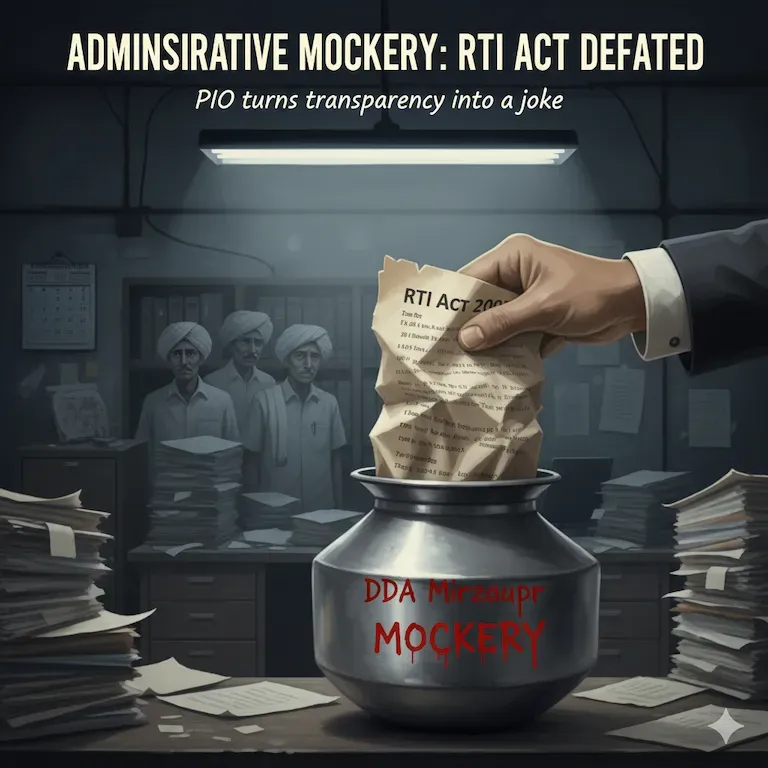
The key takeaway from the post is that : (DDA made the mockery)
administrative transparency is being systematically bypassed through the “weaponisation” of legal exemptions. In several recent cases, it has become clear that DDA made the mockery of the principles behind these openness laws. Specifically, it highlights three critical failures in the current bureaucratic handle of RTI:
The selection asserts that government agencies are intentionally undermining the spirit of the RTI Act to avoid public scrutiny.
Systemic Bypass: The DDA does not merely commit isolated errors; it systematically circumvents the accountability frameworks the RTI Act establishes. Specifically, the current bureaucratic handling of RTI demonstrates three critical failures:
- Subverting Transparency: Officials no longer treat administrative openness as the default. Instead, they actively avoid disclosure through tactical manoeuvrers.
- Weaponising the Law: The administration repurposes legal clauses—specifically exemptions intended for rare or sensitive cases—into routine tools for denying information.
- The Privacy Excuse: PIOs are incorrectly using Section 8(1)(j) (Personal Information) to hide the names of officials. They are also hiding the status of files. However, government work is a public activity and not a private matter.
- Engineered Ignorance: Departments claim “no knowledge” of Citizen Charters or time limits. This creates a “black hole” where applications can stay “Under Consideration” indefinitely. In simple words: Accountability means being responsible for your actions. It also involves being willing to accept the consequences if things go wrong. It’s the idea that “the buck stops here.”
- Violation of Statutory Duty: Officials are not helping citizens. They are not transferring queries to the right department (as required by Section 6(3)). Instead, officials are providing “template denials” to frustrate information seekers and shield themselves from scrutiny.
The Bottom Line: Officials view the RTI Act as an obstacle. Instead of fostering accountability, they bypass the law with bureaucratic jargon.This turns a “Right” into a “Mockery.”
DDA made the mockery: How RTI Exemptions Weaponised to Shield Bureaucratic Apathy
The Right to Information (RTI) Act of 2005 heralded a new era. It represents “sunlight” meant to disinfect the corridors of Indian bureaucracy. It aimed to empower the common citizen, transforming the “subject” into a “stakeholder.” However, recent trends in local administration—specifically within the agricultural departments of districts like Mirzapur, Uttar Pradesh—reveal a disturbing pattern. Public Information Officers (PIOs) increasingly exploit legal exemptions, no longer using them as a shield for privacy, but executing the “slow death” of accountability instead.
The core issue is simple yet systemic: When a citizen asks why a government service is delayed, the administration calls the delay “confidential.” The administration might also term it “personal.”
The Anatomy of a Denial: The PM-KISAN Case Study (DDA made the mockery)
Consider the case of a citizen seeking information regarding pending PM-KISAN registrations. These registrations are not state secrets; instead, they represent applications for a central welfare scheme aimed at providing financial stability to farmers. When an official keeps an application in a “Vicharadheen” (Under Consideration) status for more than ten months, it clearly signifies administrative paralysis.
When someone files an RTI asking for the Daily Progress Report, officials often issue a blanket denial. The same occurs when someone requests the names of the officials responsible for the file. They provide this response under Section 8(1)(j) of the RTI Act, which is intended to protect personal information that has no relationship to public activity. Applying this to a government clerk’s failure to process a file is not just a legal error; it mocks the democratic process.
The “Personal Information” Trap (DDA made the mockery)
The most abused tool in the PIO’s arsenal is the “Third Party” or “Personal Information” excuse. In the context of public service:
- The Official’s Identity: The name and designation of a Lekhpal, Technical Assistant, or Clerk performing public duties are public records. A government servant acting in their official capacity has no “expectation of privacy” regarding their professional output.
- The Applicant’s Identity: When a family member seeks the status of their own file, the “Third Party” argument collapses. The same occurs when the original applicant seeks their own file’s status. Information that cannot be denied to the Parliament or a State Legislature cannot be denied to a citizen.
The office of the Deputy Director of Agriculture (DDA) labels the status of a farmer’s registration as “private.” This action effectively removes the official’s accountability to the public they serve.
The Missing Citizen Charter: Governance in the Dark (DDA made the mockery)
One startling revelation in recent RTI responses is the departments’ claim. They assert having “no knowledge” of a Citizen Charter or Government Orders (GOs) stipulating time limits.
Under Section 4(1)(b) of the RTI Act, every public authority must proactively publish its norms that govern the discharge of its functions. If an office claims it does not know the maximum time limit for approving a registration, it admits to one of two things:
- Incompetence: They are operating without any standard operating procedures.
- Deception: they are wilfully withholding the rulebook to prevent citizens from proving that a delay has occurred.
Without a stipulated time limit, “Under Consideration” becomes a permanent status. The official is never “late” because there is no “due date.”
The Grievance Black Hole (DDA made the mockery)
The lack of coordination between Central and State portals is another layer of this administrative mockery. When a citizen provides a specific Central Government Grievance Number (e.g., from the CPGRAMS portal) and the local PIO responds with “no cognisance,” the system fails.
The RTI Act provides a remedy for this under Section 6(3). If a PIO does not hold the information, they are required to transfer the application to the office that does. Instead, PIOs often issue a flat denial. This forces the citizen into a cycle of appeals. This cycle can last months or years. It effectively exhausts the seeker until they give up.
The Role of the First Appellate Authority
The First Appeal is the first line of defense against an arbitrary PIO. In cases like those in Mirzapur, the Joint Director of Agriculture (JDA) holds the responsibility to correct these “template denials.” An Appellate Authority must recognize that:
- Welfare scheme status is a matter of Public Interest.
- The identity of a public servant handling a file is a matter of Public Accountability.
- Section 8(1)(j) cannot be used to hide administrative lethargy.
Conclusion: Beyond the Paper Trail (DDA made the mockery)
The RTI Act becomes a game of “hide and seek” when legal jargon is involved. This erodes the trust between the citizen and the state. A farmer waiting ten months for a registration is waiting for more than just money. They are waiting for the system to acknowledge their existence.
Treating an RTI query about a pending file as an “invasion of privacy” sends a message to the citizen. It suggests that the government’s internal workings are more important than the citizen’s welfare. The only way to end this mockery is by strictly imposing penalties under Section 20 of the Act. These penalties target PIOs who provide misleading and arbitrary replies.
The people have worked hard to win their right to transparency. The local administration in districts like Mirzapur must remember this right is not a favor granted by the bureaucracy.
The authorities involved in your case provided the consolidated contact information based on your RTI filings and official records.
1. Case Reference Details (From your documents)
- Original RTI Registration:
DRAGR/R/2025/60357(Filed: 26/12/2025) - First Appeal Registration:
DRAGR/A/2026/60017(Filed: 20/01/2026) - Application IDs (PM-KISAN):
20250119514266,20250119512524,20250119192467 - Central Grievance Number:
DOAAC/E/2025/0045542(Dated: 10/12/2025)
2. Public Information Officer (PIO) – Mirzapur
- Name: Vikesh Kumar (Deputy Director of Agriculture)
- Designation: DDA Mirzapur
- Mobile: 7839882478
- Email: ddamzp2012@gmail.com
- Address: Office of the Deputy Director of Agriculture, Mirzapur, Uttar Pradesh – 231001.
3. First Appellate Authority (FAA) – Regional
- Name: JDA Vindhyachal (Joint Director of Agriculture)
- Designation: First Appellate Authority
- Mobile: 7668571373
- Email: jdavindhyachal@gmail.com
- Jurisdiction: Mirzapur, Sonbhadra, and Bhadohi.
4. Higher Authorities (State/Nodal Level) (DDA made the mockery)
| Entity | Designation | Contact Details |
| Additional Director | Nodal Officer (Agriculture) | Mob: 8081560096 Email: dirag@up.nic.in |
| Agriculture Directorate | State HQ (Lucknow) | Website: upagriculture.com |
| UP RTI Helpline | Technical Support | Phone: 0522-7118629 Email: onlinertihelpline-up@gov.in |
5. Important Web Links
- UP RTI Online Portal: rtionline.up.gov.in (To track your appeal status)
- PM-KISAN Status Portal: pmkisan.gov.in (To check current application status directly)
- Central Grievance Portal: pgportal.gov.in (To reference your Central Grievance)
Recommended Next Step
The JDA (FAA) is the immediate authority for your appeal. You should send a copy of your appeal and the supporting documents directly to jdavindhyachal@gmail.com. Include your brother’s ID and the Central Grievance receipt. The DDA made the mockery, ensuring they have the files in a readable format immediately, as the online portal sometimes has technical delays.
Analysing your RTI application and the PIO’s reply highlights a classic conflict. This conflict is between the Right to Transparency and the Misuse of Exemption Clauses. Below is a detailed discussion based on the documents you provided and the legal framework of the RTI Act 2005.
1. Information Sought vs. PIO’s Defense
You asked for administrative records (progress reports, names of officials, and citizen charters) concerning a delayed public service. The PIO denied these under Section 8(1)(j), which protects “personal information.”
| Information Sought | PIO’s Logic for Denial | Legal Counter-Argument |
| Progress Reports of Applications | Claimed it is “Personal Information.” | Processing a PM-KISAN file is a public administrative duty, not a private affair of the officer or applicant. |
| Names & Designations of Officials | Claimed privacy of officials. | The Central Information Commission (CIC) has repeatedly ruled that a public servant’s identity while performing public duty is public record. |
| Citizen Charter / Time Limits | Claimed “No such order is in knowledge.” | Under Section 4(1)(b), every department must proactively publish its norms and timelines. Claiming ignorance is a violation of this statutory duty. |
| Status of Central Grievance | Claimed “No cognizance.” | If the PIO didn’t have it, they were legally required to transfer the request under Section 6(3), not simply reject it. |
2. Deep Dive: The Misuse of Section 8(1)(j)
The PIO’s primary shield is Section 8(1)(j). However, this section has two strict conditions. These must be met to deny information. Otherwise, the DDA made a mockery of transparency and accountability.
- The info must have no relationship to any public activity or interest.
- Disclosure would cause an unwarranted invasion of privacy.
The Reality: Since the applications relate to a government welfare scheme (PM-KISAN), they are inherently tied to public activity. Furthermore, the “Proviso” to this section states:
“Information which cannot be denied to the Parliament or a State Legislature shall not be denied to any person.
If an MLA or MP asked for the status of these farmers’ registrations, the DDA would have to provide it. Therefore, they cannot deny it to you.
3. PIO’s Response as “Administrative Mockery”
The reply provided is what experts call a “Template Denial.” * The “Personal” Fallacy: By calling the progress of a file “personal,” the PIO shields the Lekhpal or Clerk from accountability. This effectively excuses a 10-month delay.
- Arbitrary Rejection: Rejections must be “speaking orders”—meaning the PIO must explain how the disclosure would harm privacy. Simply quoting the section number is legally insufficient.
Next Steps for Your Appeal
Since you have already filed your First Appeal with the JDA Vindhyachal, your strongest point during any hearing will be that administrative delay is a matter of public concern. You have already filed your First Appeal, which strengthens your position. You are not asking for the officer’s home address or bank details; you are asking about their official conduct.
This is the most critical question in your case. In simple terms: An information seeker has an absolute right to seek information regarding the status and processing of their own application.
The PIO’s claim that your own file status is “Personal Information” ($Section 8(1)(j)$) is legally upside-down. Here is why:
1. You are not a “Third Party” to yourself
$Section\ 8(1)(j)$ is designed to protect an individual’s privacy from other people.
- The Law: It prevents the disclosure of personal information to a stranger.
- The Fact: You are the applicant (or the authorized brother of the applicant). You cannot “invade your own privacy.” Providing you with the status of your own application is the fulfillment of a service, not a breach of confidentiality.
2. The “Parliament Test” (The Proviso)
There is a specific “acid test” at the end of $Section\ 8(1)(j)$ that the PIO has completely ignored. It states:
“Provided that the information cannot be denied to the Parliament or a State Legislature. It shall not be denied to any person.”
The Argument: If a Member of the Legislative Assembly (MLA) asked the Agriculture Department, “Why is Keshav Pratap Singh’s registration pending for so long?” They might specifically ask why it has taken 10 months. The department would be legally required to answer. Therefore, they cannot deny that same information to you.
3. Public Activity vs. Private Information
The processing of a government scheme (PM-KISAN) is a Public Activity.
- The daily progress report of a file in a government office is a Public Record.
- The identity of the officer (Lekhpal/Clerk) who is sitting on that file is Public Accountability.
By calling this “personal,” the PIO is suggesting that a government officer’s work performance is their “private business.” The Central Information Commission (CIC) has repeatedly ruled that a public servant’s discharge of official duties is not personal information.
How to use this in your Appeal (DRAGR/A/2026/60017)
When you speak to or write to the Joint Director (FAA), use this specific phrasing:
“The PIO has erred in law by invoking Section 8(1)(j). This section protects an individual from third-party intrusion. It does not allow a Public Authority to hide an applicant’s own file status from the applicant himself. Furthermore, as per the Proviso to Section 8(1)(j), this information regarding a government scheme cannot be denied to the State Legislature. Therefore, it cannot be denied to me.”
Would you like me to draft a specific “Legal Rebuttal” document? It will focus entirely on why Section 8(1)(j) does not apply when seeking one’s own application status.


Facing a similar challenge? Share the details in the box below, and our team of experts will do their best to help.