
Administrative Lethargy in Action of UIDAI: A Two-Year Aadhaar Case Study from Mirzapur
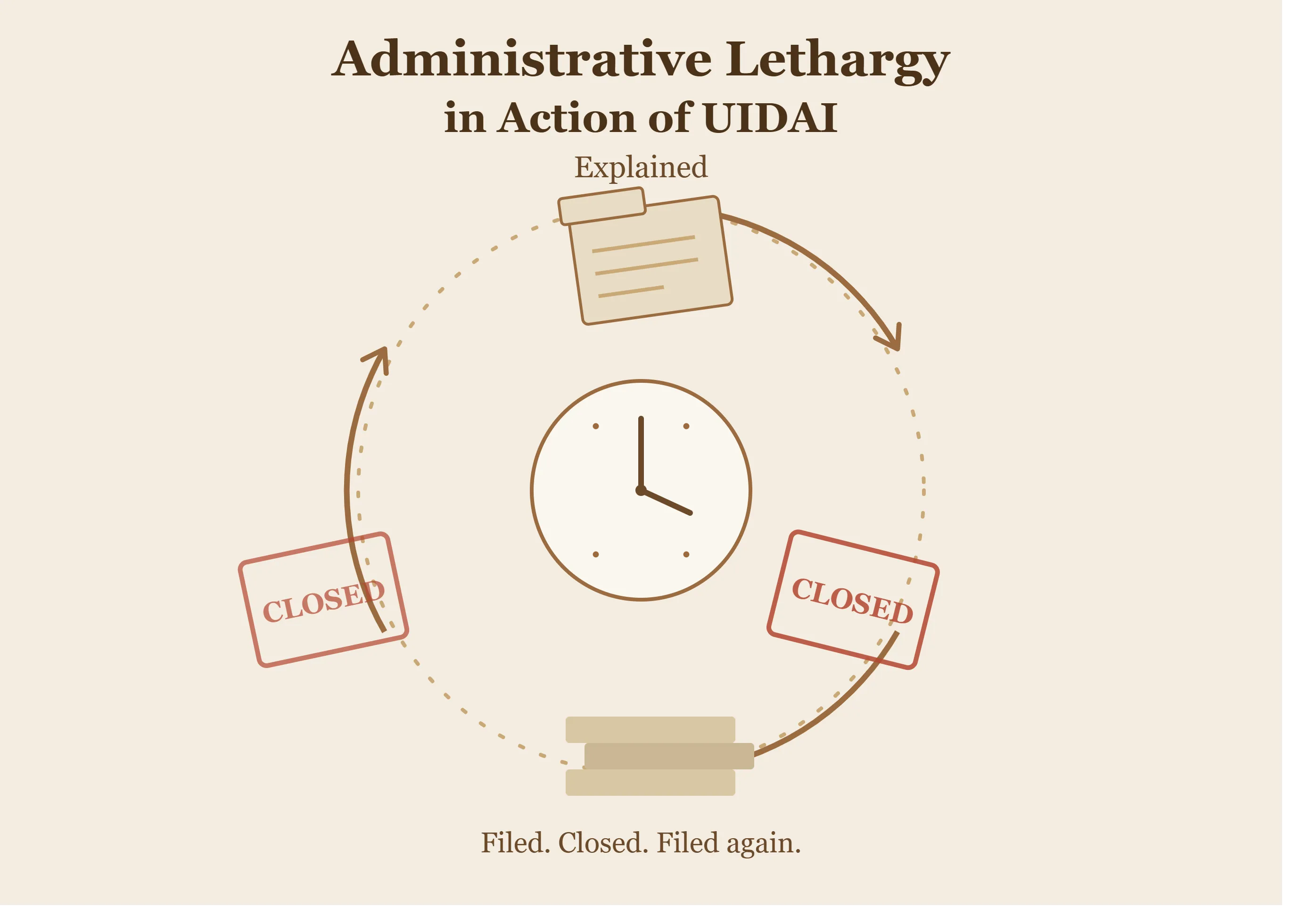
Administrative Lethargy in Action of UIDAI captures exactly what this case shows. Sadhana Tiwari paid a fee in November 2024 to update her children’s Aadhaar cards. Officials promised resolution within fifteen days. Nearly two years later, the matter still isn’t settled. She filed a grievance. Officials closed it on a technicality. She filed an appeal. Officials closed that too, with the same explanation. She obtained the exact document UIDAI demanded. Still, nothing changed. Activist Yogi M. P. Singh has filed several more grievances on her behalf, each met with the same procedural silence. This isn’t ordinary delay. It’s Administrative Lethargy in Action of UIDAI: a system that registers complaints, issues closures, and calls that resolution, while the actual problem, a child’s inaccurate Aadhaar record, remains untouched two years on.
Key Takeaways
- Sadhana Tiwari faced two years of unresolved issues with her children’s Aadhaar updates, illustrating Administrative Lethargy in Action of UIDAI.
- Despite repeated grievances and compliance with requirements, UIDAI failed to resolve the underlying problems with the records.
- Each grievance closed on procedural grounds without addressing the actual issue, highlighting the inefficiency of UIDAI’s system.
- The case reveals a concerning pattern where procedural completion replaces meaningful resolution, forcing citizens to re-file complaints.
- An activist’s sustained effort shows how challenging it is for ordinary applicants, raising questions about the integrity of the administrative process.
Introduction
In November 2024, Sadhana Tiwari paid Rs 600 at a postal facilitation centre in Mirzapur. She wanted to update the Aadhaar cards of her two minor children, Jaya Prakash and Aanchal Tiwari. Officials promised the update within fifteen days. Nearly two years later, in July 2026, the matter still isn’t resolved. Activist Yogi M. P. Singh has filed several grievances and appeals on her behalf. UIDAI’s own records track this case closely. They show administrative lethargy in action of UIDAI. A public authority keeps absorbing documented complaints. It never resolves the actual issue.
Administrative Lethargy in Action of UIDAI: A Two-Year Aadhaar Case Study from Mirzapur
Introduction
In November 2024, Sadhana Tiwari paid Rs 600 at a postal facilitation centre in Mirzapur. She wanted to update the Aadhaar cards of her two minor children, Jaya Prakash and Aanchal Tiwari. Officials promised the update within fifteen days. However, nearly two years later, in July 2026, the matter still isn’t resolved. Meanwhile, activist Yogi M. P. Singh has filed several grievances and appeals on her behalf. UIDAI’s own records track this case closely, and they show administrative lethargy in action of UIDAI: a public authority that keeps absorbing documented complaints without ever resolving the actual issue.
A Pattern, Not a Single Complaint
Persistence defines this case. This wasn’t one grievance, filed and forgotten. Instead, the family and their activist supporter lodged several grievances and appeals over time. Each carried its own registration number, and each restated the same facts. Yet each ended the same way: officials acknowledged it, closed it, and made no correction to the Aadhaar record. This repeated re-filing shows administrative lethargy in action of UIDAI in its purest form. A working grievance system, after all, shouldn’t force a citizen to keep restarting the same file year after year.
The Original Complaint
One early grievance, UIDAI/E/2024/0015024, went in on 3 December 2024. It stated that more than twenty days had passed with no update, even though officials had promised fifteen. Citing Article 51A of the Constitution, the complainant invoked the right to reason and asked the department to explain the delay and the fee the facilitation centre charged.
Along with this, she attached enrolment receipts for both children and their birth certificates. For the son, Jaya Prakash, the update seems to have gone through without further trouble.
The Rejection and Its Reasoning
The daughter’s case, however, took a different turn. On 17 December 2024, officials closed the grievance and rejected the birth certificate as invalid. According to their response, its QR code did not confirm issuance through the official Civil Registration System portal. Under the Registration of Births and Deaths Act, they explained, only CRS-issued certificates qualify.
This requirement isn’t unreasonable on its face, since document verification serves a real purpose. But the closure left the core problem unresolved. The family had paid a fee and waited well past the promised timeline. Now, once again, they had to start the paperwork over.
The Appeal, and the Cycle That Followed
In response, the complainant filed an appeal, UIDAI/E/A/25/0000105, on 12 January 2025. She called the closure an arbitrary action, since the department had offered no real solution. Additionally, she asked officials to adopt a cogent approach and redress the grievance under law, and she questioned whether the closure reflected a broader pattern of indifference.
Officials closed the appeal on 17 January 2025, repeating the same explanation: the certificate hadn’t come through the CRS portal. Notably, this wasn’t the only time this cycle played out. Earlier filings followed the same shape: a complaint goes in, and a closure follows, backed by a procedural excuse. Meanwhile, the real problem stays untouched, an Aadhaar record that still shows the wrong date of birth. Each round eats up weeks or months, yet none of them deliver what the complainant actually asked for.
Compliance, and Still No Resolution
In May 2025, the family finally obtained a new birth certificate for Aanchal Tiwari. The Nagar Palika Parishad, Mirzapur-cum-Vindhyachal, issued it under the Department of Medical and Health, Government of Uttar Pradesh, carrying a formal registration number and meeting every statutory requirement UIDAI had cited. In short, the family did exactly what UIDAI’s own response had asked of them.
Still, more than a year passed with no action. So, on 23 July 2026, the family filed a fresh grievance, UIDAI/E/2026/0022074, restating the case, attaching the compliant certificate, and asking why the update still hadn’t happened. That grievance now sits under process, handled by the same Regional Office in Lucknow and the same officer, Vipin Verma, Deputy Director, who oversaw the original appeal.
Administrative Lethargy in Action of UIDAI: What It Looks Like in Practice
Let’s name precisely what happened here, because the word “delay” understates it. Administrative lethargy in action of UIDAI doesn’t mean nothing happened. In fact, officials registered grievances, assigned file numbers, issued closures, and sent polite acknowledgments. Activity occurred at every stage; resolution did not. Instead, each closure treated the matter as complete once a procedural box was ticked, even as the resident’s actual problem, an inaccurate Aadhaar record for a minor child, stayed untouched.
Public administration has a name for this pattern: motion without progress. Through it, a department can point to a file number, a response time, and a closure date as proof of responsiveness, while the citizen starts over. Ultimately, the repeated need to re-file doesn’t reflect a complicated case. Rather, it reflects a system that treats closing a file and solving a problem as the same thing, when they clearly aren’t.
A Second, Quieter Discrepancy: The Name
A second problem surfaced once we looked closely at the documents. The child’s name in Hindi, आंचल तिवारी, stays consistent everywhere, but the English spelling doesn’t. Specifically, the original Aadhaar enrolment recorded her name as “Anchal,” with a single A, while the new birth certificate correctly spells it “Aanchal,” with a double A. This looks like an operator error from the 2024 enrolment, not a change the family ever requested. If left uncorrected, this mismatch can stall an update on its own, since automated verification systems may flag a name that doesn’t match on paper, even after officials fix the date of birth.
The Broader Question This Case Raises (Administrative Lethargy in Action of UIDAI)
This case matters for a reason beyond simple slowness, since delay alone is common enough to be unremarkable. What stands out, instead, is the sequence, and how often it repeated. Officials collected a fee, made a promise, and then issued a rejection on a technical ground. Next, they closed an appeal without fixing anything, even after the family complied fully with their own stated requirement. Following that, officials fell silent for over a year, a silence that forced yet another formal complaint just to restart the conversation. Taken together, this sequence is administrative lethargy in action of UIDAI, playing out on one family’s record.
An experienced activist pursued this case with real persistence and documented it publicly. So, if that much sustained effort still couldn’t resolve the file in two years, the outlook looks worse for an ordinary applicant without that support. Two years, after all, is long enough to ask a direct question: does this reflect a system working as intended, however imperfectly, or one that expects citizens to keep re-filing paperwork until they give up? Because even persistent, publicly tracked grievances struggle here, it’s worth wondering how much harder this process is for someone without the time or persistence to keep escalating.
What Comes Next
The current grievance remains under process. To address it, the family has prepared a consolidated escalation for UIDAI’s central grievance cell, referencing every grievance and appeal filed in this matter, attaching the newly issued documents, and asking for a written explanation of the delay. Whether this produces a different outcome remains to be seen. However, one thing is already clear: the burden of fixing a simple clerical matter has fallen on the family, not the department that created the error and has had every chance to fix it. Until that changes, this case stands as a textbook example of administrative lethargy in action of UIDAI.
This account is based on official UIDAI grievance records, appeal correspondence, and supporting documents including enrolment receipts and birth certificates, all matters of the complainant’s own record.
Case Reference Details (Administrative Lethargy in Action of UIDAI)
Application / Grievance IDs
- Grievance: UIDAI/E/2024/0015024 (filed 03/12/2024)
- Appeal: UIDAI/E/A/25/0000105 (filed 12/01/2025)
- Follow-up grievance: UIDAI/E/2026/0022074 (filed 23/07/2026)
- Earlier related grievance: UIDAI/E/2024/0015020
- Earlier related appeal: UIDAI/E/A/24/0002867
Concerned Public Authority
- Officer: Vipin Verma, Deputy Director
- Organisation: Regional Office Lucknow, Unique Identification Authority of India
- Address: T.C/46-V, 3rd Floor, Vibhuti Khand, Gomti Nagar, Lucknow
- Email: dd3-rolko[at]uidai.net[dot]in
- Contact number: 0522-2304978
- CUG mobile: 8004913799
UIDAI General Helpdesk
- Email: help@uidai.gov.in
- Toll-free: 1947
- Website: https://www.uidai.gov.in
Aadhaar Update Verification Portal
- CRS birth certificate verification: https://dc.crsorgi.gov.in/
- UP birth/death registration portal: vaad.up.nic.in


Facing a similar challenge? Share the details in the box below, and our team of experts will do their best to help.