
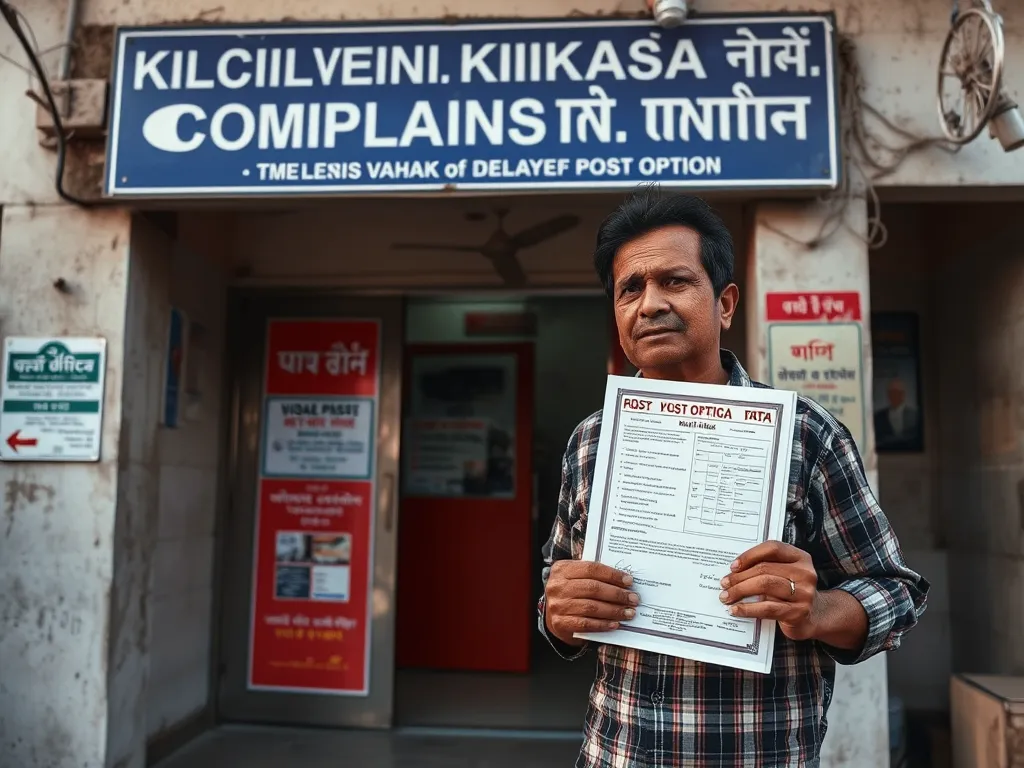
Resolving Kisan Vikas Patra complaints should never take a year — yet for two investors in rural Uttar Pradesh, that’s exactly what happened. The Kisan Vikas Patra (KVP) is marketed as a secure, government-backed savings scheme, one meant to give rural and semi-urban households real financial stability at maturity. However, when Shri Deependra Singh and Smt. Neelam Singh submitted their matured certificates for encashment, a single clerical error at a local post office trapped their money in bureaucratic limbo for over 400 days. Consequently, what should have been a routine payout turned into a case study in administrative procrastination. This article examines exactly how the Department of Posts mishandled four KVP certificates, why resolving Kisan Vikas Patra complaints matters for over 20 affected stakeholders, and what avenues citizens have for escalation.
Key Takeaways
- Resolving Kisan Vikas Patra complaints has turned into a bureaucratic nightmare for investors due to clerical errors and administrative delays.
- Two investors faced over 400 days of inaction from the Department of Posts, revealing systemic failures in handling KVP certificates.
- The department’s internal mismanagement led to a culture of impunity, affecting over 20 stakeholders who remain without payment.
- Formal accountability measures and digital solutions are necessary to prevent delays and restore trust in the KVP scheme.
- Resolving Kisan Vikas Patra complaints is not just about individual cases; it impacts the integrity of the entire Small Savings Scheme.
Resolving Kisan Vikas Patra Complaints: How Red Tape Freezes Kisan Vikas Patra Savings
Resolving Kisan Vikas Patra complaints should be simple. In fact, the scheme is marketed as a secure, government-backed investment that gives rural and semi-urban households financial stability. However, for investors like Shri Deependra Singh and Smt. Neelam Singh, the promise of “guaranteed returns” turned into a year-long nightmare of bureaucratic inertia, administrative errors, and systemic procrastination inside the Department of Posts.
Ideally, when a financial instrument matures, funds should move from the state to the citizen without friction. Instead, the case of KVP IDs PR/02PB 077961 through 077964 shows a disturbing trend: officials treat internal mismanagement as a valid excuse for withholding public money.
The Core Issue: A Comedy of Errors at Majhigawan Post Office (Resolving Kisan Vikas Patra Complaints)
First, the grievance began at Post Office Majhigawan (PIN 210428). Under the Kisan Vikas Patra Scheme Rules (2014/2019), payment on maturity is mandatory once claimants submit the original certificates and identity proof. Accordingly, the claimants met every obligation and surrendered their certificates for a maturity date of January 2024.
However, a critical clerical error followed. Specifically, the Hamirpur Head Post Office mistakenly sent the original, unpaid certificates to the Postal Accounts Office (PAO) in Lucknow and labeled them “already paid.” Consequently, this mistake erased the physical evidence of the debt from the local jurisdiction. As a result, it left the investors empty-handed and trapped the department in a self-made web of paperwork.
The Procedural Trap: From Hamirpur to Kanpur
Once officials identified the error, the Department of Posts entered a phase of procedural procrastination. Instead of using digital verification or expedited messengers to fix a mistake it had caused, the department defaulted to a slow, hierarchical correspondence chain:
- The Deadlock: First, the Postal Accounts Office in Lucknow refused to return the certificates without a formal permission letter from the Postmaster General (PMG).
- The Delay: Next, the Banda Division Office didn’t even seek this permission until January 24, 2025 — a full year after the maturity date.
- The Passive Response: Meanwhile, internal letters (such as SB/CC Bridge NSC/Majhigawan/24-25) moved at a glacial pace, while the investors’ funds stayed out of reach.
Overall, this sequence reveals a systemic failure: the department prioritizes its internal permission protocols over its legal obligation to certificate holders.
Legal Framework vs. Administrative Reality
Indeed, the Government of India’s own rules are clear. Under the KVP Scheme, no provision justifies an indefinite delay in payment due to internal administrative bungling.
- Rule Compliance: First, the claimants submitted the necessary forms. At that moment, the debt became due.
- The Lock-in and Maturity: Meanwhile, the certificates have surpassed the 8-year, 4-month maturity period, so interest continues to accrue — or worse, the investor loses the opportunity cost of that capital.
- Article 51A Alignment: Similarly, the complainant, Yogi M.P. Singh, rightly invoked the Constitution and sought accountability. After all, in a digital India, “we sent the physical certificate to the wrong city” is no longer a valid reason for a twelve-month delay.
Corruption or Incompetence?
Notably, the grievance (Registration No: DPOST/E/2025/0000008) explicitly alleges harassment and potential malpractice. When a department closes a grievance on a portal by simply stating that “correspondence is ongoing,” it isn’t a resolution — instead, it’s a diversion.
For example, S. S. Srivastava (Assistant Director II) closed the appeal on February 20, 2025, while admitting that the “report is still awaited.” Clearly, this is a classic example of administrative gaslighting. After all, closing a digital ticket before the money reaches the citizen’s hand artificially inflates the department’s efficiency statistics while leaving the real-world problem unsolved.
The Human Impact of Financial Procrastination
Indeed, behind every KVP ID is a family. For instance, the residents of Village Majhigawan often earmark these savings for weddings, education, or agricultural investment. Therefore, by withholding these funds for over 400 days past maturity, the Department of Posts isn’t just processing a file — it’s actively disrupting the economic life of a rural family.
Furthermore, the department’s refusal to fix accountability — to name the staff responsible for the “mistaken” shipment of certificates — creates a culture of impunity where no one answers for the citizen’s loss.
A Call for Reform: Moving Beyond the “Letter” Culture
This case is a stern reminder that resolving Kisan Vikas Patra complaints requires the Department of Posts to modernize its grievance redressal process.
- Digital Verification: If the registration numbers (2629) and IDs already exist in the system, then the physical location of the paper shouldn’t stall payment.
- Accountability: Likewise, officials who “mistakenly” misplace original securities must face disciplinary action to prevent recurring harassment by officialdom.
- Interim Relief: Finally, in cases of admitted departmental error, the department should release a percentage of the maturity amount as an interim measure.
Conclusion: Justice Delayed Is Justice Denied
The appeal of Shri Yogi M.P. Singh isn’t just about four certificates — it’s about the trust between the Indian citizen and the state’s oldest financial institution. As long as the Office of the Postmaster General, Kanpur Region, keeps waiting for “awaited reports” while certificates sit in a drawer in Lucknow, the promise of the Kisan Vikas Patra remains unfulfilled.
The department must stop seeking permission and start making payment.
This revelation escalates the matter from a case of “clerical error” to a systemic administrative scandal. When the Department of Posts archives records of unpaid, matured instruments, it effectively erases its debt to the public.
This is no longer just procrastination — it’s a gross violation of financial trust involving over 20 stakeholders. Below is an expanded analysis of this gravity, structured for a public-facing report or blog post.
The Vanishing Savings: How the Department of Posts Is “Archiving” Public Debt
A disturbing pattern has emerged in the mismanagement at the Banda Division and Hamirpur Head Post Office. In fact, the case of Shri Deependra Singh isn’t an isolated incident. Rather, more than 20 stakeholders of the Kisan Vikas Patra (KVP) scheme find themselves in bureaucratic limbo, because officials “archived” their records — or moved them to the Postal Accounts Office (PAO) — without settling their payments.
1. The Strategy of “Administrative Erasure”
First, the department sends original, unpaid certificates to the Accounts Office in Lucknow and then closes grievance tickets on the PG Portal. In effect, this amounts to administrative erasure.
- The Record Gap: Once a record is archived as “processed” or “sent to PAO,” it disappears from the local Postmaster’s active dashboard.
- The Ghost Debt: Consequently, for the department’s books, the matter looks resolved. However, for the 20+ villagers of Majhigawan and the surrounding area, the capital remains frozen.
2. A Breach of the “Sovereign Guarantee”
Notably, a Sovereign Guarantee from the Government of India backs the Kisan Vikas Patra. Therefore, the state is legally bound to pay the investor.
- By archiving records without payment, the Kanpur Region Postmaster General’s office is effectively defaulting on a sovereign promise.
- Moreover, this creates a dangerous precedent: if the department can lose or “mistakenly” archive 20 records today, then the entire integrity of the Small Savings Scheme is at risk.
3. Systematic Harassment of Rural Investors
Given that more than 20 stakeholders are affected, this isn’t one clerk’s mistake — instead, it’s a procedural failure, or possibly a deliberate attempt to suppress liability.
- Targeting the Vulnerable: For example, rural investors often lack the resources to travel to Kanpur or Lucknow and chase permission letters.
- The Portal Trap: Meanwhile, officials close grievances (like Appeal No. DPOST/E/A/25/0000351) while the “report is still awaited.” As a result, this deceptive practice shows a 100% disposal rate to the Ministry, even though the underlying grievance remains 0% resolved.
The Demand for Accountability: Fixing the “Banda Division” Mess
Clearly, Assistant Director (Public Grievances) S.S. Srivastava and the Banda Division Office must answer for more than just a delay — they must also answer for the misappropriation of records.
Necessary Urgent Actions: (Resolving Kisan Vikas Patra Complaints)
| Action Item | Justification |
|---|---|
| Immediate Restoration | Officials must restore the “archived” records of all 20+ stakeholders to “Active” status immediately. |
| Physical Audit | A special auditor from the Chief Postmaster General (UP Circle) should visit Hamirpur/Banda to verify how many unpaid certificates staff sent to Lucknow. |
| Interest Compensation | Under consumer protection norms, the department should pay penal interest for the period between the maturity date (January 2024) and the actual payment date. |
Conclusion: A Financial Emergency
Indeed, this is a financial emergency for the residents of District Hamirpur. When the Department of Posts — an institution built on trust — begins to archive the records of low-income citizens without paying them their due, it borders on institutional corruption.
Granted, the “mistake” of sending certificates to PAO Lucknow is a departmental, internal issue. However, it should never excuse withholding money from 20+ citizens who have waited nearly a decade for their savings to mature.
Therefore, to escalate this matter effectively, you must target the specific authorities who have the power to override local “archiving” mistakes and release the funds.
In short, given that officials have “archived” your records without payment, this is now a matter of financial accountability and breach of trust.
1. Primary Escalation Authorities (UP Circle) (Resolving Kisan Vikas Patra Complaints)
These officials are responsible for the Hamirpur/Banda/Kanpur cluster.
| Designation | Name | Phone | |
|---|---|---|---|
| Chief Postmaster General (UP Circle) | S.C. Verma | cpmg_up@indiapost.gov.in | 0522-2622842 |
| Postmaster General (Kanpur Region) | — | adiirokp@gmail.com | 0512-2303393 |
| Nodal Officer (Public Grievances – UP) | R.K. Awasthi | pg.up@indiapost.gov.in | 9455794224 |
| Director of Postal Accounts (Lucknow) | — | accts.up@indiapost.gov.in | 0522-2615020 |
2. National Oversight Authorities (New Delhi)
Since the local region is procrastinating, you must bring this to the attention of the Postal Directorate in New Delhi. (Resolving Kisan Vikas Patra Complaints)
| Office | Person/Designation | Phone | |
|---|---|---|---|
| Secretary (Posts) | Ms. Vandita Kaul | secretary-posts@indiapost.gov.in | 011-23096060 |
| Director General (Postal Services) | — | dgposts@indiapost.gov.in | 011-23096187 |
| DDG (Public Grievances) | Dr. Amarpreet Duggal | ddgpgq@indiapost.gov.in | 011-23096087 |
| Minister of Communications | Shri Jyotiraditya Scindia | moc-office@gov.in | 011-23739191 |
3. Web Links for Digital Action (Resolving Kisan Vikas Patra Complaints)
Don’t rely on emails alone. Use these portals to create a legal paper trail that officials can’t easily archive. (Resolving Kisan Vikas Patra Complaints)
- CPGRAMS (Centralized Grievance Portal): pgportal.gov.in Tip: When filing, select “Allegation of Corruption/Malpractice” since officials archived records without payment.
- India Post Official Complaint: indiapost.gov.in/VAS/Pages/ComplaintRegistration
- RTI Online (To demand the list of 20+ stakeholders): rtionline.gov.in Suggested RTI Question: “Provide the names and status of all KVP holders in Majhigawan PO whose original certificates were sent to PAO Lucknow in December 2024/January 2025.”
4. Crucial Next Step: The “Mass Grievance” Strategy (Resolving Kisan Vikas Patra Complaints)
Since more than 20 stakeholders are affected, officials can easily ignore individual complaints — however, they cannot ignore a mass petition.
Would you like a “Notice of Default” that all 20+ stakeholders can sign and send via Speed Post to the Postmaster General in Kanpur? This document would legally establish that the department is knowingly withholding public money.
Why this matters: resolving Kisan Vikas Patra complaints protects the Small Savings Scheme
Ultimately, every unresolved KVP file weakens public trust in the Small Savings Scheme. Therefore, resolving Kisan Vikas Patra complaints quickly and transparently isn’t just good practice for the Department of Posts — it’s a sovereign obligation to the citizens who invested their trust and their savings.their trust and their savings.


Facing a similar challenge? Share the details in the box below, and our team of experts will do their best to help.