
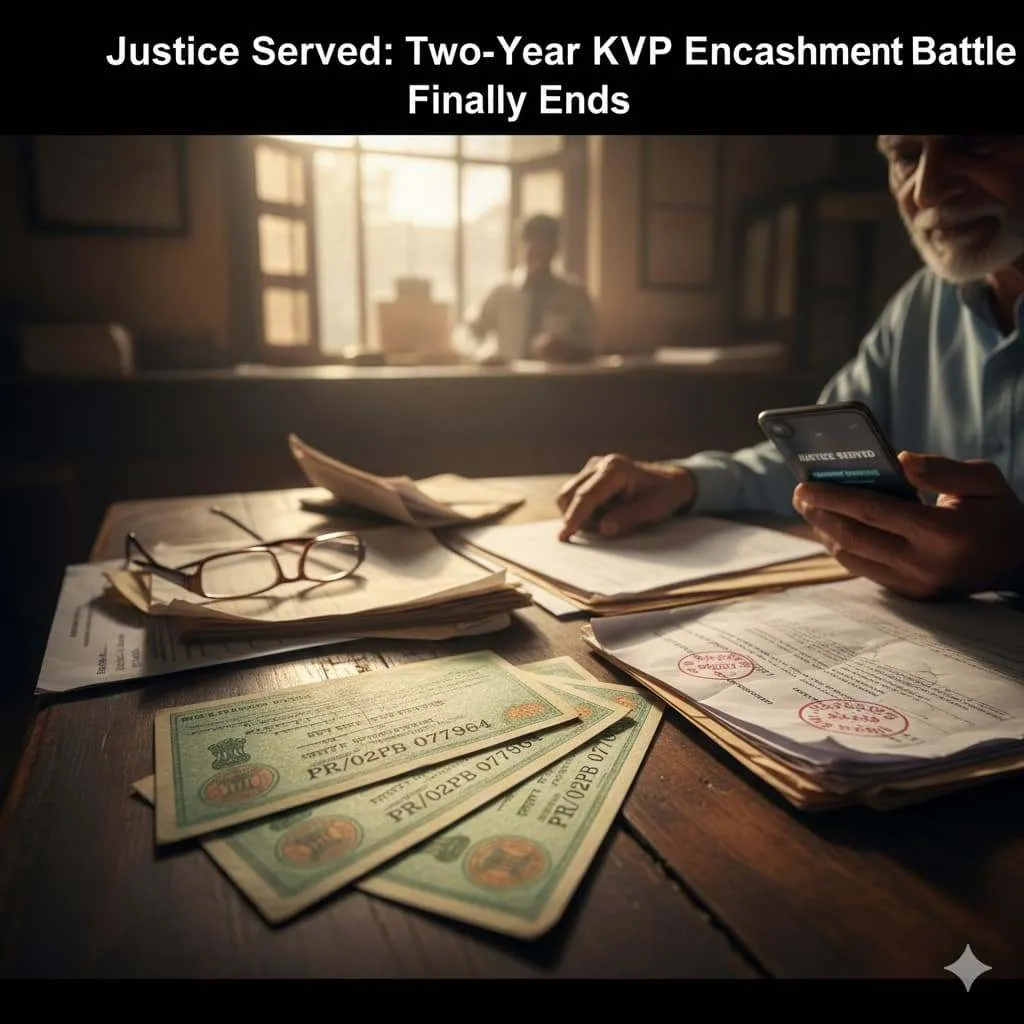
Justice Served: Two-Year KVP Encashment Battle Finally Ends
This case study demonstrates remarkable persistence and resilience in the face of bureaucratic challenges. A citizen endured a gruelling two-year ordeal involving multiple grievances, appeals, and countless hours spent advocating for their rights.
They filed a comprehensive complaint against the Department of Post regarding the frustratingly delayed encashment of Kisan Vikas Patra (KVP) certificates, which are intended to serve as a reliable investment tool for farmers and rural investors.
This prolonged battle over the KVP encashment not only tested the citizen’s patience but also exemplified the systemic issues within the administrative framework.
Finally, after persistent efforts and a steadfast refusal to back down, the case reached a resolution that, while ultimately satisfactory, came far later than it should have.
The final appeal documents provide a detailed account, presenting a clear timeline of administrative failures, persistent citizen protests, and an eventual, albeit late, resolution that emphasises the importance of accountability in public services.
The KVP encashment battle highlights the complexities involved in navigating bureaucratic systems, underscoring the critical need for reforms that ensure timely and efficient service delivery to the public.
The Problem and KVP Encashment Battle: A Bureaucratic Black Hole
An administrative error dating back over two years caused the issue that has significantly affected the ownership and encashment of certain financial instruments.
Shri Deependra Singh, a diligent and patient holder, owns the four KVP certificates with the following IDs: PR/02PB 077964, PR/02PB 077963, PR/02PB 077962, and PR/02PB 077961.
Despite his persistent efforts to resolve this matter, the drawn-out KVP battle has left him in a frustrating limbo, as the authorities have, inexplicably, not encashed these valuable certificates.
This situation not only delays his access to the funds but also raises serious questions about the efficiency of the administrative processes in place, leaving many to wonder how such errors could persist unaddressed for such an extended period.
The local office confirmed that the Head Post Office Hamirpur mistakenly dispatched the certificates. They sent them along with paid certificates to the Postal Accounts Office (PAO), Lucknow. However, they never made the payment, leading to an extended KVP encashment battle.
- The Error: A higher-level accounts office mistakenly received the original KVP bonds.
- The Consequence: The local office couldn’t process the encashment because they didn’t have the original certificates.
The Citizen’s Fight: Appeals and Arbitrary Closures
Shri Yogi M. P. Singh, a relative of the KVP holder, actively fought against the bureaucratic delay in the encashment saga, demonstrating an unwavering commitment to justice and transparency in a system riddled with inefficiencies.
He faced repeated failures of the system to provide a substantive resolution during his grievance journey, which was characterised by promises made by officials that remained unfulfilled.
Despite the challenges, Shri Singh meticulously documented every interaction and response, highlighting the systemic flaws and advocating for change.
His relentless pursuit not only underscored the difficulties faced by ordinary citizens navigating bureaucratic hurdles but also served as a rallying point for others in similar situations, showcasing the need for systemic reform to ensure efficient processing of financial entitlements.
- Prolonged Delay: The team stalled the encashment for over two years, showcasing the challenges in the KVP encashment battle.
- Arbitrary Closures: The authorities closed multiple grievances and appeals with generic remarks. In one instance, they provided a non-functional PDF attachment, which the complainant rightly protested as a violation of public accountability, continuing to fuel the KVP encashment issues.
- Unacceptable Excuse: The official closing remarks for the previous grievance (DPOST/E/2025/0039776) amounted to an admission. The Senior Account Officer, O/o GM (F) PAO UP circle Aliganj Lucknow, did not return the bonds. This is an internal administrative failure. Citizens were being forced to endure the consequences of this failure.
In his final, strongly-worded appeal (DPOST/E/A/25/0004641), Shri Singh demanded immediate intervention. He wanted to compel the return of the bonds and set a definitive encashment date. Shri Singh also requested the contact information of an overseeing officer, underlining his persistence in this KVP encashment battle.
The Resolution: A Sudden, Clear Outcome
The final appeal created immense pressure, prompting a deeper review of the situation.
The escalation to the Office of the Chief Postmaster General, Uttar Pradesh Circle, was a pivotal moment that finally triggered a resolution to this enduring KVP encashment struggle that had persisted for far too long.
Frustrations had been mounting among numerous individuals affected by the delays and unclear procedures; thus, this official intervention was not just timely but entirely necessary.
The official reply confirms the following critical details: it outlines the steps taken to address the concerns raised, ensures that future instances will be handled with greater efficiency, and reinstates the commitment of the postal department to uphold customer satisfaction as a top priority.
- Bonds Returned: The Banda Division received the original KVP certificates from the Postal Accounts Office, Lucknow, via a letter dated 29/09/2025. They received them on 07/10/2025.
- Payment Made: We finally took prompt action and made the payment for the said savings certificates on 11/10/2025.
- Verification: The payment was verified through a ledger report from the Mazgaon Sub Post Office. The transaction details show four separate closure proceeds on 11/10/2025, totalling an initial deposit of ₹58,429.00 Cr after the first withdrawal.
This case serves as a powerful reminder. The government machinery can be slow and bureaucratic. Nonetheless, persistent and well-documented appeals can ultimately force a resolution, as demonstrated in this encashment battle. The citizen’s victory, though long-delayed, holds the public service accountable in their own KVP encashment battle.
Key Takeaway for Citizens
If your grievance is closed without the actual issue being resolved, you must promptly file an appeal to seek justice and ensure that your concerns are adequately addressed.
It is vital to articulate your disappointment clearly and substantiate your claims with any relevant documentation.
As demonstrated here, framing the closure as an admission of “internal administrative failure” can be effective because it sheds light on the procedural shortcomings that led to your unsatisfactory experience.
Furthermore, labelling the situation as a “violation of public service principles” can compel higher authorities to intervene, as it highlights the importance of accountability and transparency in public services.
Engaging in this manner can not only elevate your case but also serve as a catalyst for systemic changes within the organisation.
This can help to correct the lapse in what could become your own skirmish over KVP encashment, ensuring that you don’t suffer in silence while navigating bureaucratic obstacles.
Resilient advocacy for your rights may also inspire others facing similar challenges to take similar action.
Do you have any other documents you’d like me to analyse? Are you interested in how to escalate a similar complaint in a specific system related to KVP encashment?
Mismanagement in registry of letters and speed post in sub-post offices
Whether it is not mismanagement that services of registered post and speed post are paralysed


Facing a similar challenge? Share the details in the box below, and our team of experts will do their best to help.