
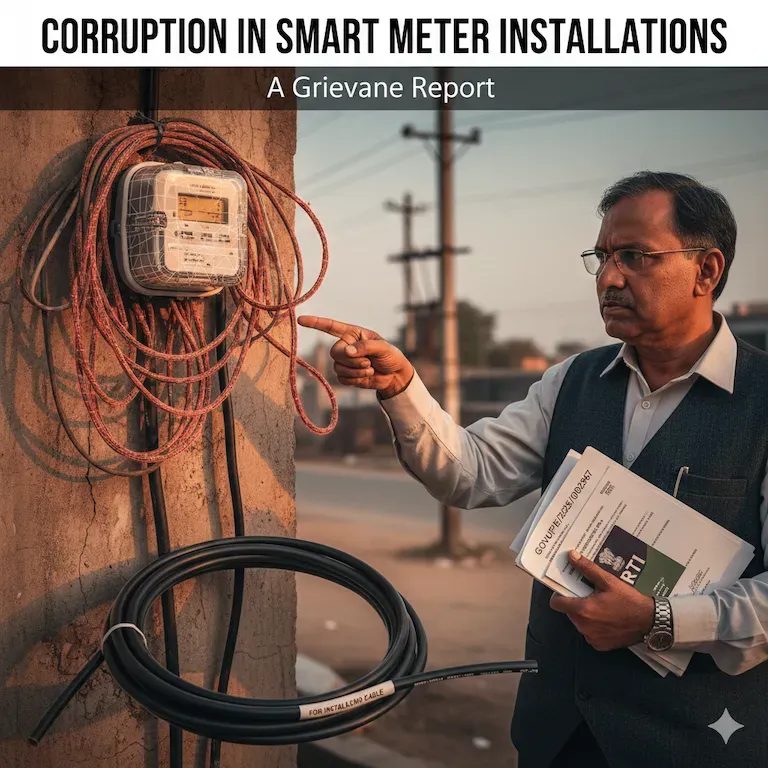
Corruption in smart meter installations can undermine public trust and lead to substantial financial losses. It often manifests through fraudulent bidding processes, inflated project costs, and kickbacks to officials, compromising the integrity of energy management systems. Such corrupt practices not only inflate consumer bills but also hinder the implementation of efficient energy solutions. Furthermore, they may lead to the deployment of substandard technology, posing safety risks and reducing operational effectiveness. To combat this, transparency, stringent regulations, and oversight mechanisms must be established to ensure that smart meter installations serve their intended purpose of promoting energy efficiency and reliability.
Key takeaways from the blog post
The blog post highlights a systemic failure in the Mirzapur smart meter rollout. Officials use misinformation to mask potential infrastructure corruption. Here are the key takeaways:
1. The “Armoured Cable” Mandate
Officials failed to replace old, weathered service wires with armoured cables. Under UPPCL guidelines, the Executive Engineer also admits a clear rule. Any premises within 40 meters of the LT line qualify for this upgrade. As a result, the upgrade should improve safety and reduce line losses.
2. Fabricated Consumer Resistance
The grievance trail shows a striking claim from the department. It says the consumer (Yogi M. P. Singh) refused the installation. However, the post calls this a false report. It also points to a basic contradiction. Why would a consumer spend months filing high-level grievances to demand a cable, and then refuse it when the contractor arrives?
3. Allegations of a “Cable Scam”
The post suggests a deeper financial discrepancy. Contractors may bill the government for armoured cables but leave the old wires in place. Then they may claim “consumer non-cooperation” to cover the gap. Therefore, the allegation points to the siphoning of public funds intended for infrastructure modernisation.
4. Technical and Safety Risks
By bypassing the cable upgrade, the department is leaving consumers with:
- Increased Faults: Old cables are prone to sparking and breakage.
- Revenue Leakage: Unarmoured cables are easier to tap for illegal connections, undermining the purpose of smart meters.
- Harassment: Consumers are forced into a cycle of litigation to receive a basic service.
5. Failure of the Redressal System (IGRS/CPGRAMS)
The blog criticises the “circular” nature of government grievance portals. Departments often close cases based on reports from the very officers being accused. As a result, outcomes can become biased. Moreover, a PMO-level grievance was closed even though the issue remained unresolved. This shows the lack of independent verification.
6. Demand for Independent Audit
The post ends with a call for an independent investigation by the Chief Minister’s Secretariat. The complainant wants officials to move beyond “paper reports.” Instead, they should run a physical audit of cable installations across the Mirzapur District. This audit could expose the scale of corruption.
Corruption in Smart Meter Installations: Missing Armoured Cables and Administrative Deceit in Mirzapur
In Mirzapur, allegations of Corruption in Smart Meter Installations focus on a basic safety upgrade. Installers should replace old service wires with armoured cables during the smart meter rollout. This post tracks a grievance trail. It also flags possible material shortfalls, questionable field reports, and weak independent verification.
The transition to a “Digital India” often involves adopting smart meters. The government presents them as tools for transparency, accuracy, and efficiency in the power sector. However, in Mirzapur district, Uttar Pradesh, the rollout is facing allegations of deep-rooted corruption and administrative apathy. At the centre of the dispute sits one simple item: the armoured cable.
Local advocate and activist Yogi M. P. Singh filed multiple grievances (Registration Nos. GOVUP/E/2025/0062967, GOVUP/E/2025/0053239, and PMOPG/E/2025/0058307). These records show a disturbing pattern. The department allegedly used misinformation. Meanwhile, the complainant alleges a “cable scam” that may affect thousands of consumers.
The Core Conflict: Transparency vs Technical Negligence
Guidelines for installing smart meters do more than replace a meter box. They also require safer wiring where needed. In cases that suggest Corruption in Smart Meter Installations, one red flag stands out. Installers keep the old “ordinary” service cable in place. They do not install the specified armoured cable. Therefore, consumers lose the protection that should also reduce technical losses.
An armoured cable has a metal reinforcement layer. This layer resists weather damage, accidental cuts, and illegal tapping. For consumers, this means a more stable connection. It also means fewer outages. For the government, it reduces line losses. However, reports from Mirzapur suggest a different reality. Installers mount smart meters on walls. Meanwhile, they leave the old, faulty cables in place.
The Executive Engineer’s “40-Meter Rule”
In official communications documented through RTI queries, the Executive Engineer of the Electricity Distribution Division II, Mr Manish Kumar Srivastava, admits to a clear requirement. Premises within 40 meters of the Low Tension (LT) line must receive an armoured cable installation.
Even so, several accounts remain connected through decaying wires. These include Mahesh Pratap Singh (A/C: 2704668219) and Keshav Pratap Singh (A/C: 8667726000). When people questioned officials, the defence shifted. First, it focused on technical feasibility. Then it moved to outright fabrication.
The Fabrication of “Consumer Refusal”
The department makes the most startling claim in this grievance. It says the consumers themselves refused to allow the installation of armoured cable.
The Executive Engineer’s report claims the complainant blocked the smart meter company staff. The situation reads like classic “gaslighting” from a public office. However, the claim triggers a simple question. Why would a consumer, who is actively filing multiple grievances at the State and Prime Minister’s level to demand an upgrade, refuse that very upgrade when the contractor arrives?
As Yogi M. P. Singh notes in his grievance:
“Why would I not allow the staff… to replace the ordinary cable with the armoured cable when I myself am submitting the grievances to replace it? It seems the staff misled the engineer to cover their own negligence.”
Therefore, the record suggests a coordinated pattern. Contractors may save money on materials. At the same time, they may report “completion” to the department. This would let them pocket funds meant for armoured cables.
A Systemic Scam: Beyond Individual Grievances
Contractors report cable installation, or they record “consumer refusal.” However, the old cables remain on-site. So a basic question follows: where did the government-funded armoured cable go? This question sits at the centre of the allegation of Corruption in Smart Meter Installations. The complainant wants the Chief Minister’s Secretariat and the PMO to investigate.
As a result, the refusal to upgrade wiring creates three major consequences:
- Safety Hazards: Old, unarmoured cables are prone to sparking and short circuits.
- Financial Loss: Public funds allocated for infrastructure upgrades are being siphoned off.
- Accountability Erosion: By submitting unsigned and arbitrary reports to the grievance portal (IGRS), officials are making a mockery of the digital oversight system.
The Failure of the Grievance Redressal Mechanism
The grievance history for these cases shows a frustrating cycle. It often follows “Action–Reaction–Rejection.”
- Case PMOPG/E/2025/0058307 was closed by the PMO on June 6, 2025, based on a report from the subordinate officer, the very officer accused of negligence.
- The status was marked as “Resolved” by the department, even though the complainant marked it as “Not Resolved” due to “Harassment by official.”
This pattern exposes a core flaw in IGRS and CPGRAMS. The system lets the “fox guard the henhouse.” For example, the portal forwards a grievance to the same officer named in the complaint. That officer then writes the closing report. As a result, the outcome can become predictably biased.
Seeking Justice: The Demand for an Independent Audit
The complainant, Yogi M. P. Singh, has now escalated the matter. He wrote to Shri Arvind Mohan (Joint Secretary) at the Chief Minister’s Secretariat in Lucknow. The demands are clear:
- Physical Verification: A team from outside the Mirzapur Electricity Division must physically inspect the accounts in question.
- Verification of Records: A comparison between the “Cable Issued” records and the “Cable Installed” reality on the ground.
- Disciplinary Action: Penalties for the officials who submitted false reports claiming consumer non-cooperation.
FAQ: Corruption in Smart Meter Installations
What are the common red flags of Corruption in Smart Meter Installations?
- Material not installed on-site: smart meters mounted, but old service wires remain instead of armoured cables.
- Paper completion vs ground reality: reports claim completion while physical inspection shows otherwise.
- Blame shifted to consumers: “consumer refusal” noted despite a documented grievance trail demanding the upgrade.
- No independent verification: grievances closed based only on internal departmental remarks.
Conclusion: The Road Ahead
The “Smart Meter Scam” in Mirzapur is not just about a few meters of wire. It tests whether the administration will accept accountability when it misleads citizens. It also tests whether Corruption in Smart Meter Installations can continue behind routine paperwork. Moreover, if an informed citizen and advocate must struggle for months to secure a mandated cable replacement, the average consumer faces an even harder path.
Now the public is watching the Chief Minister’s Secretariat. Will it let a “flimsy ground” and false reporting shield wrongdoing? Or will it uphold the “Right to Reason” in the spirit of good governance? To do that, it must order physical verification. It must also match records and enforce accountability in the smart meter rollout.
To assist you in following up on your grievances, here are the structured contact details for the primary authorities involved in your case. These details are verified as of early 2026.
1. State Level: Chief Minister’s Secretariat (Corruption in Smart Meter Installations)
This is the highest office currently handling your escalated state grievance (GOVUP/E/2025/0062967).
- Primary Officer: Shri Arvind Mohan (Joint Secretary)
- Office Address: Room No. 321, U.P. Secretariat, Lok Bhawan, Lucknow – 226001
- Email Addresses: * arvind.12574@gov.in (Personal/Official)
- jansunwai-up@gov.in (Grievance Portal Support)
- cmup@nic.in (General CM Office)
- Contact Number: 0522-2226350 (Office) / 1076 (CM Helpline)
- Official Website: upcmo.up.nic.in
2. District/Departmental Level: Purvanchal Vidyut Vitaran Nigam Ltd. (PuVVNL) (Corruption in Smart Meter Installations)
These are the authorities responsible for the actual field operations in Mirzapur and the ones who submitted the reports you are contesting.
| Authority | Name/Designation | Contact Details |
| Zone Head | Chief Engineer, Mirzapur Zone | Email: czepuvvnlmirzapur@gmail.com |
| Division Office | Executive Engineer, EDD-II Mirzapur | Address: Jangi Road, Mirzapur, UP – 231001 |
| Vigilance Team | Enforcement Squad (Mirjapur) | Phone: 8887156945 | Email: vigilancemzp@gmail.com |
| Corporate HQ | Managing Director, PuVVNL Varanasi | Email: md@puvvnl.in | Phone: 0542-2318437 |
3. Central Level: Prime Minister’s Office (PMO) (Corruption in Smart Meter Installations)
Since your PMO grievance (PMOPG/E/2025/0058307) was closed with an unsatisfactory remark, you may need these details to file a physical rejoinder or a formal appeal.
- Web Portal: pgportal.gov.in
- Mailing Address: Under Secretary (Public Grievances), PMO, South Block, New Delhi – 110011
- Fax: 011-23015603
4. Digital Grievance Links (Corruption in Smart Meter Installations)
To track your current status or file a fresh “Rebuttal” (Dastavez Rebuttal), use these official links:
- UP IGRS (Jansunwai): jansunwai.up.nic.in
- UPPCL Official Portal: uppcl.org
- PuVVNL Directory: puvvnl.in/en/page/officers-staff
Recommended Action (Corruption in Smart Meter Installations)
When emailing Shri Arvind Mohan, ensure you mention your grievance registration number in the subject line:
Subject: REBUTTAL of False Report in Grievance GOVUP/E/2025/0062967 – Yogi M. P. Singh
Would you like me to help you draft a precise email to the Joint Secretary using the details provided above?
Corruption in installation practices often shows up later as inexplicable billing anomalies. See Case of Consumer Rights Violation in Electricity Billing for Smt. Neelam Devi’s fight against a billing spike that didn’t match her actual consumption.


Facing a similar challenge? Share the details in the box below, and our team of experts will do their best to help.