
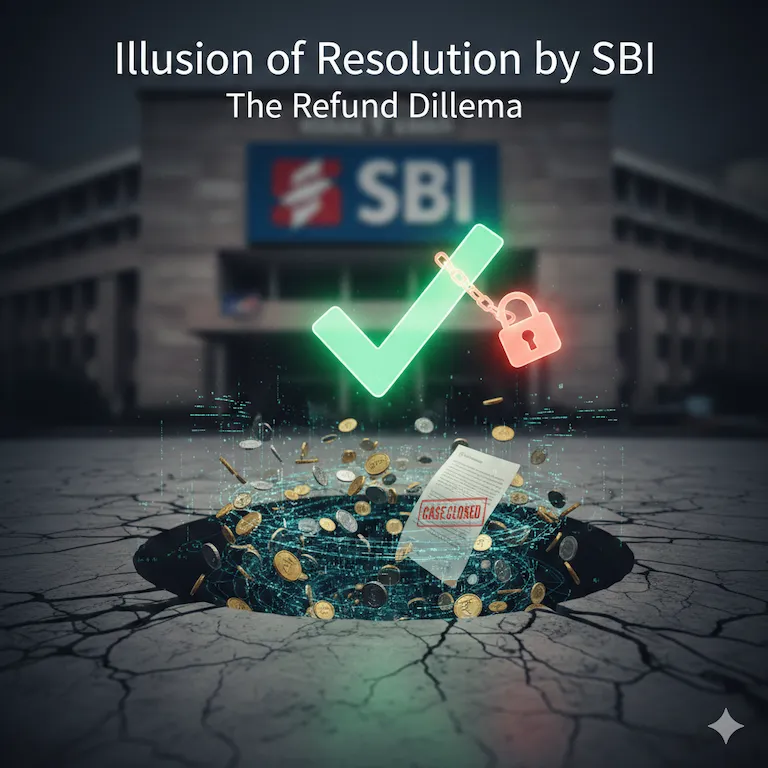
Here are the key takeaways from the blog post regarding your grievance and the bank’s handling of it. In particular, the Illusion of Resolution by SBI is a central theme to understand in this context.
1. The Strategy of “Statistical Resolution”
Banks often prioritize “closing” a file over “solving” the problem. The bank sends a promising email and immediately closes the grievance. This action improves its performance metrics on paper. However, it does not actually return your money.
2. Abuse of Official Remarks (Illusion of Resolution by SBI)
The phrase “suitably communicated” is a tactical shield. It confirms that a conversation happened. However, it bypasses the actual requirement of providing a reasoned resolution. A resolution could be technical proof that the bank traced the funds.
3. The Power of the ARN
The Acquirer Reference Number (ARN) is the ultimate tracking tool. The bank’s claim that they are still “investigating” despite having the ARN suggests technical inefficiency. It could also be an attempt to buy time for their internal settlement processes.
4. Administrative Apathy as Harassment
Harassment in modern banking isn’t just rude behavior; it is administrative apathy. Forcing a customer to repeatedly follow up on a documented refund is systemic harassment. Additionally, closing cases prematurely without resolution is also a form of harassment.
5. The Necessity of the Appeal (Illusion of Resolution by SBI)
Filing an appeal (like you did with DEABD/E/A/26/0002688) is the only way to break the loop. It removes the case from the local office’s control. Then it places it under the scrutiny of the General Manager in Mumbai. The General Manager must now hold the local office accountable for their “7-day promise.
6. Transparency Over Politeness
A polite email from a manager is not a resolution. In banking disputes, trust is only verified by a credit entry in your passbook. Until the ₹2,400.00 is visible, the bank has not fulfilled its duty.
Illusion of Resolution by SBI: How Banks Use Procedural Loops to Evade Accountability
In the digital age, technology should make financial transactions seamless. However, when international merchant refunds fail, customers often find themselves trapped in a bureaucratic labyrinth. A recent case involving a refund from AIOSEO to a State Bank of India (SBI) account illustrates a growing trend. Banks often close official grievances based on promises rather than tangible results. In fact, this is a classic Illusion of Resolution tactic employed by SBI and other financial institutions.
The Core Conflict: When Technology Meets Bureaucracy (Illusion of Resolution by SBI)
The story begins with a simple transaction. A merchant initiated a refund of ₹2,400.00 on January 27, 2026. The merchant provided an Acquirer Reference Number (ARN), which serves as the gold standard for tracking digital money. This number allows any bank to locate funds within the banking switch immediately.
Yet, weeks later, the funds remained missing. The customer filed a formal grievance through the Centralised Public Grievance Redress and Monitoring System (CPGRAMS). The bank’s response revealed a deeper systemic flaw. This flaw is often discussed in relation to the Illusion of Resolution by SBI in similar cases.
The 7 PM Strategy: A Lesson in Tactical Delay
The timing and nature of the bank’s communication offer a frustrating insight into administrative tactics. On February 17, the Chief Manager of Operations at a Regional Business Office (RBO) sent an email. He claimed the technical team was investigating the matter. He promised the credit would appear within 7 days.
Immediately after sending this email, the bank marked the grievance as Closed on the CPGRAMS portal on February 18. This action demonstrates their use of the Illusion of Resolution. Some customers experience this with SBI.
This move constitutes a Statistical Resolution. By closing the case, the bank improves its internal performance metrics. On paper, the bank resolved the complaint in five days. In reality, the customer still lacked his money. The bank essentially traded a real-world problem for a digital green checkmark. This behaviour mirrors what critics identify as the Illusion of Resolution by SBI.
The Flaw in Suitably Communicated Remarks
When a bank closes a case on CPGRAMS, it must provide remarks. In this instance, the bank used the phrase: Customer has been suitably communicated.
This phrase acts as a linguistic shield. It does not mean the bank solved the problem; it only means the bank spoke to the customer. For a consumer, this communication is meaningless if the bank balance does not change. A reasoned response should instead include:
- Confirmation that the bank traced the ARN.
- The specific date the funds reached the bank’s internal pool.
- A transaction ID for the final credit.
Without these facts, the closure remains premature. It serves the institution rather than the individual. This situation is a typical Illusion of Resolution example generated by SBI’s process.
The Power of the ARN: Why Banks Feign Ignorance
The Acquirer Reference Number (ARN) is a unique tag. The merchant’s bank assigns this tag to a transaction. It is used as the transaction moves to the customer’s bank.
The bank’s technical team can identify the exact location of the money in the suspense account. They do this when a customer provides an ARN. They can also find it in the inter-bank settlement pool. Often, delays occur because the bank’s automated systems fail to map the incoming refund to the specific customer account. Officials ask the customer to wait longer instead of performing the manual work to link these. This perpetuates the controversial Illusion of Resolution by SBI.
Fighting Back: The Strategic Appeal
In this case, the complainant did not sit idly by. He realised that the closure was a mechanical manoeuvre. Therefore, he filed an Appeal (DEABD/E/A/26/0002688) to the General Manager at the Corporate Centre in Mumbai.
This move is crucial for three reasons:
- Jurisdictional Shift: It moves the case from a local regional office to the national headquarters.
- Accountability: It highlights that the local officer closed the case based on a promise, not a fact. This reinforces the Illusion of Resolution. This illusion is so often attributed to SBI.
- Escalation: It puts the 7-day promise on the official record of the General Manager. If the money does not arrive by February 24, the bank cannot claim ignorance of the deadline.
The Harassment of Official Apathy
The customer rightly categorised the dissatisfaction as Harassment by official. Many associate harassment with physical or verbal acts. In the digital banking world, it takes the form of administrative apathy. When officials repeatedly ask for data they already possess, they harass the consumer. If they close a case before implementing the solution, the consumer is also harassed. This behaviour forces the individual to spend hours monitoring portals and writing emails just to recover their own money. As seen in many incidents, the Illusion of Resolution is perpetuated by SBI through such administrative tactics.
Conclusion: Toward a More Transparent Future (Illusion of Resolution by SBI)
The banking sector must move away from disposal-oriented grievance handling. A bank should keep a complaint open until the customer’s statement reflects the correction. Overall, learning from the Illusion of Resolution strategies by SBI is necessary to build a more transparent sector.
For other consumers facing similar issues, the lessons from this SBI case are clear:
- Record Everything: Note every email timestamp.
- Identify the Maneuver: If a bank promises action next week but closes the ticket today, it is gaming the system. This echoes the Illusion of Resolution by SBI.
- Appeal Immediately: Do not wait for the 7 days to pass before challenging a premature closure. Use the appeal to hold the bank to its own timeline.
Banking rests on trust. However, as this case shows, a credit entry in a passbook must verify that trust. A polite email from a manager is not enough to overcome the illusion of resolution often encountered by SBI users.
To ensure you have everything organized for your follow-up after the February 24 deadline, here are the structured details. These include the public authorities and contact points involved in your case.
1. Primary Case Identifiers
- Grievance Registration Number: DEABD/E/2026/0021712
- Appeal Registration Number: DEABD/E/A/26/0002688
- Merchant Refund ARN: 82305096028500012763392
- Beneficiary Account: 34645721675
2. Concerned Public Authorities & Contact Details (Illusion of Resolution by SBI)
| Authority Level | Office / Department | Contact Person | Email Address |
| Appellate Authority | SBI Corporate Centre, Mumbai | General Manager (Customer Service) | gm.customer@sbi.co.in |
| Regional Authority | RBO-7, Robertsganj | Binod Prasad (Chief Manager Ops) | cmcomp7.zovar@sbi.co.in |
| Nodal Department | Banking Division (DFS) | CPGRAMS Nodal Officer | dir-fin@nic.in |
| Local Branch | SBI City Branch, Mirzapur | Branch Manager | sbi.00133@sbi.co.in |
- Corporate Office Phone: 022-22740970
- Regional Manager Phone: +91-9672148295
3. Digital Portals & Web Links
- CPGRAMS (Official Portal):https://pgportal.gov.in/
- Use this to track your Appeal status and view the “Reply Document” once uploaded.
- RBI Ombudsman (CMS Portal):https://cms.rbi.org.in/
- If the Appeal (DEABD/E/A/26/0002688) is not resolved within 30 days, you can escalate here.
- SBI Online Complaint Status: https://www.sbi.co.in/web/customer-care/status-request-complaint
4. Critical Timeline for Action (Illusion of Resolution by SBI)
- February 17, 2026: Bank promised credit within 7 days.
- February 19, 2026: Appeal filed by you.
- February 24, 2026: Deadline for the bank to honor the credit.
- February 25, 2026: If no credit, send a formal notice to the General Manager (gm.customer@sbi.co.in) using the Appeal number as a reference.
Do you want me to draft the specific “Notice of Non-Compliance”? I would send this to the General Manager if the funds do not arrive by the 25th.


Facing a similar challenge? Share the details in the box below, and our team of experts will do their best to help.