
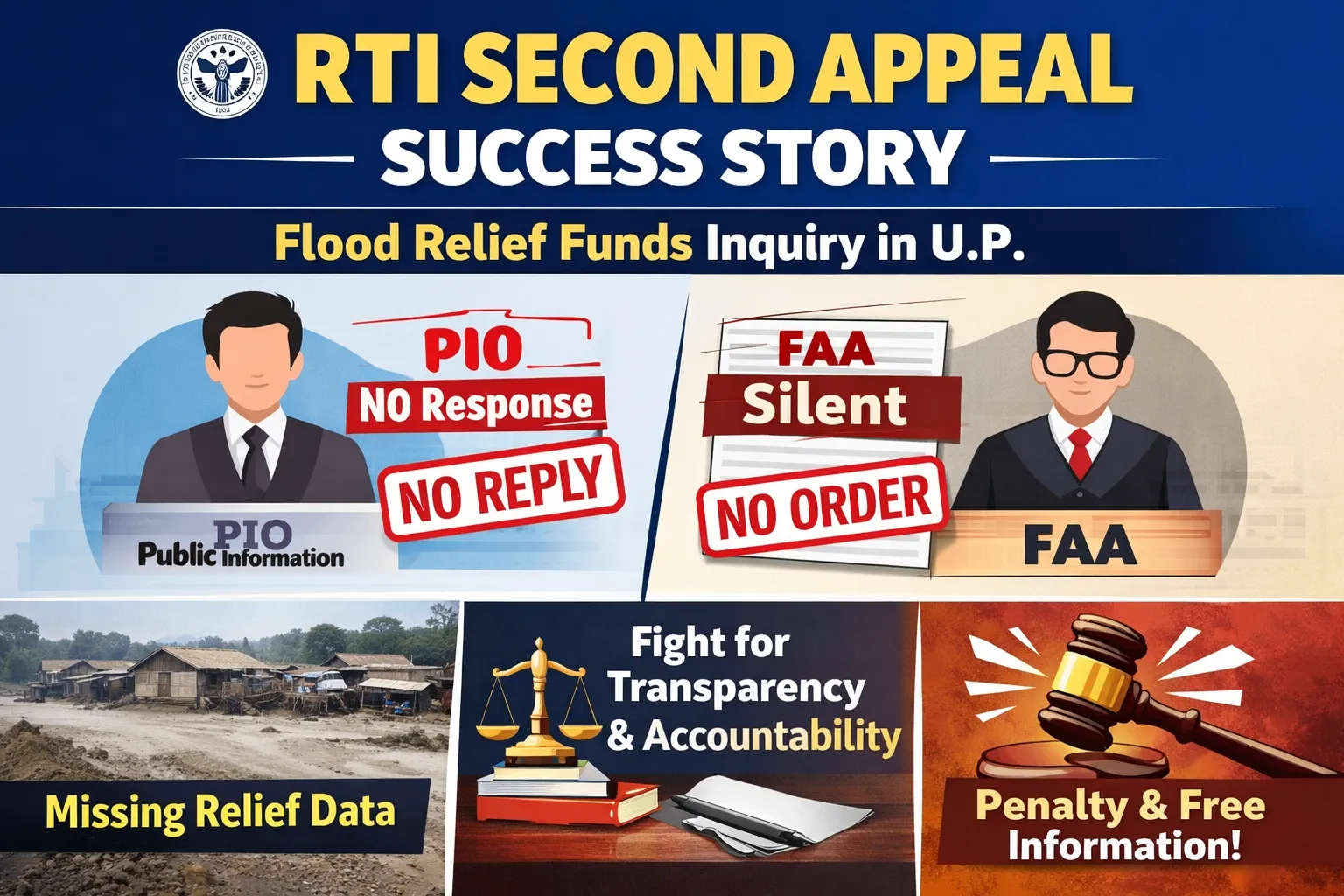
Success Story of RTI Appeal in U.P.: Exposing Silence in Flood Relief Transparency
The success story of the RTI appeal in Uttar Pradesh (U.P.) highlights the transformative power of transparency and accountability in governance. A citizen sought information on the allocation of funds for a local development project, which had been marred by delays and poor communication. Through a carefully crafted RTI application, the individual uncovered the misappropriation of funds and the officials’ negligence. As a result, their appeal not only brought the issue to light but also led to swift government action, ensuring the project’s completion and improved infrastructure for the community. This case underscores the importance of citizen engagement in holding authorities accountable.
Key Takeaways
- The success story of RTI appeal highlights how a citizen exposed misappropriation of flood relief funds in Uttar Pradesh.
- Through persistence, the applicant used legal channels, revealing negligence from officials and demanding accountability.
- This case demonstrates the importance of transparency and citizen action in governance, leading to improved infrastructure.
- The Information Commission’s role proves crucial in enforcing transparency and imposing penalties on negligent officials.
- Ultimately, the success story of RTI appeal emphasizes that transparency is a right that citizens can demand through legal means.
Introduction: A Real Success Story of RTI Appeal in U.P.
The Right to Information (RTI) Act, 2005 empowers citizens to demand transparency and hold authorities accountable. This success story of RTI appeal in U.P. clearly demonstrates how persistence and awareness can challenge administrative silence.
In Mirzapur, Uttar Pradesh, a citizen actively sought critical information about flood relief distribution. However, instead of receiving transparency, he faced complete inaction. Nevertheless, he continued the legal process and turned this case into a powerful example of accountability in action.
Background: What Triggered This RTI Appeal in U.P.
Initially, the applicant filed an RTI request to obtain detailed information about flood relief assistance in Village Panchayat Nibi Gaharwar. Specifically, he asked for:
- Number of applications received
- Total beneficiaries
- Names and details of beneficiaries
- Certified copies of records
- Government orders and circulars
- Names of officials involved
- Public disclosure links
Clearly, these questions directly addressed the use of public funds. Therefore, the request carried strong public interest from the beginning.
Core Issue 1: PIO Silence and Deemed Refusal
First and foremost, the Public Information Officer (PIO) failed to respond within the mandatory 30-day period. As a result, this silence automatically became a Deemed Refusal under the RTI Act.
Moreover, such inaction raises serious concerns. For instance:
- Did officials intentionally withhold information?
- Did irregularities occur in fund distribution?
- Did the system fail at the administrative level?
Thus, the absence of a response not only violated the law but also weakened public trust.
Core Issue 2: Failure of First Appeal Mechanism
Subsequently, the applicant filed a First Appeal to challenge the PIO’s silence. However, the First Appellate Authority (FAA) also failed to act.
Specifically:
- The FAA did not conduct any hearing
- The FAA did not issue any order
- The FAA did not provide any justification
Consequently, the entire grievance redressal mechanism collapsed at two levels. This failure highlights a deeper systemic issue rather than an isolated incident.
Core Issue 3: Transparency in Flood Relief Funds
Importantly, this success story of RTI appeal in U.P. involves disaster relief funds, which demand the highest level of transparency.
Flood relief distribution directly affects vulnerable communities. Therefore, authorities must ensure fairness and accountability. Through this RTI, the applicant aimed to verify:
- Whether all eligible beneficiaries received aid
- Whether officials distributed funds properly
- Whether any irregularities or favoritism occurred
Hence, the lack of transparency in such a sensitive matter becomes a serious concern.
Legal Violations Highlighted in This RTI Appeal
Clearly, this case involves multiple violations of the RTI Act. In particular:
- Section 7(1): The PIO failed to respond within 30 days
- Section 7(2): The silence amounted to deemed refusal
- Section 19(1): The FAA failed to decide the appeal
- Section 4(1)(b): Authorities failed to ensure proactive disclosure
Therefore, this success story of RTI appeal in U.P. highlights how legal provisions can expose administrative negligence.
Escalation: Filing the Second Appeal
After facing repeated inaction, the applicant escalated the matter by filing a Second Appeal before the State Information Commission.
At this stage, he strongly demanded:
- Complete and certified information
- Free information due to delay (Section 7(6))
- Penalty against the PIO (Section 20(1))
- Disciplinary action under Section 20(2)
Thus, the case moved from administrative neglect to formal legal scrutiny.
Why This RTI Appeal in U.P. Is a Success Story
Undoubtedly, this case qualifies as a success story of RTI appeal in U.P. for several reasons.
1. Strong Legal Position
Both the PIO and FAA failed to act, which significantly strengthened the applicant’s case.
2. Clear Public Interest
Since the issue involves flood relief funds, it directly impacts public welfare.
3. Proper Use of RTI Framework
The applicant followed every step:
- Filed RTI application
- Submitted First Appeal
- Filed Second Appeal
4. High Chances of Accountability
Consequently, such cases often lead to:
- Disclosure of information
- Penalty proceedings
Lessons from This Success Story of RTI Appeal in U.P.
Importantly, this success story of RTI appeal in U.P. offers valuable lessons for citizens:
1. Stay Persistent
Even when authorities remain silent, continue pursuing the matter.
2. Use Legal Provisions Effectively
Sections like 7(6) and 20 provide strong support.
3. Focus on Public Interest
Cases involving public funds carry greater weight and urgency.
4. Maintain Proper Records
Accurate documentation strengthens your argument significantly.
The Role of the Information Commission
Finally, the State Information Commission plays a decisive role in such cases. It can:
- Order disclosure of information
- Impose penalties on officials
- Recommend disciplinary action
- Strengthen transparency systems
Therefore, a strong decision in this case can create a wider impact beyond one village.
Conclusion: A True Success Story of RTI Appeal in U.P.
In conclusion, this case stands as a compelling success story of RTI appeal in U.P.. It clearly shows how citizens can challenge silence and demand accountability through legal means.
More importantly, it reinforces a powerful message:
Transparency is a right, not a favor.
Ultimately, when citizens act with awareness and persistence, they can transform even silence into accountability.
📄 RTI & Appeal Reference Details (Success Story of RTI Appeal)
RTI Application (Section 6(1))
- Application ID: DMOMR/R/2025/60361
- Transaction ID: DMOMRR20250000000516
- Date of Filing: 08/12/2025
First Appeal (Section 19(1))
- Appeal ID: DMOMR/A/2026/60003
- Date of Filing: 12/01/2026
Second Appeal (Section 19(3))
- Appeal No.: A-20260401822
- Date of Filing: 19/04/2026
👤 Public Information Officer (PIO) Details
- Name: Vishal Kumar Sharma
- Designation: Tehsildar Sadar, Mirzapur
- Mobile Number: 9454416823
- Email: teh-sadar.mi@up.gov.in
- Office: Revenue Department, Mirzapur Tehsil
👤 First Appellate Authority (FAA) Details
- Name: Asha Ram Verma
- Designation: SDM Sadar, Mirzapur
- Mobile Number: 9454416810
- Email: sdm-sadar.mi@up.gov.in (also shown as sadar.mi@up.gov.in in portal)
- Office: Office of District Magistrate, Mirzapur
🌐 Relevant Web Links (Success Story of RTI Appeal)
1. UP RTI Online Portal
👉 Used for:
- Filing RTI
- Tracking status
- Filing appeals
2. Uttar Pradesh Information Commission (Success Story of RTI Appeal)
Uttar Pradesh Information Commission
- Official Website: http://upic.gov.in
👉 Used for:
- Second appeal hearings
- Case status (offline/official records)
3. Public Authority (District Administration) (Success Story of RTI Appeal)
- District Magistrate Office, Mirzapur (Revenue Department)
- Typically accessible via: https://mirzapur.nic.in
👉 Should ideally publish:
- Flood relief data
- Beneficiary lists
- Orders under Section 4(1)(b)


Facing a similar challenge? Share the details in the box below, and our team of experts will do their best to help.