
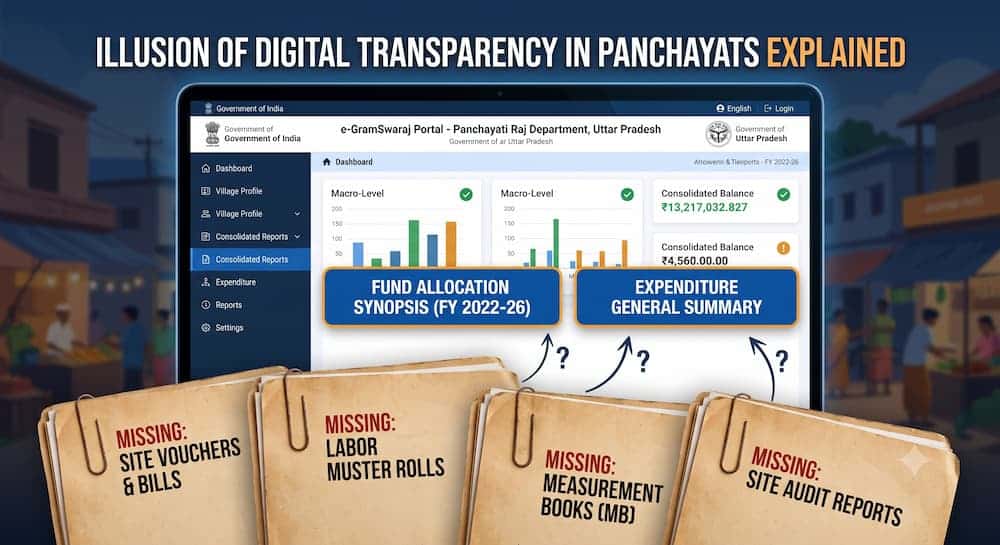
Illusion of Digital Transparency in Panchayats is quite obvious from the fact that no information is available under RTI. Even after the second appeal, the concerned authorities did not entertain the RTI application, highlighting a significant gap between the promised digital accessibility and the reality of information flow. This lack of response raises serious questions about accountability and governance at the local level, suggesting that the claimed transparency is merely a facade. Citizens are left in the dark, unable to access critical information that impacts their lives and communities. Moreover, this situation not only undermines public trust in the system but also stifles civic engagement. To truly embrace the concept of digital transparency, it is essential for Panchayats to prioritize responsiveness and fulfill their obligations under the Right to Information Act.
Key Takeaways
- There is a significant gap between promised digital accessibility and actual information flow in Panchayats, creating an illusion of digital transparency.
- Local officials exploit digital transparency portals to evade accountability and suppress public complaints.
- Funding discrepancies reveal unspent allocations, exacerbating the lack of transparency and genuine oversight.
- Field staff redirect citizens to general websites instead of providing specific records, defying legal requirements under the Right to Information Act.
- To combat this illusion of digital transparency in Panchayats, a strong demand for physical audits and strict penalties for non-compliance is necessary.
The Illusion of Digital Transparency in Panchayats: How Field Officials Exploit Portals to Conceal Rural Corruption
Public accountability in rural governance faces a key structural challenge. Specifically, local administrative staff misuse digital transparency portals to avoid direct oversight. Large national and state databases suggest open governance. However, field-level officials often use these platforms to cover up small differences. For example, a clear case of this systemic trickery has occurred in Gram Panchayat Nibi Gaharwar, located within the Chhanbey Development Block of Mirzapur district, Uttar Pradesh.
As a result, this case shows a growing administrative method that relies on creating an illusion of digital openness in Panchayats. First, local authorities send human rights defenders and citizens to general public web summaries to forcefully close ongoing public complaints. Furthermore, they intentionally keep back the detailed office receipts, technical books, and labor attendance records that could reveal financial problems. A similar pattern surfaced in the same Chhanbey block, where a public disclosure board in Bihasada Khurd listed works as completed that were never actually paid for.
The Core Dispute: Discrepancy Between Allocation and Expenditure
The foundation of accountability rests on a simple formula. In short, we must match the funds allocated for public welfare against the actual money spent on verified assets on the ground. However, macro data reveals massive unspent balances when viewed in isolation. Therefore, these balances completely lack technical explanation or physical backing.
According to official financial records, the consolidated funding roadmap for Gram Panchayat Nibi Gaharwar over the last four financial years highlights a massive gulf between allocation and field execution:
- Financial Year 2022–2023: To start with, the department gave a large amount of ₹61,19,060. However, the official record shows an actual spending of only ₹28,66,961, which leaves more than half the budget unused.
- Financial Year 2023–2024: Next, out of ₹47,98,221 in available development funds, the panchayat spent a small amount of ₹7,45,118.
- Financial Year 2024–2025: Subsequently, allocation dropped to ₹23,75,553. Meanwhile, recorded expenditures slid further down to ₹4,79,851.
- Financial Year 2025–2026: Finally, out of an allocated pool of ₹31,11,075, field offices documented an expenditure of just ₹2,91,681.
As a result, out of a total combined amount of ₹1,64,03,909, the actual recorded spending stands at ₹43,83,611. This means that over ₹1.20 crore remains stuck or unspent on paper. Additionally, the ₹43.83 lakhs claimed as used completely lacks clear, itemized public explanation.
The Evading Tactic: Portal Redirection as a Shield
Recently, a citizen lodged a formal public grievance under registration number GOVUP/E/2026/0074361 demanding a technical and physical verification of these expenditures. In response, the handling authorities engaged in classic bureaucratic stonewalling. Instead of producing the requested primary documents, the Gram Panchayat Secretary issued a brief, hand-written disposal note. Specifically, this note told the applicant to visit the national portal e-gramswaraj.gov.in to view expenditure details.
“In this regard, you are informed that the details of the expenditure incurred from the Gram Panchayat fund are available on the government website e-gramswaraj.gov.in… Therefore, you are requested to view the desired information through the said website.” — Subordinate Disposal Report, Nibi Gaharwar.
Clearly, this response clearly shows the false impression of digital openness in Panchayats. The e-GramSwaraj portal only hosts general budget plans and big-picture summaries. Importantly, it does not contain original source documents:
- For example, it lacks individual cash memos and voucher breakdowns for raw materials.
- In addition, it does not display localized Measurement Books (MB) logged by junior technical engineers.
- Likewise, it omits daily wage muster rolls, which makes it impossible for the public to verify if the paid labour was real or fictional.
Thus, by shifting the burden of research back onto the citizen, field staff use the mere existence of a government website as a shield to claim compliance. As a result, they convince upper-tier monitoring cells at the Chief Minister’s Secretariat to close active complaints prematurely.
Institutional Collusion and Defiance of Supervisory Orders
This systemic lack of accountability is rarely the work of a single isolated clerk. Instead, it points to institutional collusion that spans block-level offices up to the District Panchayat Raj Officer (DPRO).
Moreover, the refusal to yield public records directly defies explicit orders from higher supervisory structures. For instance, as early as 29 May 2024, the Divisional Deputy Director (Panchayat) of the Vindhyachal Mandal issued Letter No. 98. Following this, the DPRO Mirzapur sent a strict enforcement letter on 06 June 2024. Both mandates invoked Section 6(3) of the Right to Information Act. Consequently, they commanded the local block machinery and the Gram Panchayat Secretary to immediately release the project estimates and books to the applicant.
Despite these clear, multi-tiered administrative commands, the field staff successfully suppressed the core files for years. When the applicant pushed the issue through the Integrated Grievance Redressal System (IGRS), block staff bypassed the supervisory orders. Instead, they attached the evasive portal redirection letter, which senior desk officers in Lucknow accepted at face value to close the file. Consequently, this loop reveals a breakdown in administrative oversight. Indeed, field staff can comfortably ignore district mandates without fear of punitive action or salary deductions, further cementing the illusion of digital transparency in Panchayats.
Violations of Mandatory Transparency Guidelines
The concealment of financial records directly violates explicit statutory frameworks governing rural development fund deployment:
1. The Right to Information Act, 2005
Section 6(1) empowers citizens to demand specific public records. Furthermore, Section 8(1)(j) strictly mandates that information which cannot be denied to the Parliament or a State Legislature shall not be denied to an ordinary citizen. Therefore, pointing a citizen to a general website instead of delivering specific, certified office records constitutes a functional denial of information.
2. Mandatory Public Information Wall Paintings
Government guidelines explicitly dictate that every Gram Panchayat must display itemised asset expenses, construction costs, and labour allocations. Most importantly, they must display this data via visible public wall paintings within the village geography. This practice ensures that non-literate or rural community members can easily verify financial claims. However, in Nibi Gaharwar, the complete absence of these mandatory paintings keeps the local community entirely in the dark regarding the ₹43.83 lakhs spent in their name.
The Path Forward: Demanding Physical Audits and Legal Penalties
To break this cycle of bureaucratic evasion, the anti-corruption movement must shift its focus away from online portals. Instead, we must demand rigorous, on-ground verification to shatter the illusion of digital transparency in Panchayats.
Administrative Reality Check: Directing an online complainant to a macro-level public website does not validate whether a community asset actually exists on the ground or merely on paper.
To challenge this systemic failure, the applicant successfully lodged a new Right to Information request under registration number DIRPR/R/2026/63120. In fact, this request directly targets the Panchayati Raj Directorate and the DPRO Mirzapur as the legally accountable Public Information Officer.
Moving forward, the next steps require clear administrative escalation:
- Reopening Closed Grievances: First, citizens must formally lodge negative feedback on portal disposals. They should select options like “Harassment by Official” or “Not Resolved” to force higher review out of the hands of local block staff.
- Independent Technical Audits: Second, higher district authorities, including the Chief Development Officer (CDO) and District Magistrate, must bypass local panchayat offices. Then, they must deploy independent technical verification teams to physically measure active project sites.
- Imposing Section 20 Penalties: Finally, the State Information Commission must begin heavily penalising PIOs who use digital portal redirection as an excuse to delay or deny physical document access. Enforcing the statutory ₹250 per day personal penalty will effectively curb institutional stubbornness.
In conclusion, a web link alone cannot achieve true transparency. Instead, we must ensure that we can physically track every single rupee drawn from the state treasury to a real brick, a laid pipeline, or a fairly paid day of rural labour.
Based on the submitted documents and official correspondence, here are the application IDs, emails, mobile numbers, and web link details of the concerned public authorities for your case:
1. Application and Grievance IDs (Illusion of Digital Transparency in Panchayats)
- IGRS Grievance Registration Number:
GOVUP/E/2026/0074361 - Online RTI Registration Number:
DIRPR/R/2026/63120 - Previous RTI Registration Number:
DIRPR/R/2024/80151 - Internal IGRS Processing ID:
60000260152131 - Speed Post Tracking Number:
EU48629738SIN
2. Departmental Email Addresses (Illusion of Digital Transparency in Panchayats)
- Panchayati Raj Directorate (Nodal Officer):
up.panchayatiraj@gmail.com - District Panchayat Raj Officer (DPRO), Mirzapur:
dpromi-up@nic.in - Joint Secretary, Chief Minister Secretariat:
arvind.12574@gov.in
3. Official Contact & Mobile Numbers (Illusion of Digital Transparency in Panchayats)
- DPRO Mirzapur Office / Public Information Officer:
9506150545(Also referenced in internal loops as9506693700) - Panchayati Raj Directorate Nodal Officer:
9795140577 - Joint Secretary Office (Shri Arvind Mohan):
05222226350 - Gram Panchayat Officer (Secretary), Nibi Gaharwar: Phone details were systematically omitted on official dispatches, but local verification witnesses were logged as Jwala Singh (
7985183190/7985183740) and Ashish Kumar (7860650550).
The web link for the concerned public authorities to submit and track your application is the official Uttar Pradesh RTI Online Portal.
You can use this portal to select the specific department, submit your finalized text, and process the application fee directly.
Related Reading: DPRO Bhadohi & RTI Information: Know Your Rights


Facing a similar challenge? Share the details in the box below, and our team of experts will do their best to help.