
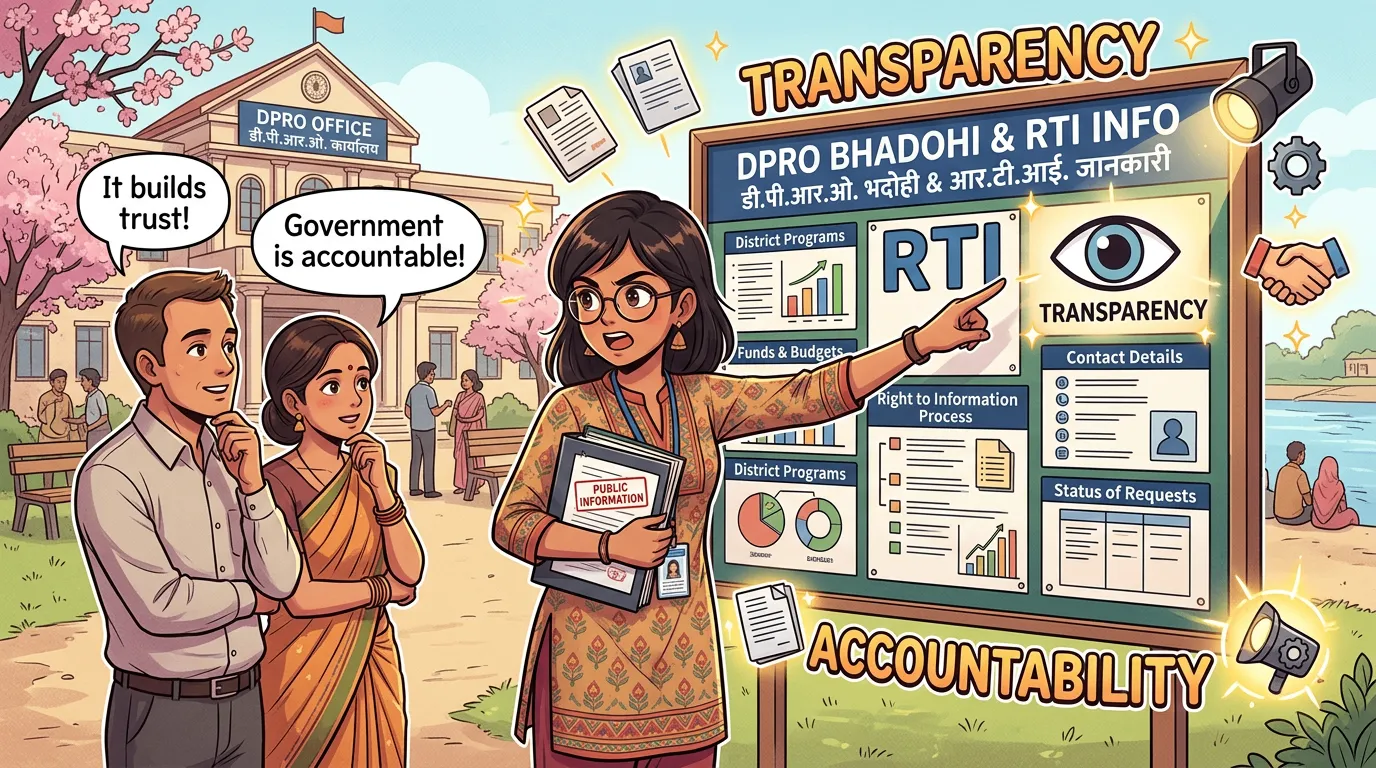
Access to DPRO Bhadohi & RTI information should be straightforward under the law, enabling citizens to freely obtain essential data that fosters accountability and transparency within public offices. However, this case vividly illustrates how a Public Information Officer’s silence and inaction can transform what should be a simple and routine request into a prolonged fight for transparency and justice. This unfortunate scenario not only frustrates the inquiry process but also raises concerns about the commitment to uphold the principles of openness, leaving citizens feeling disempowered and questioning the integrity of the very systems designed to serve them. The need for timely responses and proactive communication is critical, as it not only affects individual requests but also has broader implications for public trust in governance.
Key Takeaways
- Access to DPRO Bhadohi & RTI information is often obstructed due to Public Information Officers failing to respond within required timeframes.
- Negligence by PIOs leads to deemed refusal, forcing citizens to file appeals, which places a burden on appellate authorities.
- Concealment of information regarding public funds further erodes trust in the system and undermines governance.
- The appellant, Devi Prasad Gupta, seeks immediate provision of information and disciplinary action against the non-compliant PIO.
- This case highlights the broader issue faced by many RTI applicants in Uttar Pradesh who encounter similar obstacles in accessing information.
🛑 DPRO Bhadohi & RTI information: Concealment and Deemed Refusal
The core practice is simple. A designated Public Information Officer (PIO) fails to follow the statutory duties that the RTI Act, 2005 sets out.
Specifically, these duties exist to promote transparency and accountability within public authorities.
This negligence undermines the intent of the legislation. It also breeds distrust among citizens who are simply seeking information.
When a PIO neglects these duties, the outcome is predictable. Citizens face delayed responses, incomplete information, and sometimes no acknowledgement of their request at all.
Such behaviour damages the democratic process. It limits the public’s ability to scrutinise government action. It also blocks the flow of information that an informed citizenry needs.
Therefore, authorities must strictly enforce compliance with the RTI Act. Only then will PIOs understand their role, and the real impact their inaction has on public access to information.
1. Non-Compliance with Section 7(1) reflects truth of DPRO Bhadohi & RTI information compliance
The primary violation is the failure to respond within the mandated 30-day period.
- What it is: The DPRO, as the PIO, is legally bound by Section 7(1) of the RTI Act to either furnish the requested information or reject the application. This must happen within 30 days of receiving the request. Additionally, any rejection must cite valid exemptions under Sections 8 or 9.
- The Effect: By taking no action, the officer actively obstructs the citizen’s fundamental right to information.
2. Deemed Refusal
When the 30-day limit passes without a response, the law automatically treats the non-response as a refusal.
- What it is: This is known as a “deemed refusal” (implied refusal). In other words, the officer never has to say “I refuse” — the law treats silence itself as a refusal.
- The Implication: This deliberate silence is a tactic. As a result, it forces the appellant to spend more time, effort, and resources. Specifically, this means filing a First Appeal, and potentially a Second Appeal, just to get a response.
3. Concealment of Public Funds Information
The concealment is particularly grave. It concerns public funds spent on village development schemes. These include, for example, estimates, fund distribution, work booklets, and expenditure on wall paintings.
- Lack of Accountability: Withholding scheme-execution details for villages like Dhanwatiya points to a lack of transparency. It also opens the door to potential financial irregularities, corruption, or substandard work.
- Undermining Grassroots Governance: The DPRO’s role is crucial in monitoring Panchayat Raj institution activities. Concealment directly prevents social audits and citizen oversight at the grassroots level.
🎯 Impact on the RTI Act and Governance
In short, this widespread practice severely weakens the democratic process and the goals of the RTI Act.
A. Erosion of Citizen Trust
When government officers — especially those overseeing development funds — actively hide information, it breeds deep distrust. That distrust separates citizens from the very authorities meant to serve them. Here, it exists between the appellant, Devi Prasad Gupta, and the public authority, DPRO Bhadohi’s office).
B. Increased Burden on Appellate Authorities
As a result, the failure of the PIO (DPRO) to perform their duty creates a cascading effect. First, it shifts the initial responsibility of seeking information onto the First Appellate Authority (FAA) — the Deputy Director, Mirzapur. Then, it shifts onto the State Information Commission. Consequently, this backlog clogs the appellate machinery and delays justice for all RTI applicants.
C. Penalty Evasion
Often, the PIO hopes for one of two outcomes. Either the appellant gives up, or the FAA merely directs the PIO to supply the information. In doing so, the FAA often skips the mandatory penalty under Section 20(1) of the RTI Act. That penalty exists precisely to punish malafide denial, or the withholding of information without reasonable cause.
The relief sought in this appeal addresses exactly that gap. It asks the FAA to instruct the PIO to provide the information free of charge, under Section 7(6). It also asks for disciplinary action — precisely the mechanism that curbs this practice and enforces accountability.
🚨 DPRO Bhadohi & RTI Information: Seeking Transparency (Sant Ravidas Nagar)
This post documents a DPRO Bhadohi & RTI information dispute: a First Appeal under the Right to Information (RTI) Act, 2005. The appellant filed it after receiving no response from the Public Information Officer (PIO). That PIO is the District Panchayat Raj Officer (DPRO), Bhadohi (Sant Ravidas Nagar). At its core, the issue concerns the DPRO’s alleged concealment. Specifically, the DPRO allegedly failed to provide information about developmental schemes in Village Panchayat – Dhanwatiya.
🧑💻 Parties and Key Authority Details
This section identifies the individuals and authorities involved in the RTI process.
Appellant Details in matter of DPRO Bhadohi & RTI information
- Name: Devi Prasad Gupta
- Address: Shuklha Tri Corner Road, Anup Computer, Mirzapur City, Sadar Tehsil, Mahuariya, District-Mirzapur, Uttar Pradesh, PIN Code-231001
- Mobile: 9935329090
Public Information Officer (PIO) Details
The PIO is the officer responsible for the initial failure to provide information.
- Name & Designation: Bhadohi (Sant Ravidas Nagar) – DPRO, District Panchayat Raj Officer
- Mobile: 9450981727
- Email: dprosr-up@nic.in
First Appellate Authority (FAA) Details
The FAA is the authority that receives the appeal.
- Name & Designation: Mirzapur – Deputy Director
- Mobile: 9412445037
- Email: ddprmi-up@nic.in
Nodal Officer Contact
- Mobile: 9795140577
- Email: up.panchayatiraj@gmail.com
📅 RTI and Appeal Filing Timeline (DPRO Bhadohi & RTI information)
This section tracks the official dates and registration numbers for the application and the appeal.
- RTI Application Registration Number: DIRPR/R/2025/61901
- RTI Date of Filing: 29/07/2025
- First Appeal Registration Number: DIRPR/A/2025/61627
- First Appeal Date of Filing: 31/08/2025
🔎 Information Sought (Scope of Inquiry on Development Schemes)
The appellant sought information covering the last four years and the current year. Specifically, the request concerns Village Panchayat – Dhanwatiya (Post- Barwa, Development Block-Bhadohi, District-Bhadohi, PIN Code-221402). All requests involve documentation overseen by the DPRO Bhadohi.
- Estimates of Schemes: Provide the estimates of the developmental schemes executed in the village.
- Government Fund Distribution: Supply details about the distribution of government funds allocated for these schemes.
- Work Booklets: Provide the work booklets related to the implemented developmental schemes.
- Release of Funds: Offer a detailed description of the release of government funds allocated for the schemes.
- Wall Paintings & Expenditure: Share details of wall paintings and the corresponding expenditure incurred from government funds on them.
📜 Grounds for Appeal
Therefore, the appellant filed the appeal under Section 19(1) of the RTI Act due to the PIO’s failure to respond. The reason was simple: the PIO missed the legal timeframe entirely.
- Violation of Section 7(1): The PIO gave no response within the stipulated 30-day period.
- deemed refusal: The lack of response constitutes a deemed refusal under RTI jurisprudence, justifying the appeal.
- Denial of Transparency: The failure to supply information obstructs the fundamental objective of the RTI Act. Namely, that objective is ensuring transparency and accountability in public works.
🏛️ Relief Sought from the FAA
The appellant seeks the following intervention from the Deputy Director, Mirzapur (FAA):
- Instruction to Provide Information: Instruct the PIO to supply the requested information immediately and without charge, as Section 7(6) requires for a delayed response.
- Disciplinary Action: Take appropriate disciplinary action against the PIO for non-compliance with the RTI Act.
- Ensuring Future Compliance: Issue necessary instructions to the concerned department. This will help prevent similar violations, especially by officers holding crucial roles like the DPRO Bhadohi.
🧭 DPRO Bhadohi & RTI information and What This Means for Other RTI Applicants
This DPRO Bhadohi & RTI information dispute is not unique. Similarly, many RTI applicants across Uttar Pradesh face the same wall of silence from local PIOs. However, the law still offers a clear path forward, even when an officer refuses to engage.
For example, an applicant can start by tracking key deadlines. Moreover, keeping a written record of every RTI request, acknowledgement, and appeal is essential. In addition, applicants should note the exact date a request is filed. This date fixes the 30-day clock under Section 7(1). As a result, a clear record helps prove a deemed refusal at the State Information Commission.
In short, persistence matters. Filing a First Appeal is often just the first step. Sometimes, a Second Appeal to the State Information Commission becomes necessary too. Even so, each appeal adds pressure on the public authority to act. Eventually, most PIOs respond rather than risk a penalty under Section 20(1).
Enquiry officer may provide the information concerned with enquiry


Facing a similar challenge? Share the details in the box below, and our team of experts will do their best to help.