
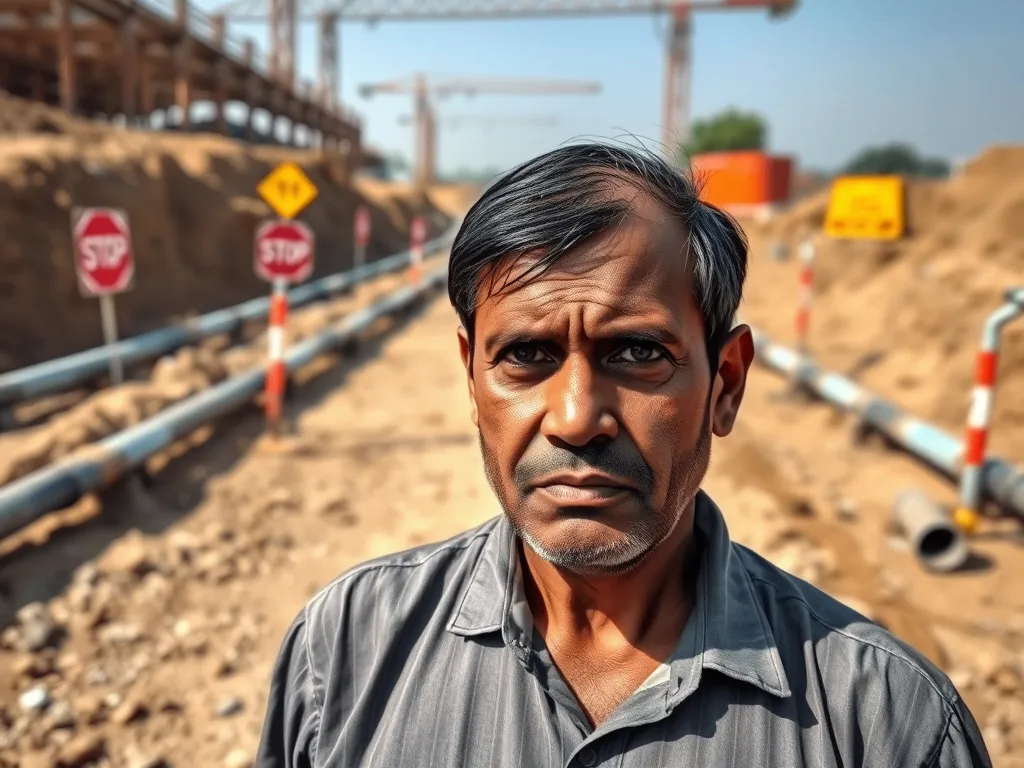
Here are the key takeaways from the analysis of the grievance regarding the water infrastructure crisis in Surekapuram, Mirzapur:
- Chronic Project Delays: Despite the project starting in July 2021, the water pipeline remains non-functional as of April 2025. This four-year delay raises significant concerns regarding the efficiency of the AMRUT scheme’s implementation at the local level.
- “Dry Tap” Infrastructure: Residents were “forcibly” given water connections, but these remain purely decorative. The infrastructure exists on paper and in physical form (taps and pipes), but it fails its primary purpose: providing drinking water.
- Bureaucratic Mismanagement: The grievance highlights a disconnect between official reports and ground reality. Authorities cited “traffic jams” and “festivals” in 2025 to justify a project backlog that dates back to 2021, which the complainant labels as “flimsy” and “baseless.”
- Collateral Damage to Roads: To lay what the complainant describes as “cheap plastic pipes,” the municipality destroyed colony roads. These roads have not been repaired, leading to a “breach of trust” and creating hazardous living conditions for the residents.
- Flaws in the Redressal System: The grievance was marked as “Case Closed” by officials based on a “promise” of future work (purchasing pipes) rather than the actual delivery of water. This highlights a systemic issue where closing a ticket is prioritized over solving the citizen’s problem.
- Lack of Accountability: The report identifies a “Jungle Raj” style of functioning where public authorities submit inconsistent reports to the IGRS portal to escape accountability, effectively ignoring the transparency goals of the Prime Minister’s mission.
The Never-Ending Wait: Accountability Crisis in Mirzapur’s Amrut Yojana
In the heart of Mirzapur, within the lanes of Surekapuram Colony, a paradox of progress has emerged. Since July 2021, residents have been forced to accept water connections under the Prime Minister’s AMRUT (Atal Mission for Rejuvenation and Urban Transformation) Scheme. Yet, four years later, these taps remain dry, and the roads remain broken.
The grievance filed by Shri Yogi M.P. Singh (Registration No: GOVUP/E/2025/0033192) pulls back the curtain on a systemic failure where administrative “paperwork” and “technical reports” fail to translate into a single drop of water for the common man.
A Timeline of Unfulfilled Promises (2021–2025)
The ordeal began in July 2021. At a time when most households in Surekapuram had already invested in private submersibles or hand pumps due to a lack of municipal support, the Jal Nigam began a “forced” connection drive. Roads were excavated, plastic pipes were laid, and meters were installed.
By April 2024, three years after the initial work began, a formal complaint was lodged highlighting that the connections were non-functional. The recent status update from April 2025 shows that the situation has not only stagnated but has been met with what the complainant describes as “arbitrary and inconsistent reports.”
The core of the grievance lies in a simple question: If a pipeline takes four years to lay and still yields no water, can it be called development, or is it merely the “misuse of public funds”?
The Official Defense: Delays, Festivals, and Traffic Jams
In response to the mounting pressure, the Executive Engineer of the Uttar Pradesh Water Corporation (Urban), Mirzapur, provided a report (Letter No. 694/M-7). The department cited three primary reasons for the delay:
- Reservoir Testing: Water supply is dependent on the Shiropaari reservoir under construction at the Mandi Parishad Campus. This reservoir is reportedly still in the “testing” phase.
- Permission Hurdles: The department claims there was a significant delay in receiving “road cutting” permissions for the Rewa-Mirzapur road.
- External Obstructions: In a move the complainant labeled as “flimsy,” the department cited the Kumbh Mela and Chaitra Navratri traffic as reasons for the work stoppage in early 2025.
While these reasons may appear technical on paper, they fail to explain why a project started in 2021 remained incomplete for nearly 1,400 days. As the complainant rightly points out, citing traffic jams in 2025 to justify a delay that began in 2021 is a logical fallacy that undermines the credibility of the Jal Nigam.
The Infrastructure Paradox: Connections Without Water
The AMRUT scheme’s primary goal is to provide a “functional tap connection” to every household. However, in Surekapuram, the “connection” has become a liability rather than an asset.
- Forced Infrastructure: Residents report being forced to take connections they didn’t ask for, only to have their existing roads destroyed.
- The Dry Tap Syndrome: Having a tap in the house with no water is a psychological and financial burden. It represents a “completed” statistic on a government dashboard that has zero utility in real life.
- The Sewerage Gap: Along with the water lines, the status of the sewer lines remains “operational on paper” but non-functional in reality, leading to sanitation concerns.
The Human Cost: Broken Roads and Lost Trust
One of the most stinging criticisms in the grievance is the condition of the local roads. To lay “cheap plastic pipes,” the Jal Nigam and Municipality dug up the colony’s infrastructure.
Under the AMRUT guidelines, any agency digging up a road for utility work is mandated to restore it to its original state. In Surekapuram, the roads remain in shambles. This has led to a “breach of trust” between the citizens and the local government. When the administrative machinery prioritizes completing “pipe-laying targets” over “water delivery” and “road restoration,” the spirit of the Prime Minister’s mission is lost.
Accountability or “Jungle Raj”?
The complainant’s dissatisfaction stems from the “closed” status of the grievance. In the IGRS (Integrated Grievance Redressal System) portal, the case was marked as “disposed” based on the department’s assurance that a private firm, M/s GDCL, New Delhi, is currently “purchasing pipes.
Why is this problematic?
- Premature Closure: Closing a grievance based on a “promise of future work” rather than “actual completion” defeats the purpose of a redressal system.
- Bureaucratic Insolence: The report submitted by the officials is viewed by the residents as a “concocted story” designed to clear the backlog of pending complaints without providing actual relief.
The Path Forward: What Needs to Change?
The case of registration number GOVUP/E/2025/0033192 is not just about one colony in Mirzapur; it is a symptom of a larger transparency crisis. To resolve this, several steps are necessary:
- Physical Verification: Instead of accepting paper reports, senior officials from the Chief Minister’s Secretariat should conduct a physical audit of the Surekapuram water lines.
- Penalty for Delays: The firm M/s GDCL and the concerned Jal Nigam officials should be held financially accountable for the four-year delay.
- Restoration Mandate: Water supply should not be considered “commissioned” until the roads are fully repaired and water pressure is verified at the terminal tap.
Conclusion
The residents of Surekapuram are not asking for a miracle; they are asking for the basic right to water and safe roads—services for which the government has already allocated massive funds. When “Amrit” (nectar) is promised, the citizens should not be left with dry pipes and dusty roads. It is time for the Government of Uttar Pradesh to move beyond “parrot reports” and ensure that accountability flows as freely as the water should.
Based on the grievance details provided, here are the structured contact and identification details for the authorities responsible for the Surekapuram, Mirzapur water project.
1. Primary Case Identification
- Grievance Registration Number:
GOVUP/E/2025/0033192 - Related IGRS Reference Number:
60000250072626 - Complainant Name: Yogi M. P. Singh
2. High-Level Oversight (CM Secretariat)
These authorities handle the monitoring and systemic accountability of the IGRS portal.
- Concerned Officer: Shri Arvind Mohan
- Designation: Joint Secretary, Government of Uttar Pradesh
- Office Address: Chief Minister Secretariat, Room No. 321, U.P. Secretariat, Lucknow.
- Contact Number: 0522-2226350
- Official Email:
arvind.12574@gov.in
3. Execution & Local Accountability (Mirzapur)
These are the officials directly responsible for the technical execution (pipes, reservoirs, and commissioning) in Mirzapur.
- Nodal Officer (IGRS Mirzapur): Additional District Magistrate (Land/Revenue)
- Executive Engineer (Ground Level): Md. Ayaz
- Organization: Uttar Pradesh Water Corporation (Urban) / Jal Nigam
- Local Office Address: Office of the Executive Engineer, Construction Block, 14 MLD STP Campus, Ramaipatti, Pakka Pokhara, Mirzapur – 231001.
- Organization Email:
gpcumzp@gmail.com
4. Important Web Links
| Resource | Link Details |
| UP IGRS (Jansunwai) Portal | jansunwai.up.nic.in |
| Track Grievance Status | Check Status Link |
| UP Jal Nigam (Urban) | jn.upsdc.gov.in |
| AMRUT Mission (India) | amrut.gov.in |
5. Summary of Mobile/Contact Channels
- CM Helpline: Dial
1076(For escalations regarding unresolved IGRS complaints). - Joint Secretary Phone:
05222226350 - Jal Nigam Mirzapur Email:
gpcumzp@gmail.com
Would you like me to help you draft a formal email to the Joint Secretary (Shri Arvind Mohan) citing the Executive Engineer’s report as insufficient?


Facing a similar challenge? Share the details in the box below, and our team of experts will do their best to help.