
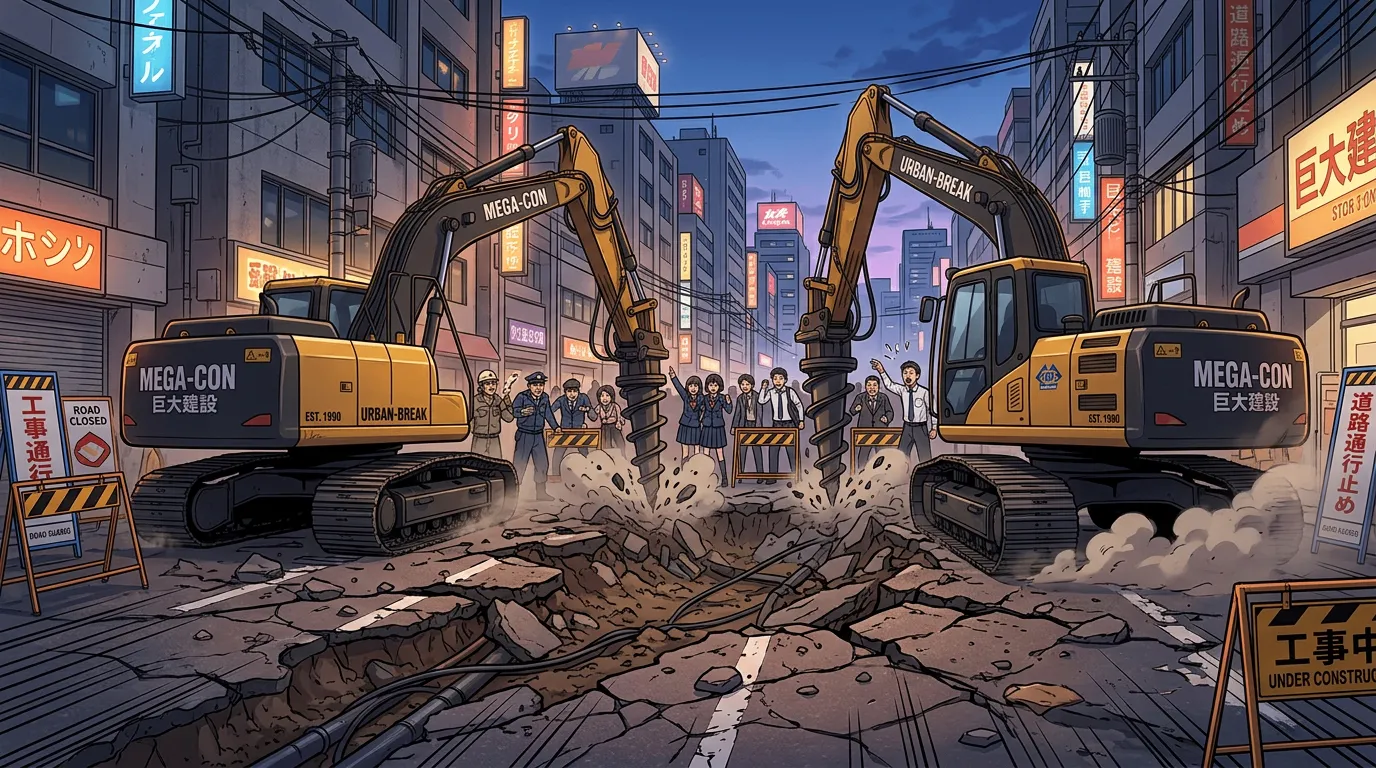
Companies Breaking Roads with Non-Accountability: A Case Study from Surekapuram Colony, Mirzapur
Explore how companies breaking roads with non-accountability affect Indian towns and uncover one real case from Mirzapur. The repercussions of such irresponsible actions can be profound, impacting daily life for residents. Roads are essential for connectivity, commerce, and access to vital services; when they are damaged or left unrepaired, it can lead to significant disruption. In Mirzapur, a specific example highlights the struggles faced by citizens as regular traffic is hindered and emergency services are delayed due to the neglect displayed by certain companies. This unchecked behavior not only frustrates locals but also raises questions about corporate responsibility and government oversight. Such incidents provoke anger and distrust towards authorities, urging a need for stricter regulations and accountability measures to safeguard community interests and ensure fundamental infrastructure is respected and maintained.
Key Takeaways
- Companies breaking roads with non-accountability significantly disrupt daily life in Indian towns, as seen in Mirzapur.
- A resident’s grievance highlighted issues like a neglected park, unfulfilled restoration duties, and an unsecured trench.
- Despite formal complaints, authorities often mark issues as resolved without addressing the actual problems on the ground.
- The case emphasises the need for thorough documentation and persistent follow-up to hold responsible parties accountable.
- Ultimately, active citizen engagement is vital to ensure genuine accountability and infrastructure restoration.
Introduction: How Companies Breaking Roads with Non-Accountability Escape Scrutiny
Across Indian towns and cities, a familiar pattern repeats itself. A utility company arrives to lay a gas pipeline, a sewer line, or a cable. It digs up a public road. Then it leaves, often without restoring what it broke. This is the story of companies breaking roads with non-accountability. It’s told through one real, documented case from Surekapuram Colony, Mirzapur, Uttar Pradesh. Specifically, a resident’s persistent follow-up exposed exactly how this pattern plays out on the ground.
Public grievance portals like Jansunwai exist to close this accountability gap. However, as this case shows, even a formally “closed” grievance can leave the problem untouched. In short, companies breaking roads with non-accountability remains a real and ongoing issue.
This case also sits alongside other documented instances of civic negligence in the region, including meter installations recorded only on paper in Mirzapur and delayed flood relief in Mirzapur’s tehsils — a reminder that ground-level accountability failures rarely occur in isolation.
The Original Complaint Against Companies Breaking Roads with Non-Accountability
In mid-2026, a resident of Surekapuram Colony filed a formal grievance. The reference was Jansunwai Ref. No. 600002601173453. He addressed it to the Chief Secretary, Chief Minister Secretariat, Government of Uttar Pradesh. The complaint outlined a set of interconnected civic problems that had built up over years. At their core, these problems trace back to companies breaking roads with non-accountability during utility construction work.
A Park Promised, Never Delivered
On 14 February 2023 — more than three years before the grievance — officials inspected the neglected Second Park in Surekapuram Colony. The City Engineer and Junior Engineer of the Nagar Palika Parishad Mirzapur conducted that inspection. Based on it, the department prepared a cost estimate of ₹77,303 for drainage repair work. In addition, it gave a written commitment. Once funds under the 15th Finance Commission arrived, the park’s beautification and development would follow immediately.
Years passed. Eventually, crews completed the drainage repair. Yet they never touched the park itself.
A Public Space Turned Dump Yard
Meanwhile, residents waited for the promised park development. As they waited, their neighborhood degraded in a different way. Contractors dumped massive piles of interlocking bricks and broken stone — leftover construction material — around the park. They left this debris unattended for over a year. As a result, a community green space effectively became an open-air debris yard. In other words, it’s another symptom of companies breaking roads with non-accountability. Contractors simply walk away once the work is done.
An Unsecured Trench in the Middle of the Street
On top of that, utility pipeline work made the problem worse. Workers dug a deep pit directly in the street. They left it open and unsecured for about a week. Consequently, excavated earth and stone piled up beside it. This completely blocked the main thoroughfare. As a result, residents could no longer navigate the street safely — especially children and older people. Furthermore, the lack of proper street lighting made this worse at night.
The Request
Overall, the grievance asked for three clear actions:
- Immediate removal of debris blocking public space around the park.
- Safe closure of the open pit and reopening of the road for public movement.
- A definite timeline for completing the park’s beautification using the already-designated 15th Finance Commission funds.
The Closure: A Response That Didn’t Match the Ground Reality
On 4 August 2026, the department marked the grievance “Case closed.” Specifically, the Executive Officer of the Nagar Palika Parishad Mirzapur stated that an inspection had taken place. He also claimed that crews had removed the debris from the site.
However, there was one problem: they hadn’t.
In fact, photographs taken at the site told a different story. They showed sprawling piles of bricks and stone still present. The open, unsecured pit was also still there. Moreover, the closure remark never even mentioned the park beautification. This was the central and most enduring demand of the original complaint.
At this point, the story shifts. What began as a routine civic complaint becomes a case study in a wider problem. Digital grievance systems sometimes prioritize procedural closure over verified ground execution — a pattern also visible in cases of documented accountability gaps at Prayagraj Nagar Nigam. In short, this shows how easily companies breaking roads with non-accountability can hide behind a single administrative sign-off.
Digging Deeper: The Waterlogging Problem Nobody Addressed
As the resident kept monitoring the site, a further complication came to light. Notably, it hadn’t been part of the original complaint at all.
During the pipeline construction, crews raised the connecting road at the junction of two residential rows. They raised it to a height of about six feet. As a direct consequence, water now stagnates at this junction even during light rainfall. Specifically, the waterlogged stretch runs roughly six feet long. It covers the entire width of the road.
To prevent this in advance, the resident had taken proactive steps. In a phone call with municipal officials, he made a specific request. He asked for a temporary mori — a small drainage outlet or culvert — at the raised junction. This would let water pass through instead of pooling. Nevertheless, officials ignored that request entirely. They then closed the grievance without taking any action on it. Once again, this is yet another instance of companies breaking roads with non-accountability. Meanwhile, civic authorities let the resulting hazard persist unchecked.
Notably, this is not a Mirzapur-only phenomenon. In Delhi, the New Delhi Municipal Council has had to ban road cutting during the monsoon months specifically because unrestored trenches were causing waterlogging and public safety hazards — the exact failure pattern seen in Surekapuram Colony.
The Restoration Question: Why Companies Breaking Roads with Non-Accountability Violate an Obligatory Duty
One principle often gets lost in day-to-day civic disputes. Yet it may be the most structurally important point in this entire case. When a public road is cut open for utility work — in this case, for laying a gas pipeline — the executing agency carries an obligatory duty. It must restore the road to its original condition.
In other words, this is not a courtesy the agency extends at its own convenience. Rather, it is typically a binding condition. It’s attached to the very permission that allows a road to be cut in the first place. Often, a restoration security deposit backs this condition, collected by the municipality. Therefore, when that duty goes unfulfilled, it becomes the textbook definition of companies breaking roads with non-accountability. They profit from access to public infrastructure while leaving the public to bear the cost of the damage.
Indeed, crews eventually filled the excavated pit, but only with loose earth. They never compacted it, paved it, or restored the original road surface. Consequently, a filled pit is not the same as a restored road. Loose earth settles unevenly. It doesn’t bear traffic safely. And it does nothing to fix either the surrounding debris or the waterlogging the raised road caused.
Some cities have started enforcing this obligation more strictly. Bengaluru’s civic body, for instance, now levies fines of up to ₹25 lakh on agencies that dig roads without authorisation or fail to follow restoration procedures — a model of enforcement that smaller municipalities like Mirzapur have yet to adopt.
Given all this, the case raises pointed, answerable questions. These go to the heart of the non-accountability problem:
- Which agency executed the gas pipeline work, and under what municipal permission?
- Did the municipality collect a restoration security deposit? If so, has it refunded that deposit despite the road not being properly restored?
- Who bears accountability for a week-long unsecured, unlit trench in a residential lane?
Citizens seeking answers to exactly these questions can turn to the Right to Information Act, 2005, which entitles any Indian citizen to request such records directly from the public authority responsible. This is a similar approach used in other documented cases, such as RTI applications used to seek accountability from the Directorate of Agriculture.
Taking the Fight Further: Feedback and Escalation Against Companies Breaking Roads with Non-Accountability
Rather than let the matter rest with an inaccurate closure, the resident used the tools available within the Jansunwai system itself. He did this to push back against this pattern of companies breaking roads with non-accountability.
Step One: Filing Dissatisfaction Feedback
First, against the closed grievance, the resident submitted feedback. He marked the complaint as “Not Resolved,” citing the reason as “Incorrect/False report attached.” Additionally, his comment laid out exactly how the closure remark diverged from ground reality, within the portal’s character limit. Specifically, it cited the debris, the open trench, and the unaddressed park beautification commitment. It also flagged the new waterlogging hazard the raised road caused.
Step Two: A Formal Escalation to the District Magistrate
However, feedback alone often isn’t enough to guarantee a substantive review. Therefore, the resident drafted a detailed, structured escalation letter. He submitted it as a fresh grievance addressed to the District Magistrate, Mirzapur. Altogether, this letter consolidated every strand of the case into five clear points. It directly named the non-accountability of the executing agency as a central issue:
- The closure remark was factually incomplete, and photographic evidence contradicted it.
- The road, broken for gas pipeline work, had not been genuinely restored — only loosely filled. As a result, this raised unanswered questions about the executing agency’s obligatory restoration duty and the status of any security deposit.
- The raised road junction was actively causing waterlogging. Officials had ignored a specific, reasonable request for a temporary mori.
- The Second Park’s promised beautification remained pending more than three years after the original written commitment.
- Debris around the park still had not been fully cleared, despite the earlier closure claiming otherwise.
Finally, the letter closed with five direct requests. These were: reopen the original grievance, ensure genuine road restoration with accountability disclosed, install a temporary drainage outlet, complete debris removal, and commit to a fixed timeline for the park’s development.
As a result, officials registered this escalation as a new grievance — GOVUP/E/2026/0112205. They received it on 1 September 2026 and forwarded it to the Uttar Pradesh Chief Minister Secretariat for review.
Why “Companies Breaking Roads with Non-Accountability” Is a Pattern, Not an Isolated Incident
This single grievance thread spans multiple sub-issues and two formal registration numbers. Indeed, it illustrates a pattern that plays out in civic administration far beyond Mirzapur. In short, the phrase “companies breaking roads with non-accountability” captures something residents across India will recognize instantly. This pattern of institutional non-response echoes a broader culture of RTI noncompliance documented in bodies like the Lucknow Development Authority, where paperwork routinely substitutes for actual resolution:
- Paperwork can outpace ground reality. For instance, a closure remark filed from a desk can claim resolution that a five-minute site visit would disprove.
- Partial compliance often masquerades as full compliance. After all, filling a pit with loose earth is not restoration. Removing some debris is not removing all of it. In effect, it’s a cosmetic fix that lets companies breaking roads with non-accountability avoid real consequences.
- Verbal requests need documentation. Officials found it easy to ignore the resident’s phone call requesting a mori, because it left no paper trail. Therefore, every request to civic authorities is best followed up in writing.
- Digital grievance systems are only as good as the verification behind them. Ultimately, the credibility of platforms like Jansunwai depends entirely on one thing: whether closures reflect actual ground execution, not just procedural sign-offs.
- Persistence and documentation are the citizen’s strongest tools. For example, photographs with context, precise measurements, specific dates, and structured written follow-ups matter. Together, they turn a vague complaint into a case that’s difficult to dismiss. In fact, this is the only real counter to companies breaking roads with non-accountability.
What Comes Next
As of the most recent update, officials have registered the new escalation (GOVUP/E/2026/0112205). They forwarded it for review, with the status marked as “Grievance received.” Meanwhile, the resident plans to keep monitoring the case. If this fresh grievance also fails to produce ground-level action, further tools remain available. These include a formal RTI application, filed to seek details of the gas pipeline agency, its road-cutting permission, and the status of any restoration deposit.
Conclusion: Ending the Cycle of Companies Breaking Roads with Non-Accountability
Ultimately, the Surekapuram Colony case reminds us of something important. Closing a file and closing a problem are not the same thing. Moreover, it clearly illustrates how companies breaking roads with non-accountability can operate for years. They cut through public infrastructure, leave it degraded, and face no real consequence — unless citizens actively push back.
Therefore, residents facing similar situations have one real path forward. This applies whether the issue is a road left broken after utility work, a park promised and never delivered, or a grievance closed without real resolution. The path is simple: document everything, follow up precisely, and escalate through every available administrative channel. Only through that persistence will the paperwork finally match what’s actually happening on the ground. And only then will the companies and contractors responsible be held to the accountability standard they were bound to from the start.


Facing a similar challenge? Share the details in the box below, and our team of experts will do their best to help.