
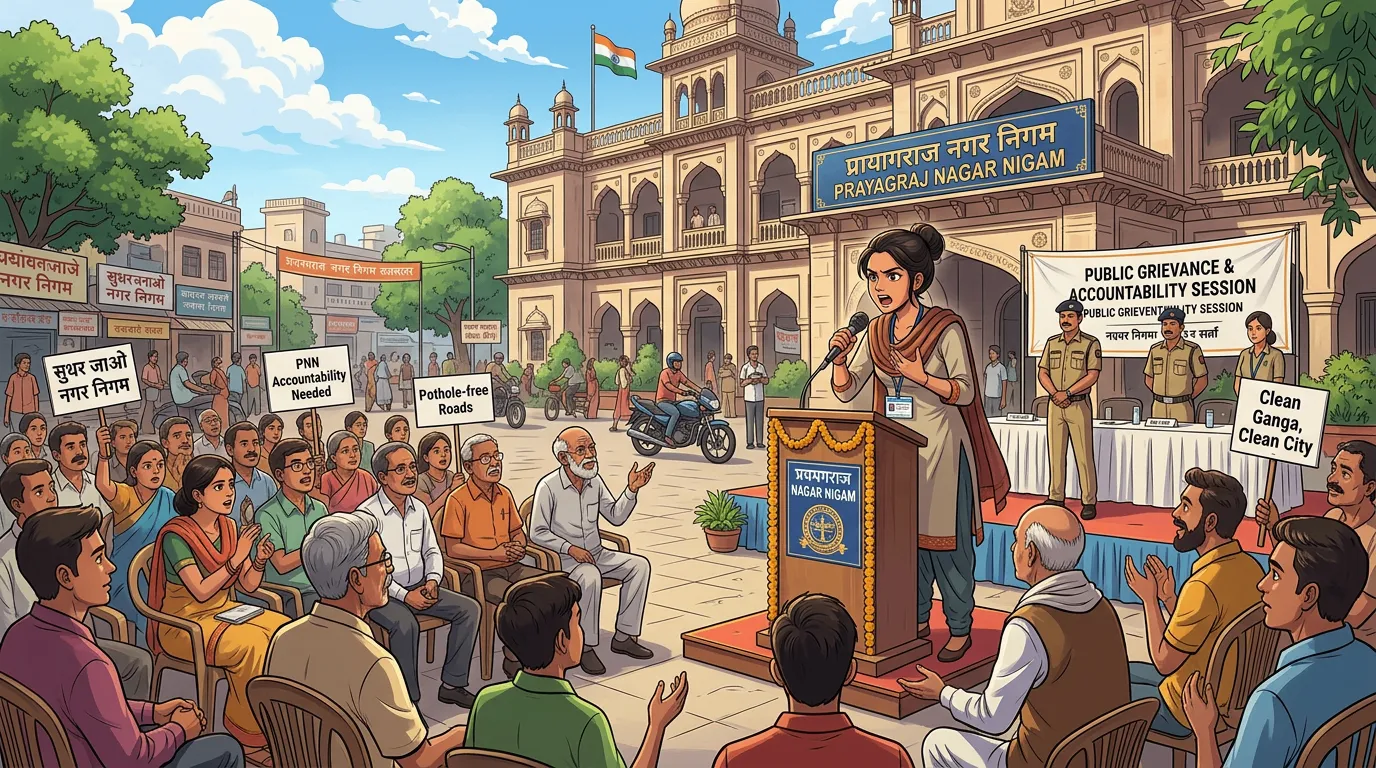
Accountability in Prayagraj Nagar Nigam: Why RTI Applicants Still Struggle to Get Straight Answers
A look at the systemic gaps in transparency and accountability in Prayagraj Nagar Nigam — and what they reveal about RTI Act implementation across urban local bodies in India
The Right to Information Act, 2005 makes a simple promise. Any citizen can ask a public authority a question. The authority must answer completely, accurately, and within 30 days. Two decades on, however, that promise still gets tested every day. Ordinary applicants file a request expecting transparency. Instead, they navigate months, sometimes years, of appeals and adjournments born from PIO silence that our earlier coverage has also tracked in detail. In fact, people often discuss accountability in Prayagraj Nagar Nigam in principle far more than they practice it day to day. Below, this piece looks at the recurring, systemic patterns that blunt the Act’s effectiveness for ordinary citizens.
1. Accountability in Prayagraj Nagar Nigam Starts — and Often Stalls — at the “Deemed Refusal” Stage
Section 7(1) of the Act requires a Public Information Officer (PIO) to respond within 30 days. When that deadline passes with no response, however, the law treats it as a deemed refusal. In practice, this legal fiction offers little comfort to an applicant who simply receives silence.
What commonly happens:
- First, an applicant files an RTI application and receives a registration number and acknowledgment.
- Then, 30 days pass. No reply arrives, no rejection order arrives, and no communication arrives at all.
- As a result, the applicant must assume refusal and start a First Appeal, just to get the authority to engage.
Overall, this shifts the burden of enforcement onto the citizen. The law, however, places that burden on the public authority instead. For accountability in Prayagraj Nagar Nigam and similar municipal bodies, this first-stage silence is often where citizen trust starts to erode.
2. Accountability in Prayagraj Nagar Nigam: First Appellate Authorities Who Don’t Appellate
Section 19(1) gives applicants a First Appeal before a senior officer in the same department. This step applies whenever the PIO fails to respond or gives an unsatisfactory answer. In principle, this is a fast, internal step toward stronger accountability in Prayagraj Nagar Nigam. In practice, however, a common and well-documented failure pattern emerges:
- To begin with, the applicant files and registers the First Appeal.
- After that, no hearing takes place, no order gets passed, and no reasons get recorded.
- Meanwhile, the Commission’s own case records often mark the appellate authority’s response field simply as “There is no answer.”
Consequently, when the internal appellate mechanism stays silent, the applicant has no choice but to escalate. Instead, they must approach the State Information Commission by way of a Second Appeal for a problem the first appeal should have resolved.
3. Accountability in Prayagraj Nagar Nigam and the Slow Grind to the Information Commission
By the time a Second Appeal under Section 19(3) gets registered, 80 to 90-plus days have often elapsed since the original application. In other words, that timeline runs well beyond the 30-day window the Act envisions. Once the matter reaches the Commission, a familiar cycle then begins:
- First, the Commission issues interim orders directing compliance.
- Next, compliance deadlines pass without full compliance.
- Subsequently, the Commission adjourns the matter to a further hearing date.
- Finally, the cycle repeats across multiple hearings, sometimes for years.
For applicants without legal help, this drawn-out timeline often proves exhausting. As a result, many simply give up. This, in turn, defeats the purpose of a transparency law. Each time it happens, it quietly undermines accountability in Prayagraj Nagar Nigam and similar bodies.
4. “No Record Found” as a Non-Answer
One troubling pattern, moreover, affects accountability in Prayagraj Nagar Nigam-type bodies directly. Officials use “no record found” to close out a hard question without truly engaging with it. This becomes especially problematic in two situations:
- First, the information sought concerns a mandatory step in an official process — for example, verifying credentials before a government appointment. That step, after all, should generate a record if the process was followed correctly.
- Second, the same authority already named a specific office in earlier correspondence as responsible for that step. Therefore, a later “no record exists” answer directly contradicts its own prior statements.
In some cases, a public authority’s file already holds related documents — certificates, appointment orders, promotion orders. Yet, at the same time, the authority claims no record exists of who verified any of it. Understandably, applicants then ask a hard question: did the verification step actually get skipped, or has a record simply gone missing? Either way, neither answer is acceptable. “Not found” should not substitute for a real one.
5. Administrative Mix-Ups That Undermine Accountability in Prayagraj Nagar Nigam
A less-discussed but equally real problem, similarly, affects accountability in Prayagraj Nagar Nigam and comparable departments, as our detailed case study of Nagar Nigam Prayagraj’s RTI issues illustrates. Officials often juggle several RTI matters from the same applicant. Because case numbers can look similar, they sometimes send the wrong response to the wrong file. For instance, this can look like:
- A letter addressed to the Commission under one case number, yet containing information that actually answers a different RTI application.
- A hearing date cited in correspondence that, in fact, doesn’t match the Commission’s own case-status record.
For the applicant, this isn’t a harmless clerical slip. Instead, it can mean showing up to a hearing where the department argues the wrong matter entirely. Meanwhile, the actual questions asked remain unaddressed yet again.
6. Contact-Channel Inconsistencies and Accountability in Prayagraj Nagar Nigam
RTI portals typically require a public authority to register a specific PIO name, email, and phone number. In practice, however, applicants sometimes notice a gap:
- Official-looking correspondence, for example, arrives from an email address different from the one registered with the Commission.
- Applicants send follow-ups to the officially listed address, but no one monitors it. Meanwhile, all real communication happens through an unregistered channel instead.
As a result, this undermines basic verifiability. It also becomes harder for an applicant, or the Commission itself, to hold one accountable official responsible for a reply. Overall, it’s a small but telling detail in the larger picture of accountability in Prayagraj Nagar Nigam and similar bodies.
7. Why These Gaps Compound: The Real Cost to Accountability in Prayagraj Nagar Nigam
On their own, each of these issues might look like a minor bureaucratic hiccup. Together, however, they describe something bigger. Indeed, deemed refusals, silent first appeals, and multi-year timelines all point the same direction. So do “no record found” non-answers, case mix-ups, and inconsistent contact channels. Together, they show a system whose default outcome favors delay and non-disclosure. Consequently, only a persistent, well-organized applicant is likely to get a real answer eventually.
That outcome, unfortunately, runs opposite to what the RTI Act was designed to achieve. After all, the Act’s Preamble speaks of promoting accountability “to contain corruption and to hold Governments… accountable.” Therefore, strengthening accountability in Prayagraj Nagar Nigam requires more than policy language. Ultimately, it requires a system that doesn’t need this much citizen effort just to enforce its own 30-day guarantee.
The same gap between paper and ground reality shows up in grievance portals, not only in RTI replies. In Mirzapur, a Jansunwai complaint about an unrestored gas-pipeline trench and dumped construction debris was marked “case closed” while photographs showed nothing had changed — see Companies Breaking Roads with Non-Accountability Issues.
Case Reference: A Documented Example Before the UP State Information Commission
The patterns above are not abstract. They appear across two connected RTI matters currently before the Uttar Pradesh State Information Commission, Hearing Room S-10, both involving Prayagraj Nagar Nigam as the public authority. The reference details below are drawn from the Commission’s own official case-status records and correspondence, and are provided so readers can independently verify and track this matter.
A third matter before the same Court S-10, on whether Nagar Nigam Prayagraj actually implemented the State’s Annual Transfer Policy 2024-25, is documented separately in Transfer Policy of Government & Implementation Explained.
Update (September 2026): for a case in which the Commission issued two show-cause notices under Section 20 and the PIO ignored both, see Two Show-Cause Notices & No Reply Explained.
Matter 1 — Appointment and Verification Records
- RTI Application Registration No.: NGNPR/R/2024/60100, filed 23/07/2024
- First Appeal Registration No.: NGNPR/A/2024/60051, filed 29/08/2024
- Second Appeal (Commission) No.: S10/A/1469/2024
- Commission Registration No.: A-20241001256
- Public Authority: Nagar Nigam Prayagraj — Office of the Municipal Health Officer
Matter 2 — Grievance-Handling and Leave Records
- RTI Application Registration No.: DIRLB/R/2025/60405, filed 10/11/2025
- Second Appeal (Commission) No.: S10/A/0540/2026
- Commission Registration No.: A-20260300227
- Public Authority: Nagar Nigam Prayagraj — Office of the Municipal Commissioner
Officially Registered Contact Details on Record
- PIO email (as registered with the Commission): osnagarnigam@rediffmail.com
- Nodal officer contact number (as registered): 8303701003
- First Appellate Authority (Matter 1): Sri Arvind Kumar Rai, Additional Nagar Ayukt, Nagar Nigam Prayagraj — contact as registered with the Commission: osnagarnigam@rediffmail.com, 8303701003
- Additional signatory on departmental correspondence in this matter: Sri Rajiv Shukla, Apar Nagar Ayukt / Jan Suchna Adhikari, Nagar Nigam Prayagraj
- Hearing Room: S-10, Uttar Pradesh State Information Commission, Lucknow
Where to Verify
- Uttar Pradesh Information Commission case-status portal (search by Registration Number or File Number above)
- National RTI portal: rtionline.gov.in
Note: the officials named above are identified solely in their official statutory capacity as Public Information Officer and First Appellate Authority under the RTI Act, 2005 — roles that carry a legal duty to respond to citizens and are properly subject to public accountability reporting. This piece does not name or publish personal details of any private individual who is the subject of the underlying RTI applications.
What Would Strengthen Accountability in Prayagraj Nagar Nigam and Similar Bodies
Transparency advocates and applicants consistently raise a few structural fixes. Together, these fixes would address much of the above:
- Enforce penalties under Section 20(1) automatically, instead of requiring the applicant to argue for them at every hearing.
- Require reasoned orders from First Appellate Authorities, with a hard deadline, so the internal appeal step actually functions.
- Standardize and verify contact information for every PIO, and cross-check it against the Commission’s own portal.
- Build basic case-management safeguards at the department level, so responses get matched to the correct case number and hearing date.
- Create a presumption against “no record found” for mandatory steps, requiring the authority to state clearly whether the step was skipped or the record is missing.
A Note for Applicants Facing These Issues
Are you navigating a stalled or evasive RTI matter with Prayagraj Nagar Nigam or a similar authority? If so, a few practical habits can help:
- Keep a dated paper trail of every application, reply, appeal, and follow-up, including tracking numbers and email timestamps.
- Cross-check every case number and hearing date. Specifically, compare each one against the Commission’s own portal record before relying on it.
- Point out inconsistencies directly and in writing. For example, if a position changes between two letters, place both side by side and ask for an explanation, as documented in this second appeal case record.
- Use the First Appeal and Second Appeal mechanisms fully, even when slow, since they build the record a Commission needs to act. For related context on how transfers and postings are handled, see Nagar Nigam Prayagraj’s transfer policy explained.
For further guidance, India’s national RTI portal offers official information on filing, tracking, and appeal timelines: rtionline.gov.in. Additionally, the Uttar Pradesh State Information Commission portal covers municipal authorities, including Prayagraj Nagar Nigam.
Overall, this piece discusses systemic patterns in RTI Act implementation and accountability in Prayagraj Nagar Nigam. It draws on commonly reported applicant experiences. It does not refer to any specific individual, and it includes no personal or private contact information.
Related reading: ACP Manoj Kumar Singh: Service Details Revealed


Facing a similar challenge? Share the details in the box below, and our team of experts will do their best to help.