
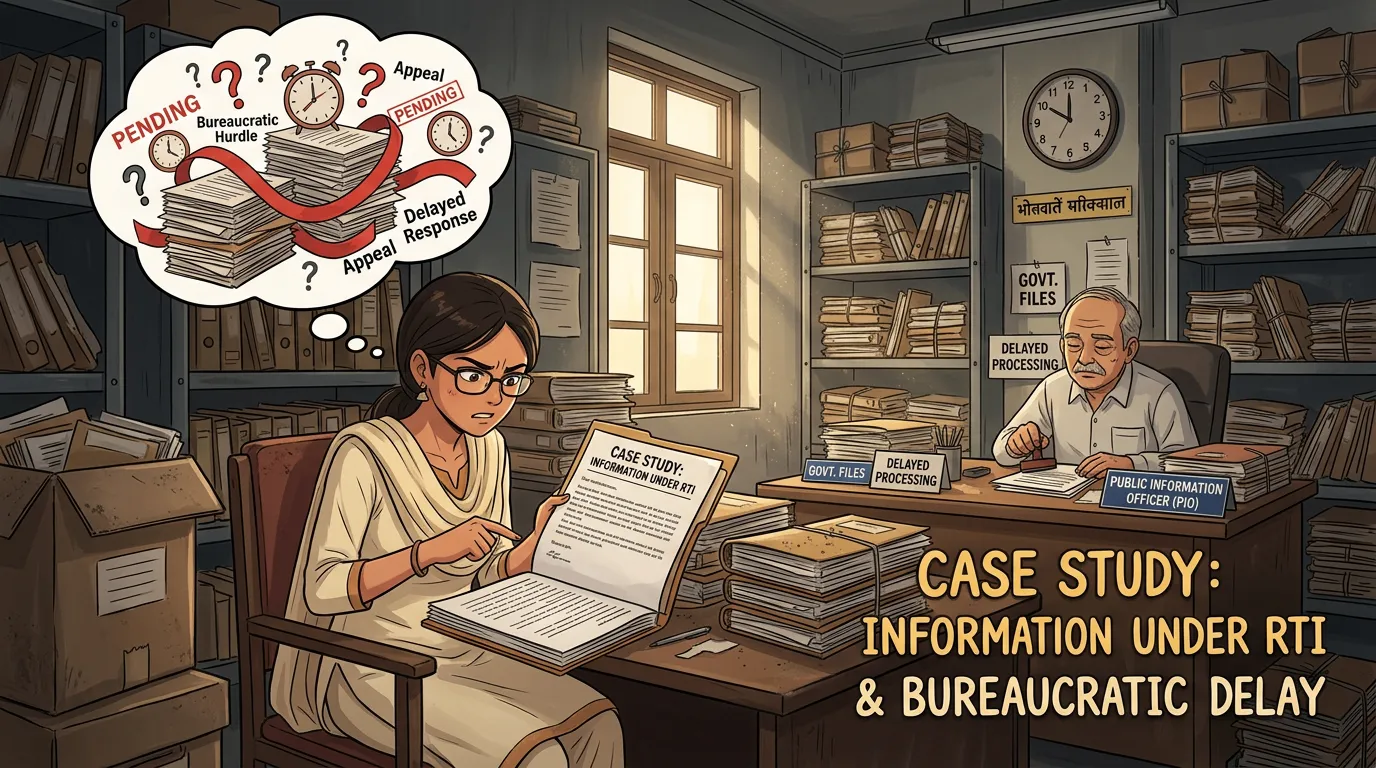
Information under RTI & Bureaucratic Delay: A Case Study in How a Simple Request Took Two Years
A detailed case study of information under RTI & bureaucratic delay — tracing a five-point RTI request through five hearings, an illegal transfer, and 31 months without resolution before the UP State Information Commission. This investigation delves deep into the complexities surrounding Right to Information (RTI) applications within the bureaucratic framework of Uttar Pradesh. It highlights the struggles faced by applicants in navigating a system often mired in inefficiency and red tape. Each hearing unveils new layers of challenges, including obstructive tactics, administrative hurdles, and a lack of accountability that contributes to prolonged delays. The case not only shines a light on individual experiences but also raises critical questions about the effectiveness of RTI as a tool for transparency and the urgent need for reforms in how information requests are processed.
How one RTI application about a government transparency order got caught in the very opacity it sought to expose
Key Takeaways
- This case study explores how a simple RTI request took 31 months due to bureaucratic delays and inefficiencies.
- Despite the RTI Act’s 30-day requirement for responses, the applicant faced repeated deferrals and a lack of accountability.
- Key issues included an initial claim of lacking information and an improper transfer of the request to an unrelated body.
- The study highlights systemic failures in the RTI process, raising concerns about the actual effectiveness of the legislation.
- Ultimately, the experience illustrates how bureaucratic delay undermines transparency and the right to information.
Introduction: A Case Study in Information under RTI & Bureaucratic Delay
The Right to Information Act, 2005 gives citizens a strict clock: 30 days. The law extends that window only in limited circumstances. Yet more than two and a half years after filing a routine RTI application in Uttar Pradesh, the applicant is still waiting for a real answer. This post examines that gap between the law’s promise and its practice. It uses one real case, filed before the Uttar Pradesh State Information Commission, as a worked example of information under RTI & bureaucratic delay.
This case makes a useful lens for a simple reason: the facts sought are not dramatic. The applicant asked for mundane, internal records — the kind any office should hold on its own compliance work. Yet the request sat unresolved through five hearings before the State Information Commission. That outcome says less about this one case and more about how delay compounds inside an appellate RTI process when no one enforces the clock. At its core, information under RTI & bureaucratic delay describes exactly this: a citizen’s statutory right colliding with an administrative culture that treats deadlines as suggestions.
Background: What Information Was Actually Sought
On 8 February 2024, Yogi M. P. Singh filed an online RTI application (Registration No. DIRLB/R/2024/60013) with the Directorate of Local Bodies, Uttar Pradesh. The request tied to a specific Government Order dated 4 January 2024. The Special Secretary issued that order. It directed all Provincial Civil Service (Executive Branch) officers across the state to declare their movable and immovable assets online. Officers had to do this through the “Sparrow Portal” by 31 January 2024.
The applicant did not ask for anyone’s personal asset details. He asked the Directorate — the nodal office responsible for enforcing that order among its own staff — to disclose five things:
- The names and designations of staff who complied with the disclosure requirement by the deadline.
- The names and designations of staff who did not comply.
- What action the Director, Local Bodies, took regarding non-compliance with the 4 January 2024 order.
- Copies of internal communications exchanged with subordinate offices to pursue compliance.
- The names and designations of the staff processing this government order within the Directorate itself.
In short, the applicant wanted the Directorate’s own administrative paper trail on its own compliance exercise. Section 4 of the RTI Act arguably requires a well-run public authority to publish this kind of internal record proactively. Producing it on request should have been simple.
Related reading: Challenges Faced with the Social Welfare Directorate’s RTI Replies · RTI Appeal Against Delay in Mirzapur Social Welfare Response
The Escalation: From Application to Second Appeal
The applicant received no satisfactory response within the statutory period. He exhausted the first-appeal stage. On 7 July 2024, he filed a Second Appeal under Section 19(3) of the RTI Act before the Uttar Pradesh State Information Commission. The Commission registered the appeal as Appeal No. S06/A/1200/2024 (Registration No. A-20240700485) and assigned it to Hearing Room S-6.
What followed illustrates, almost textbook-fashion, how officials can stretch out a simple five-point query for years — without anyone ever formally refusing it.
Timeline of Hearings: A Chronicle of Deferral
| Date | What Happened |
|---|---|
| 20.11.2024 | Both parties stay absent. The Commission orders fresh notice and fixes the next hearing. |
| 28.01.2025 | The Commission lists the matter again; proceedings continue without resolution. |
| 01.05.2025 | The Commission again directs the PIO (Nagar Vikas Anubhag-6, identified as Sri Susheel Chandra Gupta) to file a written statement. |
| 27.06.2025 | The department files a written response, but it doesn’t answer the five points. Instead, it claims the asset-disclosure exercise “is not worked and monitored at the directorate level” — effectively denying custody of its own compliance data. |
| 28.10.2025 | Without addressing the applicant’s request, the Commission transfers the matter downward to the Executive Officer, Nagar Palika Parishad, Mirzapur — a municipal body with no plausible connection to the Directorate’s internal staff records. |
| 22.12.2025 | The applicant formally objects to this transfer as illegal, citing Section 6(3) of the RTI Act. |
| 14.05.2026 | The Commission agrees with the applicant. It discharges the Mirzapur municipal officer from the case and redirects the matter back to the original PIO at the Directorate — nearly a year after that PIO first claimed not to hold the information. |
| 07.07.2026 | The applicant files a detailed representation seeking penalty and disciplinary action. The Respondent files no compliance report. |
| 11.09.2026 | The Commission schedules the next hearing. The five original questions from February 2024 remain unanswered. |
By the most recent hearing notice, roughly 31 months had passed since the original application. A request this simple should have taken the Directorate a few internal emails to answer.
Anatomy of the Delay: Three Distinct Failures in Getting Information under RTI
1. The “We Don’t Hold This Information” Deflection
The Directorate-level PIO’s first substantive response claimed no one “monitored” the Sparrow Portal compliance exercise at that level. This implied the information simply didn’t exist in the Directorate’s custody. Authorities use this tactic often in RTI proceedings, and it works well for them. Refusing a request outright invites scrutiny and requires reasons under Section 8. Claiming you lack the records sidesteps that scrutiny — and shifts the burden back onto the applicant to prove otherwise.
The applicant’s counter-argument was straightforward. The Government Order of 4 January 2024 named the Director of Local Bodies as an addressee, explicitly tasking that office with ensuring subordinate compliance. An office cannot receive a compliance mandate and then claim, in the same breath, that it holds no records of whether anyone followed it.
2. The Illegal Downward Transfer
Section 6(3) of the RTI Act permits a PIO to transfer an application, but only under specific conditions. The information must be actually held by another public authority. Even then, the PIO must complete the transfer within five days of receipt and notify the applicant.
Nearly 18 months into the case, the Commission instead redirected the matter to a municipal-level Executive Officer’s office in Mirzapur. That office had no conceivable custody over the Director’s internal staff files or correspondence. Section 6(3) doesn’t contemplate this kind of transfer. The provision exists to move a request to the correct custodian of records — not to the most convenient dead end.
Notably, the Commission itself later agreed with this reading. In May 2026, it formally discharged the Mirzapur officer from the proceedings and re-fixed responsibility on the original Directorate PIO. This vindicated the applicant’s objection — but only after the matter had cycled through an entire additional round of hearings.
3. Absence of Any Written Statement Despite Repeated Directions
Perhaps the most striking feature of this case is procedural. At multiple hearings, the Commission directed the Respondent PIO to file a written statement or compliance report at least two days before the scheduled hearing. Each time, according to the case record, the PIO appears to have ignored that direction. The case simply rolled forward to the next date. Nothing happened as a consequence.
This is where the structural weakness of the appellate process becomes visible. The RTI Act does provide teeth. Section 20(1) allows the Commission to impose a penalty of up to ₹25,000 — calculated at ₹250 per day of delay — on a PIO who fails, without reasonable cause, to furnish information within the prescribed time. Section 20(2) allows the Commission to recommend disciplinary action where a PIO’s conduct is found to be mala fide. Both provisions exist precisely for situations like this one. In practice, though, invoking them tends to require the applicant to demand it repeatedly and explicitly — as has happened here, through successive written representations. The Commission rarely applies these provisions automatically, even once a pattern of default becomes evident on the record.
Related reading: Bureaucratic Inaction is Crippling RTI Act Effectiveness · Right to Information Act: Recent Appeal Insights
Why Bureaucratic Delay in RTI Cases Is Its Own Distinct Harm
It’s worth pausing on why the delay itself is a meaningful injury under the RTI framework — independent of whatever the underlying information eventually shows.
- The law has a built-in clock. Section 7(1) requires information within 30 days, or 48 hours for life-and-liberty matters. A statute this insistent on speed treats delay not as a minor inconvenience, but as a failure mode the legislature specifically tried to prevent.
- Delay defeats the purpose of transparency. Information about whether public servants complied with an asset-disclosure order matters most while it’s current and actionable. Two years on, much of its accountability value has eroded. The same dynamic plays out across departments — see, for instance, this RTI Appeal Against Corruption in UP Health Department, where delay similarly blunted the value of the information sought.
- Delay costs a non-complying office nothing — unless someone pushes back. A PIO who does nothing faces very little practical risk, unless the applicant persistently files objections, representations, and appeals, as has happened in this case. The burden of enforcement falls almost entirely on the citizen.
- Delay compounds across appellate layers. Each hearing that ends in “next date fixed,” without a penalty or firm deadline, effectively restarts the clock informally. The statute never contemplated this kind of indefinite deferral.
What This Case Illustrates About Information under RTI & Bureaucratic Delay in the Appellate Process
Looked at as a system rather than a single dispute, this case shows how a Second Appeal — meant to correct exactly this kind of default — can itself become a site of prolonged delay. That happens when:
- Commissions direct written statements but don’t enforce them;
- PIOs use Section 6(3) transfers loosely rather than strictly;
- Commissions treat Section 20 penalty provisions as a last resort rather than a standard response to demonstrated non-compliance; and
- The burden of tracking, objecting to, and re-litigating each procedural lapse falls on the applicant, rather than being managed proactively by the forum itself.
None of this requires bad faith from any individual functionary to produce a bad outcome for the applicant. Institutional inertia does the job on its own. So does unclear internal ownership of a compliance record, and a hearing calendar that treats “list for next date” as a safe default. Together, these forces can turn a request for five straightforward facts into a 31-month wait.
Where the Matter Stands
The Commission has listed the case for 11 September 2026, and has once again directed the Directorate PIO to file a written statement in advance. In his latest representation, the applicant has asked the Commission to:
- Impose the maximum penalty under Section 20(1) for the accumulated delay;
- Recommend disciplinary action under Section 20(2);
- Decline to entertain any oral or last-minute submission unaccompanied by a prior written statement; and
- Issue a firm, time-bound direction — seven days — for the outstanding information.
Will the Commission finally exercise its penalty powers, or defer the question to yet another date? Either way, the answer will send a meaningful signal — not just to this applicant, but about how seriously the Commission treats the RTI Act’s deterrent provisions when an authority’s non-compliance is this well documented.
Conclusion: The Real Cost of Bureaucratic Delay in Accessing Information under RTI
This case didn’t begin as a dispute about corruption, scandal, or sensitive government secrets. It began as a request for an internal compliance list — the kind of record a functioning office should locate in an afternoon. Its slow path through denial, deflection, an improper transfer, and five unresolved hearings illustrates everyday RTI dysfunction better than a more dramatic case might.
The Right to Information Act gave citizens a 30-day clock. This case shows how easily a system without automatic consequences can lose that clock entirely. Information under RTI & bureaucratic delay isn’t an abstract policy phrase. It’s the lived experience of an applicant who, 31 months on, is still asking the same five questions he asked in February 2024. Provisions like Section 20 exist for cases exactly like this one — and the Commission needs to use them.
FAQ: Information under RTI & Bureaucratic Delay
What counts as “undue delay” under the RTI Act? Section 7(1) requires a PIO to furnish information within 30 days of a request, or 48 hours for matters concerning life or liberty. Any response beyond this window, without a valid statutory exception, counts as delay — and can trigger penalty proceedings under Section 20.
Can a PIO transfer an RTI application to avoid answering it? Only if another public authority genuinely holds the information, under Section 6(3). Even then, the PIO must complete the transfer within five days and notify the applicant. Using a transfer to shift a request to an office with no real custody of the records — as happened in this case — misuses that provision.
What can an applicant do about persistent bureaucratic delay in an RTI appeal? File written representations at each hearing that document the pattern of non-compliance. Explicitly invoke Section 20(1) for penalty and Section 20(2) for disciplinary action. Object formally to any improper transfer or unsubstantiated claim that information “is not held.”
Does delay itself matter, even if the information eventually arrives? Yes. The RTI Act sets a short statutory timeline because delayed information often loses its practical value for accountability purposes. Persistent delay also shifts the burden of enforcement onto the citizen rather than the public authority — undermining the Act’s core design.
This account is based on the applicant’s RTI application, appeal filings, Commission notices, and written representations in Appeal No. S06/A/1200/2024 before the Uttar Pradesh State Information Commission, as of August 2026.


Facing a similar challenge? Share the details in the box below, and our team of experts will do their best to help.