
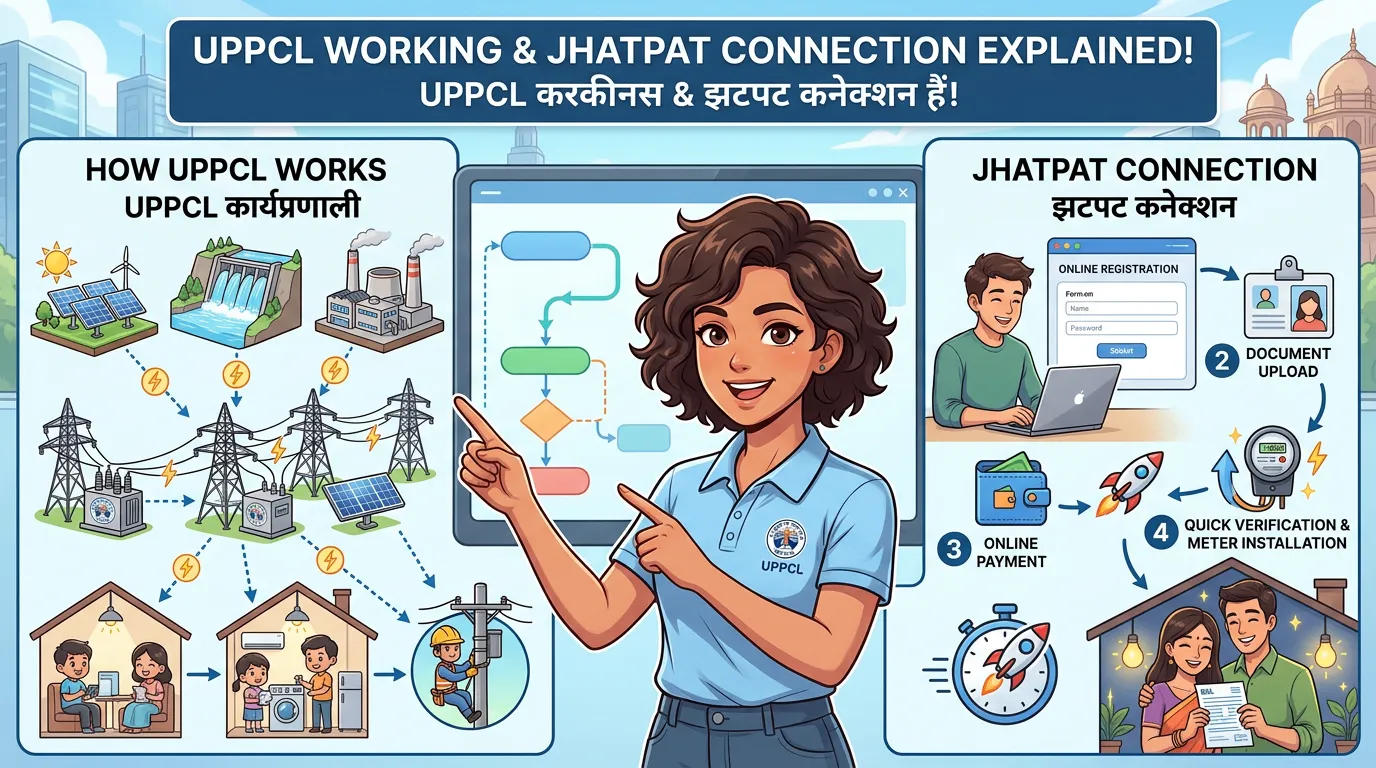
UPPCL Working & Jhatpat Connection: A Citizen’s Ground Report from Jigna Subdivision, Mirzapur
A first-hand account of how UPPCL working actually plays out on the Jhatpat Connection portal in Village Nibi Gaharwar. It also raises bigger questions about transparency, accountability, and unchecked power theft in one Uttar Pradesh electricity subdivision.
Key Takeaways
- The article highlights issues with UPPCL Working & Jhatpat Connection applications, emphasizing lack of transparency and accountability.
- It details a specific case where false objections delayed a user’s application for an electricity connection.
- The applicant escalated the concern through formal channels, highlighting the need for accountability in UPPCL’s operations.
- The writer notes a broader pattern of unregulated power usage and insufficient action against power theft in the area.
- Ultimately, the article underscores that effective governance relies on traceable decisions and accountability for public services.
Introduction: What Real UPPCL Working Looks Like on a Jhatpat Connection Application
Applying for a new home electricity connection through UPPCL’s Jhatpat Connection portal should be simple. You submit documents, pay the fee, wait for inspection, and get connected. But one application changed that picture.
Application No. J2812823O1 covered a newly built home in Village Nibi Gaharwar, Post Nibi Gaharwar, District Mirzapur. This single case turned into a real test of how UPPCL working functions on the ground. It also showed how much effort a citizen must put in just to ask: “Who made this decision, and why?”
Below, this post walks through what happened, step by step, on the Jhatpat Connection process. Then it looks at the wider pattern this case may point to.
Core Issue 1: Alleged False Objections with Ulterior Motives by UPPCL Staff
After the Jhatpat Connection application went in, the portal raised a query. It claimed “the premises could not be located and the mobile number provided could not be reached.”
This claim didn’t match reality. The department’s own team had already visited the site in person. They had asked questions there directly. Even so, the contact number worked the entire time. So why did the portal record show something else?
What the Applicant Alleges
The applicant’s position is direct: the “premises could not be located” and “could not be contacted” remarks were themselves false objections — raised specifically to avoid carrying out the site visit, not because of any real difficulty in finding the premises or reaching the applicant. Notably, the department’s own field team had already visited the site and asked questions in person before staff filed this objection. On top of that, the listed contact number worked the entire time. Given these facts, the objection doesn’t hold up as an honest description of what happened on the ground.
This remains an allegation, and it is serious. No formal inquiry has confirmed it yet. However, the underlying facts — a documented prior visit, a fully functional phone number, and a portal entry claiming neither existed — leave little room for an innocent explanation. That gap is exactly why the applicant has demanded, through a formal RTI request and a state-level grievance, that UPPCL name the staff member responsible and confirm in writing whether a real visit ever took place.
How the Applicant Responded
In response, the applicant filed a formal written reply. It included three supporting documents: a family partition deed from 2022 that proves ownership, an Aadhaar card that confirms identity and address, and the application’s own record, which already listed the premises as “new” construction. Following this, UPPCL let the application move forward. As a result, the team scheduled inspection dates, and the applicant paid the processing fee.
The real problem isn’t that the portal raised a query. Rather, the problem is this: a query that could reject a legitimate Jhatpat Connection application went in without a proper ground check. And no one could say who was responsible for the mistake.
Core Issue 2: UPPCL Working Has an Accountability Gap — No Name Attached
Once the application moved forward, one question remained: who filed the original “premises not found” report? And who was actually sent to inspect the site?
This isn’t a hostile question. Every citizen has the right to ask a public utility this. So the applicant filed a formal request that cited two legal grounds:
- Article 51-A of the Constitution of India (Fundamental Duties). This article asks every citizen to oppose corruption and push public institutions toward excellence.
- The Right to Information Act, 2005. This law forces a public authority to disclose exactly this kind of information within 30 days.
The request asked for two things: the name and job title of the staff member who filed the disputed report, and the name and job title of the person assigned to inspect the site. Additionally, it asked UPPCL to confirm whether a real visit took place.
When a decision affects a real outcome — approval, rejection, or delay — the person who made that call should carry a name. Anonymous decisions are where accountability quietly disappears from UPPCL working.
Core Issue 3: The Bigger Pattern Behind UPPCL Working — Paper Meters and Ignored Power Theft
This single Jhatpat Connection query might look like a one-off mistake. But it sits inside a much bigger problem with how UPPCL working functions at the subdivision level.
The applicant reports that over 75% of consumers in the Nibi Gaharwar Gram Panchayat area use unmetered or improperly metered connections — commonly called “paper meters.” As a result, the department doesn’t accurately record or bill their real power use. Despite this, the applicant has sent multiple written complaints about suspected electricity theft in the Jigna subdivision over time, and none led to visible action.
This is where one connection dispute becomes a public issue:
- A genuine, well-documented, newly built home got hit with a false “not found” report. So what happens when someone reports large-scale unmetered power use — a problem with far bigger revenue and fairness stakes?
- The department applies scrutiny unevenly. It puts pressure on compliant new applicants, but appears to overlook long-running irregularities. This pattern is one of the clearest warning signs of a public utility in trouble.
This pattern of selective enforcement isn’t unique to this one case. For a closer look at how the same subdivision handles allegations under the theft provisions of the Electricity Act, see Section 135 Misused & Executive Engineer Mirzapur: Insights and Misuse of Section 135 in Electricity Cases Explained. A related grievance, detailed in Misuse of Section 135: Loknath Yadav vs Electricity Department, shows a similar pattern of inconsistent enforcement against ordinary consumers.
Core Issue 4: Citizens Escalate UPPCL Working Concerns Through Formal Channels
The applicant didn’t let the matter rest at the subdivision level. Instead, they escalated both the Jhatpat Connection dispute and the wider concerns about UPPCL working through the state grievance redressal system. The complaint carries registration number GOVUP/E/2026/0111351. Officials forwarded it to a Joint Secretary in the Chief Minister’s Secretariat, Lucknow.
The grievance formally asked for:
- The identity of the staff member responsible for the disputed portal entry.
- Confirmation of whether the assigned inspection staff actually visited the site.
- A clear, transparent inquiry into how the department handled the case — to fix the process, not to punish anyone.
- Acknowledgment of the wider, unresolved pattern of suspected power theft in the subdivision.
This is the right way to escalate a concern. It stays documented and factual, and it moves through official channels, rather than remaining an informal accusation. Consumers facing delayed or disputed compensation claims from UPPCL can find a similar step-by-step approach in How to Navigate Compensation by UPPCL Effectively.
Why UPPCL Working on Jhatpat Connection Matters Beyond One Application
You could read this as a story about one delayed electricity connection. But it’s really a bigger story. It asks whether UPPCL’s working — from the Jhatpat Connection portal down to subdivision field staff — is transparent enough for citizens to trust by default. And it asks what recourse exists when that trust breaks down.
Uttar Pradesh is a huge, densely populated state. As a result, small pockets of unaccountable decisions, repeated across thousands of subdivisions and millions of Jhatpat Connection applicants, add up fast. Consequently, they become a governance question, not just a local complaint. After all, good governance means more than fast service — it means traceable decisions, where every “no” or “not found” carries a name and a reason behind it.
Where This Jhatpat Connection Case Stands Now
- Application J2812823O1: UPPCL has resolved the query, scheduled the inspection, and collected the fee. The case is actively moving through the Jhatpat Connection portal.
- RTI/accountability request: The applicant has submitted it, and the 30-day legal response window is running.
- State grievance (GOVUP/E/2026/0111351): The portal has registered it and forwarded it to the CM Secretariat, and a response is still pending.
- Broader power-theft concern: The applicant has flagged it again through this escalation, after the department reportedly ignored multiple earlier complaints about UPPCL working.
This post will get updates as responses arrive. If you’re navigating UPPCL working through the Jhatpat Connection portal, or facing similar friction anywhere in the state, document everything in writing. Cite the RTI Act directly when you ask for staff accountability. Use the state grievance portal instead of relying only on local-level resolution. Billing disputes are another common friction point in the same subdivision — see Phantom Bill in UPPCL Mirzapur: Consumer Rights for how one such case was handled.
This account reflects the applicant’s personal experience and submissions to date. References to departmental conduct describe the applicant’s documented observations and formal complaints. These claims remain pending verification through the ongoing inquiry and grievance process. the ongoing inquiry and grievance process.


Facing a similar challenge? Share the details in the box below, and our team of experts will do their best to help.