
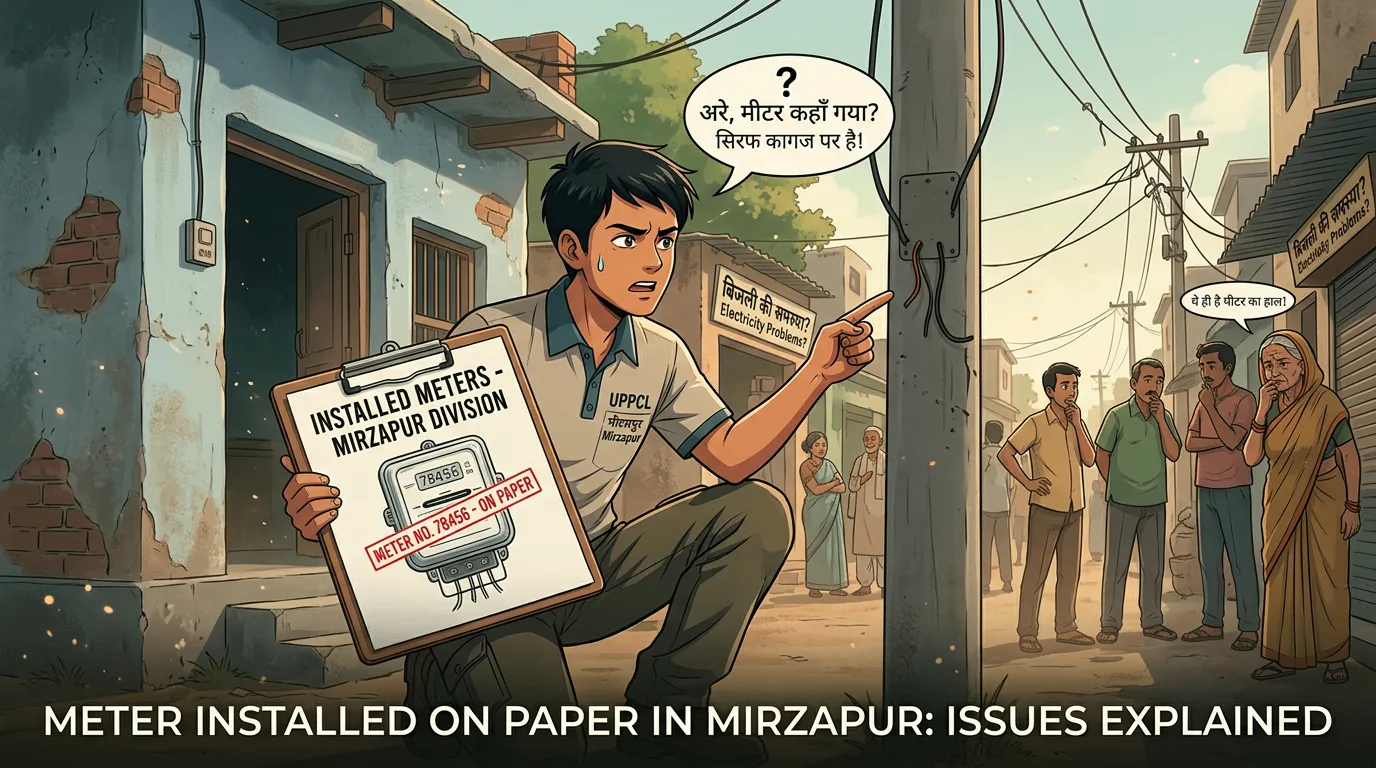
Explore the issue of meters installed on paper in Mirzapur and its impact on consumers facing unfair electricity bills. In many cases, residents receive inflated bills due to these fraudulent meter installations, where the actual energy consumption is never accurately measured. This not only burdens households financially but also leads to growing frustration among consumers who feel exploited by the electricity distribution companies. Moreover, the lack of transparency surrounding the billing processes makes it challenging for residents to contest or verify their charges. As a result, many families are forced to pay bills that bear no relation to their actual usage, perpetuating a cycle of economic hardship. Addressing this issue is essential for restoring trust in the system and ensuring that consumers are fairly charged for their electricity consumption.
Meter Installed on Paper in Mirzapur: The Real Cost of Estimated Electricity Bills
Key Takeaways
- The issue of Meter Installed on Paper in Mirzapur leads to inflated electricity bills for consumers.
- Consumers often pay bills based on estimates, without having a physical meter installed at their property.
- Installation delays exacerbate the problem, as utilities provide vague excuses without resolving issues.
- Even with a physical meter installed, billing inaccuracies can persist due to outdated systems and lack of data integration.
- Structural changes, such as mandatory retroactive audits and real-time data sharing, are necessary to protect consumers.
Introduction
Imagine opening your electricity bill. The number doesn’t match how much power you used. No one took a meter reading. No one visited your home. Instead, your connection carries a meter installed on paper — a billing entry that exists in departmental records but not on your wall. For thousands of consumers, this isn’t a hypothetical. It’s routine, especially in semi-urban and rural areas like Mirzapur, Uttar Pradesh.
This post looks at two connected failures in electricity distribution. First, utilities bill consumers against a meter installed on paper rather than a real one. Second, they delay physical installation for months or years. We’ll also cover a third, less obvious problem: what happens when a real meter finally goes in, and the billing system still doesn’t correct the bill even after two weeks of genuine readings.
What Does “Meter Installed on Paper” Actually Mean?
A meter installed on paper means the utility’s records treat the account as metered for billing purposes. No physical device sits at the premises. Instead of a field agent reading actual consumption, the utility generates an estimate. Sometimes it averages a “similar” household. Sometimes it just carries forward or inflates the previous bill.
A few common reasons explain this:
- No meter exists on the premises, even though the utility sanctions, activates, and bills the connection as though one does.
- Field staff shortages or access issues cause meter readers to skip inaccessible areas or miss a cycle entirely.
- Slow infrastructure upgrades leave a long gap between “sanctioned connection” and “physically metered connection.” Utilities running smart-meter rollouts, including parts of Mirzapur district, often fill that gap with a meter installed on paper.
Whatever the cause, this practice shifts the burden of proof onto the consumer. The utility doesn’t have to justify the number. The consumer has to disprove it — usually by complaining, escalating, and waiting.
The Mirzapur Case: When a Meter Installed on Paper Isn’t a Meter at All
A recent grievance from a village in Mirzapur district shows this pattern clearly. A consumer’s connection carried bills for an extended period despite having no physical meter. Only an official letter from the Sub-Divisional Officer confirmed the truth: the account had a meter installed on paper, and nothing more.
The installation process itself became a flashpoint. Field staff allegedly demanded an informal payment to “adjust” future readings. When the consumer refused, the staff walked away without installing the meter. The department had long blamed the delay on uncooperative residents. That excuse didn’t hold up — this consumer actively wanted installation, and the contractor’s own staff turned them away.
This case matters because a meter installed on paper isn’t just a data-entry inconvenience. It can hide real accountability gaps in billing accuracy, contractor conduct, and complaint handling.
The Procrastination Problem
Billing against a meter installed on paper is the symptom. Delayed physical installation is the disease. Utilities often offer a convenient, unfalsifiable excuse for non-installation: “local residents are not cooperating,” or “the area is not accessible.” No one can easily verify these claims. That’s the problem — they shut down inquiry instead of inviting it.
Installation delays tend to compound rather than resolve:
- A utility sanctions a connection but never installs a meter, leaving it as a meter installed on paper.
- Estimated bills pile up, often inflated, with no real number to check them against.
- The consumer files a complaint. The department offers a vague promise instead of a firm installation date.
- Outsourced contractors handle physical installation under smart-metering programs but face little accountability for delay.
- The consumer keeps paying estimated bills indefinitely, while disconnection threats hang over an account the utility never metered properly.
The deeper issue is incentive design. A utility that can bill against a meter installed on paper — without penalty for the delay — has no urgency to fix it. The consumer bears the entire cost of the department’s inaction. First come the inflated bills. Then comes the administrative effort needed to get anyone to look at the problem.
The New Meter Paradox
Here’s where things get particularly frustrating. A physical meter finally replaces the meter installed on paper and starts recording real usage. You’d expect the story to end there. It often doesn’t. In many cases, the new meter accurately captures the household’s real consumption for two weeks or more — sometimes well past 15 days of clean, verifiable readings — yet billing systems still don’t correct the bill.
Why does this happen?
- Billing cycles don’t sync with installation dates. A meter might go in mid-cycle, but back-end billing systems keep applying the old estimated formula until the next full cycle closes. They ignore the real data already coming in.
- No retroactive correction mechanism exists. Actual consumption might differ dramatically from the estimated figure, but most billing systems have no default process to reconcile or refund the gap from the paper-meter period. The consumer has to specifically request an audit. That request often disappears into the same slow grievance pipeline that caused the delay in the first place.
- Departmental silos block data sharing. The field team installs the meter. The billing team generates the invoice. The two teams rarely share real-time data. The real meter reading sits in one system. The billing system generates the bill in another, on an older basis.
The result is absurd: the fix that was supposed to resolve the dispute — a real, working meter — sits there generating accurate data that the billing system ignores. The consumer’s proof of correct usage exists. Nobody uses it.
The Human Cost
None of this stays abstract for the people living through it. A consumer facing an inflated, unexplained bill has three unpleasant choices. Pay it anyway to avoid disconnection. Dispute it and wait through a grievance process that can drag on for weeks or months. Or risk falling into arrears that snowball with penalties. These outcomes hit lower-income households hardest, especially in areas like parts of Mirzapur where physical metering has lagged behind billing.
A harder-to-measure trust cost also builds up. A citizen sees a bill generated against a meter installed on paper. They file a complaint. The department closes it with a one-line note saying it “eventually” installed a meter. No one explains what happens to the earlier disputed charges. This pattern teaches people that grievance redressal is procedural theatre, not genuine correction. And that erosion of trust makes people less likely to report future problems — including serious ones like staff misconduct or extortion attempts tied to installation delays.
What Needs to Change
A few structural fixes would help:
- Make retroactive audits mandatory. Any account billed against a meter installed on paper should trigger an automatic reconciliation once real readings arrive. Consumers shouldn’t have to request it separately.
- Set time-bound installation deadlines with real penalties. Departments should back up excuses like “villager non-cooperation” with documented evidence, not accept them at face value.
- Integrate field and billing data in real time. No good reason exists for a meter to record usage actively while the billing engine ignores it for weeks.
- Add independent oversight of installation contractors. Outsourced vendors running smart-meter rollouts need accountability that matches the trust placed in them, especially given their direct financial relationship with the households they meter.
Conclusion
The Mirzapur case shows what happens when utilities bill consumers against a meter installed on paper: real financial harm falls on people least equipped to fight it. Even a properly installed physical meter, generating two or more weeks of accurate data, often fails to correct the underlying bill. That failure isn’t really about hardware. It’s about whether the systems around that hardware serve the consumer’s interest — or simply close the file.
A more recent case shows this same paper-meter, no-accountability pattern from the other side of the process — at the new-connection stage. See UPPCL Working & Jhatpat Connection Explained, a ground report from Village Nibi Gaharwar in Mirzapur’s Jigna subdivision.
The habit of recording work on paper that never happened on the ground is not confined to the electricity department. The Nagar Palika Parishad Mirzapur closed a road-restoration grievance in the same way — declaring debris removed and a trench secured while photographs showed otherwise. Read that case in Companies Breaking Roads with Non-Accountability Issues.
The Chief Minister’s Secretariat handles this particular grievance internally through its Joint Secretary’s office rather than a dedicated public-facing webpage, which is why no specific web link exists for that office itself. However, grievances routed through it — including this one — are tracked through the central CPGRAMS/PG Portal at pgportal.gov.in, where the registration number GOVUP/E/2026/0081590 can be looked up directly. Separately, the general website for the Uttar Pradesh Chief Minister’s Office is cmoup.nic.in, though it functions mainly as an informational portal rather than a grievance-tracking system in itself.
Official website: https://puvvnl.in/ (also accessible via puvvnl.up.nic.in)
Registered office: Bhikharipur, Varanasi – 221004
Phone: 0542-2318348
Arbitrary and unexplained electricity charges aren’t unique to paper-metered connections either. See Case of Consumer Rights Violation in Electricity Billing for Smt. Neelam Devi’s fight against a billing spike that didn’t match her actual consumption.


Facing a similar challenge? Share the details in the box below, and our team of experts will do their best to help.