
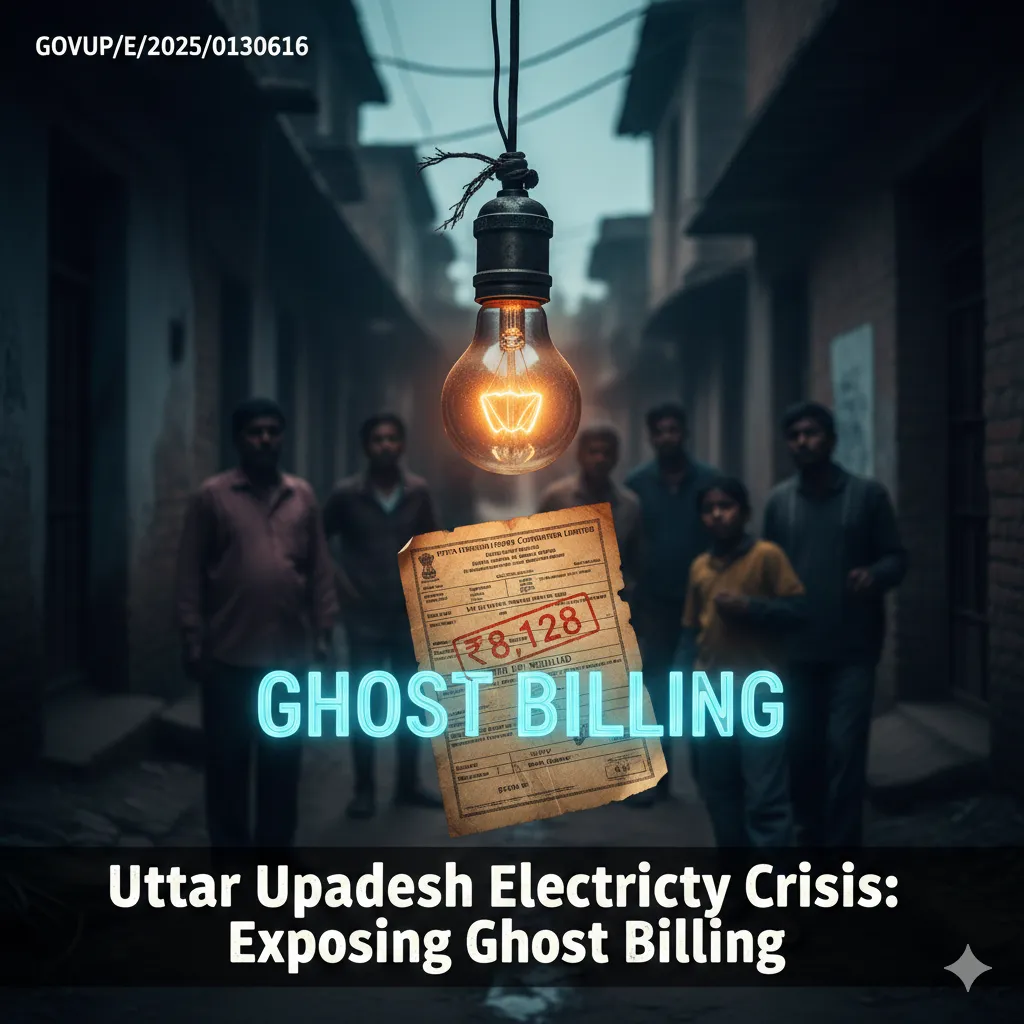
Key Takeaways (Uttar Pradesh Electricity Crisis)
- The case of Ms. Kalawati Devi illustrates bureaucratic apathy in resolving complaints related to the Uttar Pradesh Electricity Crisis.
- She received an inflated bill of ₹8,128. There was no functional meter. Officials refused to correct it based on an ‘assumed’ reading.
- The grievance process suffers from delays, conditional resolutions, and lack of accountability, leaving consumers in unresolved situations.
- The department improperly marked grievances as ‘Closed’ without actual resolutions, perpetuating financial risks for consumers.
- There are demands for immediate action. These include revising the bill. Additionally, there is a request to install a meter within seven days. Lastly, officials should be held accountable for their negligence.
Uttar Pradesh Electricity Crisis: The Ongoing Struggle for Fair Billing in Uttar Pradesh
The case of Ms. Kalawati Devi, represented by social activist Yogi M. P. Singh, highlights a troubling trend in public grievance redressal. The ongoing Uttar Pradesh Electricity Crisis is a relevant example. Departments tend to “close” cases on paper. However, they do so without actually resolving the underlying issue. (Uttar Pradesh Electricity Crisis)
There is a clear history of billing errors and administrative delays. However, the latest status of grievance GOVUP/E/2025/0130616 shows a “Case Closed” status. This leaves the consumer exactly where they started.
1. The Core Dispute: Inflated Bills Without Meters
The grievance centers on a bill of ₹8,128 issued to a consumer whose premises lacks a functional meter.
- The Inconsistency: The Executive Engineer (EE) admitted in a disposal report that no meter was installed.
- The Flaw: Despite this admission, the department has refused to suspend the bill. They have also refused to revise it. This refusal is based on an “assumed” reading. That reading far exceeds the consumer’s historical average of approximately ₹242.
2. Deficiencies in the Redressal Process (Uttar Pradesh Electricity Crisis)
The complainant has identified four critical failures in how the Uttar Pradesh Electricity Distribution Division (Second) handled the matter:
- Slow-Walking Progress: The Executive Engineer took over a month to initiate the paperwork. This was just for a meter installation from October 9 to November 7.
- Conditional Justice: The Subdivisional Officer (SDO) of Chhanabe reportedly made bill corrections conditional upon the installation of a meter. This situation creates a “catch-22” that penalizes the consumer for the department’s own equipment failure.
- Lack of Accountability: There has been no inquiry into the SDO’s refusal to provide assistance or the EE’s administrative procrastination.
3. The “Case Closed” Paradox
Sure, here you go:
“On December 8, 2025, the Joint Secretary’s office marked the grievance as ‘Closed.’ The remarks indicate that they closed the case by relying on an internal report. They did not resolve it by fixing the bill or installing the meter.” (Uttar Pradesh Electricity Crisis)
Feel free to let me know if you need any adjustments!
- Feedback: The complainant has rated the resolution as unsatisfactory.
- Current Status: The consumer remains at risk of an illegal financial demand. Meanwhile, the department claims they “resolved the matter.”
4. Formal Demands for Relief (Uttar Pradesh Electricity Crisis)
The petitioner has requested the following actions before the Chief Minister’s Secretariat to ensure justice:
- Immediate Bill Revision: Reverting the bill to a provisional amount based on 6-month averages within 7 days.
- Strict Deadlines: Completion of meter installation within one week, rather than the vague “one-month” timeline provided by the EE.
- Disciplinary Measures: An inquiry into Shri Manish Kumar Srivastava (EE) and the SDO of Chhanabe for negligence and professional misconduct.
Summary Table: Grievance Data (Uttar Pradesh Electricity Crisis)
| Field | Details |
| Registration Number | GOVUP/E/2025/0130616 |
| Complainant | Yogi M. P. Singh (for Kalawati Devi) |
| Department | Uttar Pradesh Electricity Department |
| Closing Date | 08/12/2025 |
| Status | Disposed (Unresolved) |
Would you like me to draft a formal rejoinder? Alternatively, would you prefer an appeal letter to the Joint Secretary based on this “unsatisfactory” closure?
🛑 Uttar Pradesh Electricity Crisis: The “Ghost Billing” Crisis in UP’s Electricity Department
## 1. The Trap of No-Meter Connections
The Department of Energy often issues electricity connections without physical meters. While this allows the department to meet “targets,” it leaves the consumer in a legal vacuum. Without a meter, there is no data. Without data, the department resorts to “Assessed Billing.” This approach is often arbitrary. The situation violates and breaks the law. (Uttar Pradesh Electricity Crisis)
## 2. The Case of Ms. Kalawati Devi: A Case Study in Apathy (Uttar Pradesh Electricity Crisis)
The recent grievance (Registration: GOVUP/E/2025/0130616) exposes a disturbing trend:
- The Error: A bill of ₹8,128 issued to a consumer with no meter.
- The Delay: The Executive Engineer (EE) took over a month. They needed this time just to write a letter to the private vendor (GMR Company).
- The False Resolution: “The portal marked the case as ‘Closed.’ It stated that the team would correct the bill after they installed the meter.” This leaves the consumer under the shadow of a massive debt they do not owe.
## 3. Why “Closing” the Grievance is a Mockery of Justice
The department’s disposal report is a classic example of “kicking the can down the road. (Uttar Pradesh Electricity Crisis)
- No Interim Relief: They refuse to suspend the disputed bill while waiting for the meter.
- Shifting Blame: By blaming external companies (GMR), the EE avoids personal accountability for the delay.
- Lack of Discipline: Despite clear evidence of the SDO Chhanabe’s refusal to assist, no inquiry has been initiated.
## 4. The Violation of the Electricity Supply Code (Uttar Pradesh Electricity Crisis)
Under the law, a consumer is entitled to:
- A functional meter at the time of connection.
- Provisional billing based on actual average consumption (which in this case is roughly ₹242, not ₹8,128) during disputes.
- Timely redressal of grievances within the 14-day window as per IGRS norms.
## 5. Our Demands for Accountability
We are calling on the Chief Minister’s Secretariat and Shri Arvind Mohan (Joint Secretary) to intervene:
- Immediate Suspension of the ₹8,128 demand.
- 7-Day Deadline for physical meter installation at the premises.
- Strict Action against the Executive Engineer and SDO for “Slow-Walking” public grievances.
“A grievance closed on paper is not a grievance resolved in reality. We demand justice, not just reports.”
#UPGovernment #PUPCL #Jansunwai #ElectricityCrisis #CorruptionFreeUP #YogiAdityanath
The Department uses this classic defensive tactic to shift the burden of proof. By claiming “consumer resistance,” officials create a convenient excuse. This excuse covers their own administrative delays and the inefficiency of their private contractors (like GMR).
To counter this narrative in your posts or legal appeals, you can use the following structured points to expose the flaw in their logic:
## Debunking the Myth: “Consumers Resist Meters”
1. The Burden of Proof Lies with the Department (Uttar Pradesh Electricity Crisis)
If a consumer truly refuses a meter installation, the Department must fulfill its legal obligations:
- Issue a formal notice to the consumer regarding the refusal.
- Create a “Panchnama” (Spot Report) signed by witnesses or local authorities.
- Provide Evidence: In the case of Ms. Kalawati Devi, the Executive Engineer’s report (08.12.2025) mentions only a letter sent to GMR, not a refusal by the consumer. This proves the delay is internal.
2. High Bills are the Real “Resistance”
The Department claims rural consumers avoid meters to hide consumption. However, the opposite is true here:
- The consumer is begging for a meter to prove their consumption is low (₹242 vs. ₹8,128).
- The Department gains from the absence of a meter. They can continue to issue “Assessed Bills” that are 30 times higher than actual usage.
3. Systematic Negligence vs. Individual Refusal
In rural Uttar Pradesh, meter installation is outsourced to private vendors. Often: (Uttar Pradesh Electricity Crisis)
- Vendors do not visit remote villages because it is not “cost-effective” for them.
- The Department fails to monitor these vendors. Then it blames the “rural mindset” to cover up for the vendor’s breach of contract.
4. Legal Consequences of Non-Installation (Uttar Pradesh Electricity Crisis)
According to the UP Electricity Supply Code:
- It is the mandatory duty of the Licensee (PVVNL/MVVNL) to provide a meter.
- If they cannot provide one, they cannot penalize the consumer with exorbitant “provisional” bills. The “Assessed” bill must be reasonable and based on connected load, not arbitrary figures.
## How to Weaponize this in your Appeal:
When filing your next rejoinder, use this specific phrasing to shut down their excuse:
“The Department’s general claim of ‘consumer resistance’ is inapplicable and defamatory in this specific case. The complainant has made multiple written requests for a meter (IGRS No. 60000250241115). The Executive Engineer’s own report confirms that the delay is due to the Department’s failure to coordinate with GMR Company. If there was resistance, why is there no ‘Refusal Memo’ on record? This is a clear case of administrative procrastination, not consumer non-compliance.”
Here is the updated structure for your post. It now includes a dedicated section to debunk the “Consumer Resistance” excuse used by the Department.
🛑 SYSTEMIC FAILURE: The “Ghost Billing” Crisis in UP’s Electricity Department (Uttar Pradesh Electricity Crisis)
## 1. The Trap of No-Meter Connections
The Department of Energy often issues electricity connections without physical meters. While this allows the department to meet “targets,” it leaves the consumer in a legal vacuum. Without a meter, there is no data. Without data, the department resorts to “Assessed Billing”. This is often arbitrary, inflated, and illegal. (Uttar Pradesh Electricity Crisis)
## 2. Debunking the Myth: The “Consumer Resistance” Excuse (Uttar Pradesh Electricity Crisis)
The Department frequently claims that rural consumers prevent meter installations to avoid paying for power. In this case, that narrative is a blatant lie.
- The Consumer is the Petitioner: In the case of Ms. Kalawati Devi, the consumer is begging for a meter to stop the fraudulent billing of ₹8,128.
- Missing Evidence: If the consumer had resisted, where is the “Refusal Memo” or “Panchnama” from the department?
- Vendor Apathy: The Executive Engineer’s report admits the delay is due to his office’s correspondence with GMR Company. The consumer is not at fault for the delay.
- The Reality: The “Resistance” is coming from the Department. It finds it easier to issue inflated “Assessed Bills” than to send a technician to a rural doorstep.
## 3. The Case of Ms Kalawati Devi: A Case Study in Apathy (Uttar Pradesh Electricity Crisis)
The recent grievance (Registration: GOVUP/E/2025/0130616) exposes a disturbing trend:
- The Error: A bill of ₹8,128 issued to a consumer with no meter.
- The Delay: It took the Executive Engineer (EE) over a month just to write a letter to the private vendor.
- The False Resolution: The portal marked the case as “Closed.” They claimed that they would correct the bill after installing a meter. This leaves the consumer under the shadow of a massive debt they do not owe today.
## 4. Why “Closing” the Grievance is a Mockery of Justice
A “Closed” status on the IGRS portal should show that someone has solved the problem, rather than simply noting it. (Uttar Pradesh Electricity Crisis)
- No Interim Relief: They refuse to suspend the disputed bill while waiting for the meter.
- Shifting Blame: By blaming external companies (GMR), the EE avoids personal accountability for the delay.
- Lack of Discipline: Despite evidence of the SDO Chhanabe’s refusal to perform his duty, the department has taken no action. The department remains silent on disciplinary action.
## 5. Our Demands for Accountability
We call upon the Chief Minister’s Secretariat and Shri Arvind Mohan (Joint Secretary) to act:
- Immediate Suspension of the ₹8,128 demand and issuance of a bill based on actual average usage (approx. ₹242).
- The Executive Engineer must install the meter within 7 days, or he will be personally liable.
- Strict Inquiry into the “Consumer Resistance” excuse used to mask administrative incompetence.
“A grievance closed on paper is not a grievance resolved in reality. We demand justice, not just reports.” (Uttar Pradesh Electricity Crisis)
#UPGovernment #PUPCL #Jansunwai #ElectricityCrisis #CorruptionFreeUP #YogiAdityanath #ConsumerRights


Facing a similar challenge? Share the details in the box below, and our team of experts will do their best to help.