
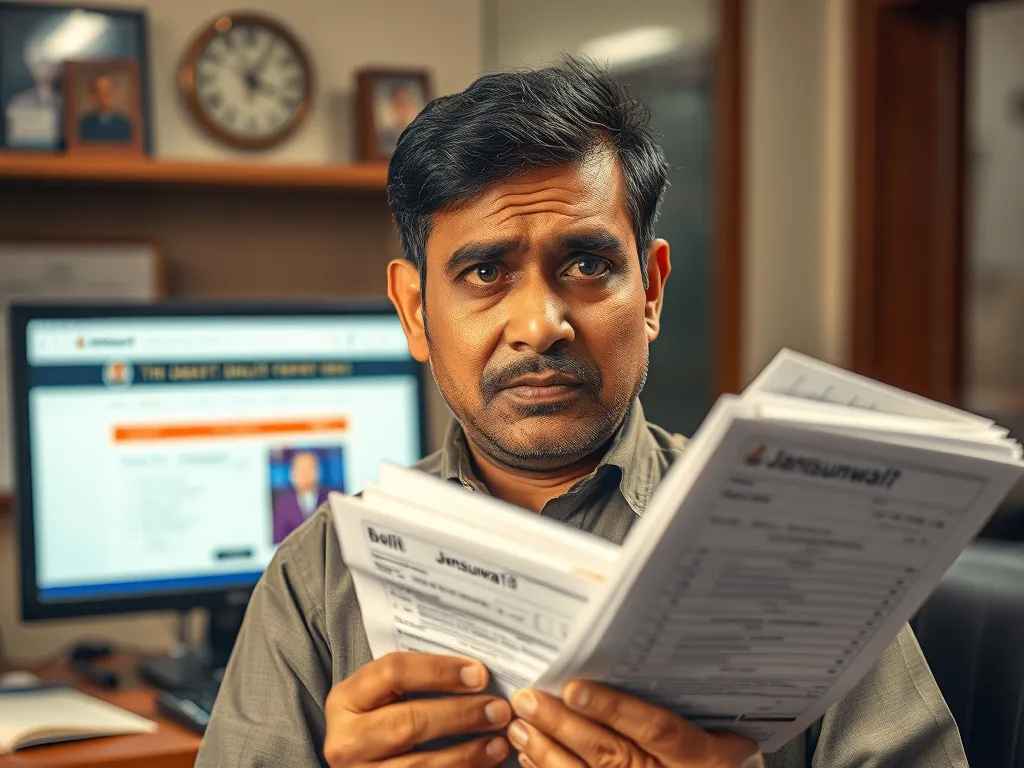
Resolving Electricity Billing Issues in Uttar Pradesh is an increasingly pressing concern nowadays. Many consumers frequently face inflated bills that often seem to appear out of nowhere, consequently raising significant concerns and frustration. Initially, the electricity providers issue these tempered bills, which ultimately leave customers bewildered and angry. To make matters worse, they often rectify the errors only after receiving bribes, a troubling practice that severely undermines trust in the system. Furthermore, this widespread corruption exacerbates the situation, leading to substantial financial strain for families who rely on accurate billing for effective budgeting. Thus, urgent reforms are not only necessary but imperative to restore integrity and ensure fair practices within the electricity sector in the state.
The blog post highlights a significant disconnect between the digital promises of “Good Governance” in Uttar Pradesh. It contrasts with the reality of local administrative operations.
Here are the key takeaways:
- Bureaucratic “Paper Compliance”: The central issue is not just a billing error. Officials file false or misleading reports on the Jansunwai (IGRS) portal. They claim they will fix a problem in “three days.” However, they fail to act for months. The department creates a facade of efficiency that masks their underlying inaction.
- Arbitrary Billing Without Meters: The Electricity Distribution Division 2nd (Mirzapur) issues estimated bills instead of installing a functional meter. This violates basic consumer rights and forces consumers to pay for electricity that they may not have consumed.
- Institutional Fear and Harassment: The case illustrates a “bureaucratic trap.** The complainant felt compelled to pay arbitrary bills for an unoccupied house. This is because the process of disconnecting and reconnecting services is cumbersome. It is also expensive. Such difficulties deter them from seeking a fair resolution.
- Erosion of Public Trust: When local officials like Executive Engineer Manish Kumar Srivastava fail to honor commitments monitored by the Chief Minister’s Office (CMO), it lowers the dignity of the state’s grievance redressal systems. This failure contradicts the government’s claims. The administration is supposed to be led by “law-and-order.”
- Call for Consequence Management: The post argues that digital portals are ineffective without accountability. It suggests that there need to be real disciplinary consequences for officials. These consequences are necessary for those who submit misleading status reports. Until such measures are implemented, the cycle of administrative apathy will continue.
Administrative Apathy and the Illusion of Governance: The Case of Lalit Mohan Kasera vs. UPPCL
In the digital age, the government of Uttar Pradesh frequently touts its Jansunwai (IGRS) portal as a beacon of “Good Governance” (Su-shasan). Furthermore, they establish it as a direct bridge between the common citizen and the administration. This, in turn, ensures that grievances reach the system and receive resolution under the watchful eye of the Chief Minister’s Office. However, the reality on the ground often reveals a different, more troubling picture. Specifically, this picture illustrates bureaucratic inertia, false reporting, and a systemic lack of accountability.
The ongoing struggle of Lalit Mohan Kasera (Grievance No: GOVUP/E/2025/0038986) undoubtedly serves as a quintessential case study in how administrative mismanagement can transform a seemingly simple utility issue into a prolonged saga of mental and financial harassment.
The Core of the Dispute: Arbitrary Billing and Broken Promises (Resolving Electricity Billing Issues)
The grievance centers on the Electricity Distribution Division 2nd in Mirzapur, specifically under the jurisdiction of Executive Engineer Mr. Manish Kumar Srivastava. At the heart of the matter is a classic administrative failure: the issuance of arbitrary electricity bills without the foundation of actual meter readings.
For many citizens, electricity bills are not just monthly expenses but legal documents that should reflect actual consumption. In Mr. Kasera’s case, the department has allegedly bypassed the standard operating procedure of meter-based billing. They opted instead for estimated or arbitrary figures. This is not merely a clerical error; it is a violation of the consumer’s right to fair billing as mandated by the Electricity Regulatory Commission.
Resolving Electricity Billing Issues: The Paper Trail of Neglect
The most damning aspect of this case is not just the billing error itself, but the repeated failure of the department to honor its own written commitments.
- December 20, 2024: The government filed the first grievance (GOVUP/E/2024/0093661), signaling the start of the formal complaint process.
- February 7, 2025: The party filed a follow-up grievance (GOVUP/E/2025/0013079) because no progress occurred.
- February 19, 2025: In a formal response (Letter No. 1080), Executive Engineer Manish Kumar Srivastava clearly stated that they would install an electric meter within three working days. They also mentioned that they would modify the bill based on actual readings after the installation. (Resolving Electricity Billing Issues)
Fast forward to April 18, 2025. The complainant finds himself back at square one. Two months have passed since the department’s “three-day” promise. Yet, they have not installed any meter. They have also failed to correct any bills. This timeline highlights a disturbing trend. Officials use the Jansunwai portal to submit “disposal reports” that exist only on paper to meet internal KPIs. Meanwhile, the actual problem festers on the ground.
Lowering the Dignity of the Chief Minister’s Office
The complainant raises a poignant philosophical and legal question: Does such blatant misinformation not lower the dignity of the public grievance portal? (Resolving Electricity Billing Issues)
The Jansunwai portal is monitored by the Chief Minister’s Office (CMO). When an Executive Engineer submits a report claiming a matter will be resolved in three days and then fails to act for sixty, it is a direct affront to the authority of the state. It suggests that the local bureaucracy feels a sense of impunity, believing that as long as a “status update” is uploaded, the actual outcome is irrelevant.
This “paper compliance” creates a facade of efficiency. On the dashboard of the CMO, the grievance might appear as “processed” or “resolved,” but for the citizen, the “lawlessness and anarchy” (as described by Mr. Kasera) remains the lived reality. This gap between digital data and ground reality is where the trust in democratic institutions begins to erode.
The Consumer’s Dilemma: The Trap of Reconnection Fees
A unique facet of this case is the psychological and financial burden placed on the consumer. Notably, Mr. Kasera highlighted that the premises in question (Account No: 2521372000, under the name of Neelam Devi) are currently unoccupied. Despite the fact that he is not living there, he has nevertheless continued to pay bills in order to avoid the “cumbersome proceedings” and “huge amounts” associated with official disconnection and future reconnection. (Resolving Electricity Billing Issues)
This is a form of institutional extortion. Specifically, the fear of a complex, bureaucratic nightmare ultimately forces citizens to pay for services they aren’t even using. Furthermore, the department’s failure to install a meter—which would effectively prove zero consumption in an empty house—unquestionably serves the department’s interests by maintaining a steady stream of arbitrary revenue at the expense of an honest citizen.
The Role of Leadership: A Call for Accountability
The grievance is currently under the perusal of Shri Arvind Mohan, Joint Secretary at the Chief Minister’s Secretariat. The eyes of the public are now on the Lucknow administration to see if they will hold the Mirzapur division accountable. (Resolving Electricity Billing Issues)
Good governance cannot be achieved through portals and apps alone; it requires consequence management. If an Executive Engineer submits a misleading report to a state-monitored portal, there must be disciplinary repercussions. Without accountability, the Jansunwai portal risks becoming a “black hole” where complaints go to be theoretically resolved but practically ignored.
Conclusion: The Path Forward
The demand of the complainant is simple, logical, and legally sound:
- Immediate Installation: Install the meter as promised in February.
- Bill Rectification: Reverse the arbitrary charges and bill according to actual (or zero) consumption.
- Administrative Audit: Investigate why the reports submitted on February 19th were never implemented.
Lalit Mohan Kasera’s struggle is not just about a ₹391 bill or a missing meter; rather, it represents a fight against a system that feels it is above the people it serves. In order for the slogan of “Sabka Saath, Sabka Vikas” to hold weight in Mirzapur, the Electricity Department must not only transition from a culture of “submitting reports” but also embrace a culture of “solving problems.”
To address the issues regarding arbitrary billing and non-compliance by the electricity department in Mirzapur, the following contact details and resources for the relevant public authorities are provided.
1. Local Authority: Electricity Distribution Division (EDD-II), Mirzapur (Resolving Electricity Billing Issues)
The primary official responsible for your case is the Executive Engineer of Division 2nd.
| Detail | Contact Information |
| Officer Name | Mr. Manish Kumar Srivastava |
| Designation | Executive Engineer (EDD-II), Mirzapur |
| Mobile Number | 9450963598 |
| Email Address | ee.2mirzapur@puvvnl.in |
| Personal Mobile | 05442-252008 |
2. State Authority: Chief Minister Secretariat, Lucknow (Resolving Electricity Billing Issues)
Since your grievance is currently “Under Process” with the CMO, you can reach out to the Joint Secretary for escalation regarding the false reports submitted by the local division.
| Detail | Contact Information |
| Officer Name | Shri Arvind Mohan |
| Designation | Joint Secretary, Chief Minister Office |
| Phone (Lok Bhawan) | 0522-2226350 |
| Direct Phone | 0522-2226354 |
| Official Email | arvind.12574@gov.in |
| Alternate Email | jansunwai-up@gov.in (Technical/General Support) |
3. Higher Management: Purvanchal Vidyut Vitaran Nigam Ltd. (PuVVNL) (Resolving Electricity Billing Issues)
If local officials fail to act, the Managing Director’s office in Varanasi oversees all Mirzapur operations.
- Managing Director (PuVVNL): Shri Shambhu Kumar, IAS
- Phone: 0542-2318437
- Email: md@puvvnl.in
- Superintending Engineer (Mirzapur Circle): Shri Ram Das (9415304000; se.mirzapur@puvvnl.in)
4. Important Web Links & Portals (Resolving Electricity Billing Issues)
- Jansunwai (Samadhan) Portal:jansunwai.up.nic.in
- Use this to track your existing grievance numbers: GOVUP/E/2025/0038986 and GOVUP/E/2025/0013079.
- UPPCL Consumer Portal:www.uppcl.org
- For “Self Bill Generation” or to register a formal departmental complaint.
- PuVVNL Official Website: puvvnl.in
Actionable Next Steps (Resolving Electricity Billing Issues)
- Send a Direct Email: Use the emails provided above to send a formal PDF letter to the Joint Secretary (arvind.12574@gov.in) and the MD (md@puvvnl.in). Mention that the Executive Engineer’s report dated 19th Feb 2025 (Letter No. 1080) contained false promises that were never fulfilled.
- Call the Helpline: Dial 1912 (UPPCL Toll-Free) to register a “Non-Compliance of IGRS Order” complaint. This is a separate internal tracking system.
Would you like me to draft the specific text for an email to the Joint Secretary to highlight the “false reporting” aspect of your case?
For another documented case of consumer rights violations in electricity billing, see Case of Consumer Rights Violation in Electricity Billing, detailing Smt. Neelam Devi’s grievance against arbitrary billing practices.


Facing a similar challenge? Share the details in the box below, and our team of experts will do their best to help.