
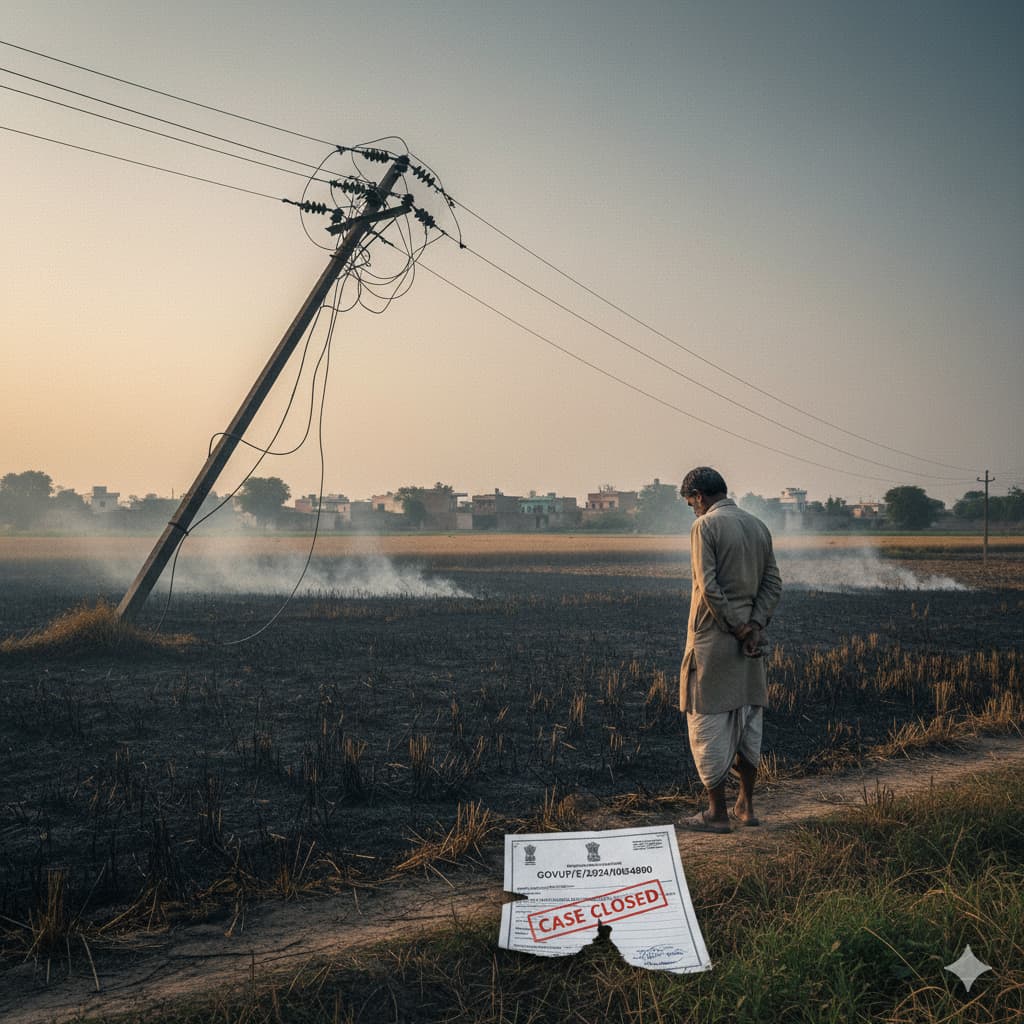
The Uttar Pradesh Power Corporation Limited, consequently, delays the compensation payment for farmer Dayanand Singh, thereby demonstrating inefficiency that affects not just one individual, but the larger farming community that depends on timely financial support.
This situation, furthermore, clearly illustrates the shortcomings of the administration, revealing a systemic flaw that undermines trust in governmental institutions.
It also, additionally, highlights how easily one can get caught in a bureaucratic loop, where endless paperwork and red tape stall crucial payments, leaving farmers in precarious financial positions, unable to meet their basic needs, which further exacerbates their challenges in an already difficult agricultural environment.
A Bureaucratic Loop: The Three-Year Fight for Crop Compensation in Mirzapur
The Sparks that Flew: A Farmer’s Loss Ignored Since 2021 reflects Bureaucratic Loop in U.P.
The case of Dayanand Singh from Mirzapur, Uttar Pradesh, serves as a stark example of the challenges faced by farmers in rural India; consequently, it highlights how bureaucratic delays can transform a clear case of loss into a protracted legal and administrative battle that leaves individuals feeling helpless and frustrated.
Specifically, on April 18, 2021, a fire tragically burned Mr. Singh’s wheat crop due to a short circuit, which is not just an unfortunate incident but also a reflection of the inadequate infrastructure and safety measures in place within the region.
Therefore, it becomes evident that the distribution company is responsible for this electrical accident, as their negligence directly contributed to the loss of livelihood for Mr. Singh and potentially many others in the area.
Furthermore, the loss was significant: the fire affected an area of 0.4999 hectares, with assessed damages totaling Rs. 25,200, a sum that represents not only the immediate financial burden but also the long-term impact on Mr. Singh’s ability to sustain his family and invest in future crops.
This case exemplifies the urgent need for effective policy reforms and improvements in bureaucratic efficiency to ensure that farmers can reclaim their losses promptly and fairly.
What should have been a straightforward compensation process has, unfortunately, devolved into a frustrating cycle as officials repeatedly reject grievances. Consequently, we have entered another classic bureaucratic loop, even with clear reports backing the processes. Moreover, officials give non-committal responses, and they continually defer justice.
The Paper Trail of Delay: Key Dates and Documents
The paper trail confirms the facts and the timeliness of the starting investigation; however, it hasn’t secured the compensation that Mr. Singh desperately needs to navigate this challenging situation.
Consequently, this reinforces the bureaucratic loop experienced by Mr. Singh, as he finds himself repeatedly providing the same documentation and evidence to various departments, each time feeling the weight of frustration and the invasive nature of the process.
Moreover, the endless back and forth results not only in a significant delay but also amplifies his sense of helplessness, making it increasingly difficult for him to focus on other essential aspects of his life during this tumultuous period.
| Event | Date | Detail |
| Crop Burning | 18/04/2021 | Due to an electrical short circuit. |
| Lekhpal’s Report | 15/06/2021 | The revenue official (Lekhpal) assessed the damages. |
| Report Forwarded | 19/06/2021 | The Revenue Inspector forwarded the report from Tehsil Sadar. |
| Grievances Filed | 20/09/2024 | Two detailed grievances (GOVUP/E/2024/0064800 & GOVUP/E/2024/0064818) registered with the Government of Uttar Pradesh (UP). |
| Case Closed (Twice) | 05/10/2024 | Both grievances were closed under the remark “प्रकरण मांग श्रेणी का है” (The matter is of the demand category). |
| Official Reply | 05/11/2024 (Dated 21/10/2024 in one reply) | The Executive Engineer, Electricity Distribution Division Second, informs that the matter has been sent back to the Tehsildar-Sadar for re-investigation |
The team prepared a detailed report in June 2021. Now, in late 2024, the Executive Engineer’s office is initiating a re-investigation. This indicates that the authorities are returning to the starting point. This will effectively add more months, if not years, to this bureaucratic loop.
The Reason for Rejection: ‘Non-Prescribed Format’
One of the grievances (GOVUP/E/2024/0064818) points to a key reason for the hold-up that has frustrated many residents awaiting their due compensation. The Tehsil Sadar office submitted the initial compensation report, a document that is crucial for the processing of claims. Allegedly, it was not in the prescribed format, which has led to significant delays in addressing the concerns of those affected.
This issue arose due to a lack of clarity in the guidelines established, which were detailed in the circular issued by the Uttar Pradesh Power Corporation Limited (UPPCL). The circular outlined the required documentation and protocols, but it seems there was a misalignment in understanding among the local officials.
As a result, this miscommunication has perpetuated the bureaucratic loop, creating barriers for individuals who rely on timely compensation for their loss.
This raises a serious question about administrative competence and accountability:
Should a farmer, who has already suffered a loss, be penalized? This is due to the clerical error of a senior government official. This official is the Sub Divisional Magistrate Sadar. They neglected to send the report in the correct format, showing “dereliction of duty”.
The complainant argues that every public authority has an obligatory duty. Specifically, this is under the Right to Information Act, 2005, Section 4(1)(d). Consequently, they must give the reasons for its decision to the parties concerned. Moreover, the rejection, based on a formatting technicality, is what is causing the immense delay in justice.
The Vicious Cycle: From Closure to Re-Investigation
On October 5, 2024, the officer swiftly marked both grievances “Case closed.
In a rather disappointing turn of events, the highly unsatisfactory remark stated that the officer regarded the matter merely as a “demand,” dismissing the underlying issues that warranted more serious consideration.
The officer resolved the grievances at the “subordinate officer level,” which felt inadequate to the individuals involved, as they had expected a more thorough investigation and a fair resolution.
It was clear that the complexities of the situation were not fully appreciated, leading to a perception that the grievances were treated with indifference rather than the urgency and seriousness they deserved.
This approach left many questioning the effectiveness of the grievance redressal system, prompting discussions about the need for more accountability and a deeper understanding of such critical issues.
The Executive Engineer’s office replied later, indicating that they returned the process. They sent it back to the Tehsildar-Sadar for a fresh “Jaanch” (investigation). This action contradicts the initial closure. It suggests that the authorities have not actually closed the case. Instead, it merely gets trapped in a new phase of administrative ping-pong.
Mr. Singh’s complaint highlights that the Kotwali Vindhyachal Police already registered an FIR in this matter. This further cements the facts of the electrical accident. The administrative system has neglected to act in the interest of justice. This failure is clear in the continued procrastination in paying compensation. Three years have passed since the incident, yet there is still a delay in resolving this bureaucratic loop.
The case remains a live and pressing issue. The public loses faith in the state’s law and order. This happens when the victim of an accident must spend years fighting the bureaucracy for a mere Rs. 25,200 in compensation. The relevant authorities must step in. This includes the Joint Secretary at the Chief Minister’s Secretariat, Shri Arvind Mohan. They need to break this cycle of delay.
Farmer Dayanand Singh could not get compensation in 3 and half years


Facing a similar challenge? Share the details in the box below, and our team of experts will do their best to help.