
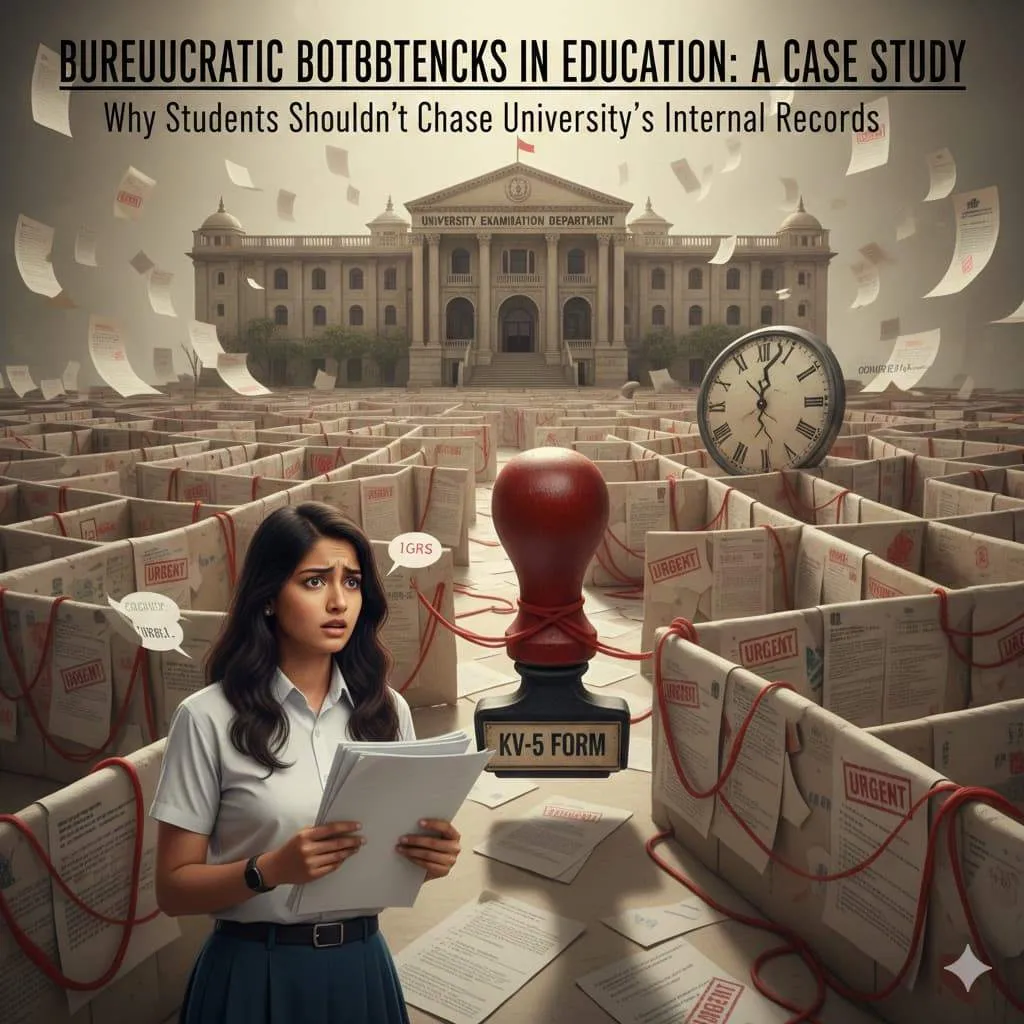
Key Takeaways (Bureaucratic Bottlenecks in Education)
- Students should not bear the burden of retrieving university records, highlighting bureaucratic bottlenecks in education.
- The case of Bhoomika Singh illustrates significant failures in institutional processes and delays in result correction.
- The university’s instruction for students to provide the KV-5 form reflects a broader issue of institutional inaction and responsibility diffusion.
- Delays in addressing student grievances can impact academic standing and future opportunities, stressing the need for institutional accountability.
- Proposed solutions include direct coordination between departments. There is also a 7-day mandate for resolution. This ensures students are not left to navigate administrative hurdles.
🏛️ Bureaucratic Bottlenecks in Education: Why Students Should Not Be Forced to Chase University’s Internal Records
The Core Conflict: A Case Study in Institutional Inaction
The academic journey should culminate in a correct and timely result, not a protracted administrative battle. The case of Bhoomika Singh (Roll No. 40525870057), a B.Sc. II Semester student, points out a critical failure point in institutional processes. This case illustrates how Bureaucratic Bottlenecks in Education can directly impact individuals. It reveals the improper shifting of an internal administrative burden onto the student.
I was incorrectly marked ‘ABSENT’ in a Chemistry Practical (MAJOR II). The effort to correct this error has devolved into a multi-layered grievance. This situation highlights a profound lapse in coordination between the affiliating University (MGKVP) and its constituent college (K.B. P.G. College, Mirzapur).
This situation goes beyond a simple result correction. It clearly asserts the principle that institutional duties must remain institutional duties. When a University demands a student retrieve a document, it creates a bureaucratic loop. This document, like the official attendance sheet (KV-5 form), is strictly under the custody of a departmental head. This loop is designed to frustrate and delay, rather than resolve.
The Paper Trail: Applicant Diligence vs. Institutional Drift
The applicant, in this case, the student’s father, Yogi M. P. Singh, has demonstrated exceptional diligence, meticulously following all prescribed procedural steps: (Bureaucratic Bottlenecks in Education)
- Formal Application Submission: The request for correction was officially submitted and forwarded through the affiliated college (K.B. P.G. College). This is the standard, prescribed channel, signalling institutional acknowledgement of the discrepancy.
- Grievance Filing and Escalation: Multiple online grievances were registered on the official UP Government portal (IGRS). Examples include case numbers like GOVUP/E/2025/0128430 and GOVUP/E/2025/0129743.
- Representation to Apex Authority: The matter was formally brought to the attention of the Chief Minister Secretariat. This highlighted the severity of the institutional delay.
Despite these exhaustive steps, the process remains stalled due to a single, erroneous directive from the University’s Examination Confidential Department.
The KV-5 Form: Custody, Duty, and the Logic of Institutional Records (Bureaucratic Bottlenecks in Education)
The crux of the current deadlock lies in the University’s instruction, issued via letter (No. P.G.O./2159/2025 dated 14.11.2025), that the student must submit the KV-5 form (Attendance Sheet).
Understanding the KV-5 Form (Bureaucratic Bottlenecks in Education)
The KV-5 form is not a personal document; it is the official, departmental attendance record. By its very nature, this record is:
- Custody of the College: It is a critical administrative document. The College’s Chemistry Department and the Principal’s office exclusively hold and certify it.
- Proof of Institutional Function: It confirms that the college, as a unit of the University, held the examination. It also recorded attendance.
The Assertion of Institutional Duty (Bureaucratic Bottlenecks in Education)
The student’s initial application for correction was forwarded by the College. This action constituted a formal request from one institutional body to another. The forwarding process inherently acknowledges the college’s role in verifying the student’s claim.
The institutional logic must therefore be:
The College has already forwarded the application asserting the error. The University’s Examination Confidential Department must initiate direct, time-bound coordination with the Principal/Examination Controller of K.B. P.G. College to retrieve the required, certified KV-5 form.
Forcing the student to manually retrieve official records is unfair. It is like asking a citizen to collect evidence for a government department from another government department. This practice bypasses administrative processes. It inappropriately makes the student the courier. The student serves as an intermediary between two structurally linked offices. (Bureaucratic Bottlenecks in Education)
🚨 The Larger Ramifications of Administrative Stalling
This single incident reflects a broader problem in the higher education administration system. Administrators often use bureaucratic procedures to shield against prompt action. (Bureaucratic Bottlenecks in Education)
- Mental Toll on the Student: Delays in result correction can impact a student’s eligibility for further studies. They also affect subsequent semesters and future career plans. An ‘ABSENT’ mark for an attended exam is not just a clerical error. It is a direct attack on the student’s academic standing.
- Dilution of Accountability: The University requires the student to chase the KV-5. This implicitly absolves its confidential department of the duty to coordinate with its own affiliated unit. This diffuses institutional accountability and ensures the delay persists.
- The Inefficiency of IGRS: The IGRS (JanSunwai) portal is a vital tool for public grievance redressal. However, the Chief Minister’s Office responds by directing the applicant back to the portal for a formal entry. This response, while procedurally correct, underscores the bureaucratic loop. The citizen must use the formal channel. When the formal channel fails to force institutional action, they must then use a separate formal grievance channel. This often leads to the same stalled outcome.
✅ A Path to Resolution: The 7-Day Mandate (Bureaucratic Bottlenecks in Education)
The proposed resolution is clear, efficient, and institutionally sound:
- Immediate Cessation: The MGKVP Examination Confidential Department must immediately stop. They must not demand the manual submission of the KV-5 form by the student.
- Direct Coordination: The Department must issue a time-bound directive (e.g., a 7-day mandate) to the Principal/Examination Controller of K.B. P.G. College.
- Evidence Retrieval: This directive must instruct the College to immediately verify the claim. The College must also officially transmit the certified KV-5 form (Attendance Sheet) to the University’s examination department.
The resolution of this issue depends on the University asserting its administrative authority. The University needs to correct a mutual institutional error with its affiliated institution. Students benefit from the system. They should not be forced to become the administrative muscle that keeps the system running.
Actionable Next Step (Bureaucratic Bottlenecks in Education)
The applicant, Mr. Singh, should consider framing a final, concise communication to the University. He should cite the forwarding letter from the College and the University’s own letter. This will legally establish the document trail. He should explicitly state that the burden of internal record retrieval now rests entirely with the University. He should demand a final correction within a stipulated timeframe. (Bureaucratic Bottlenecks in Education)
2023 Corruption Perceptions Index reveals urgent need for tangible change in Asia Pacific


Facing a similar challenge? Share the details in the box below, and our team of experts will do their best to help.