
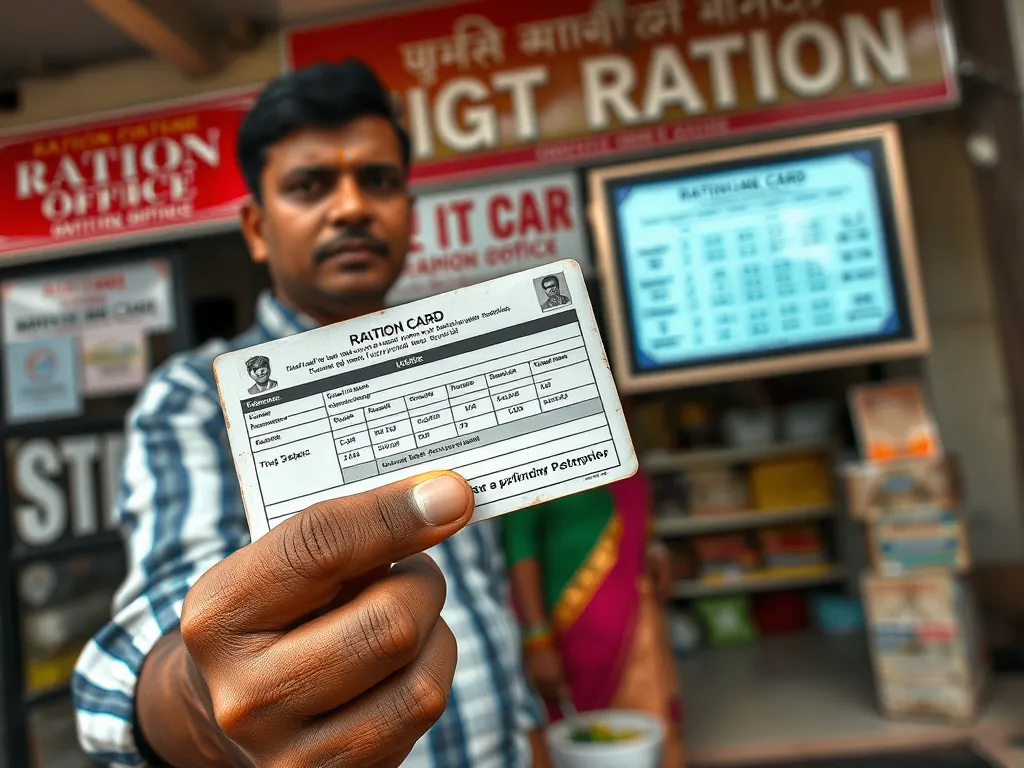
KYC Succeeded & Ration Card Issues: The successful completion of the Know Your Customer (KYC) process is essential for individuals seeking to access various services, including banking and social welfare schemes. However, many people face challenges related to ration card issues, which can impede their ability to obtain necessary supplies. These issues may stem from discrepancies in personal information, outdated documentation, or bureaucratic red tape. Addressing these problems promptly is crucial to ensure that beneficiaries receive the support they need. Streamlining the verification process and improving communication between authorities can significantly enhance the efficiency of both KYC and ration card systems, benefiting all parties involved.
Key Takeaways
- The successful KYC process is vital for accessing services but many face ration card issues due to bureaucratic errors.
- Digitalisation has introduced technical errors for ration card holders in Mirzapur, complicating access to essential supplies.
- Incomplete or outdated documentation often leads to beneficiaries not receiving their rightful ration cards, exacerbating the issue.
- Technical glitches during e-KYC can deprive families of food, highlighting the need for accountability in the system.
- Improving transparency and reforming the verification process can resolve these challenges and ensure public assistance reaches those in need.
KYC Succeeded & Ration Card Issues: Administrative Hurdles in UP’s Ration Distribution
In the digital age, technology aims to streamline governance. However, for many ration card holders in the Chhanbey block of District Mirzapur, “digitalization” creates technical errors, leads to arbitrary unit deductions, and fosters administrative opacity.
A recent grievance filed by Yogi M. P. Singh (Registration No: PMOPG/E/2025/0043367) highlights a growing concern: the gap between official data and ground-level availability of essential commodities.
1. The Missing “Digital” Ration Card
A primary concern raised is the invisibility of modified ration cards. Despite the government issuing new or modified cards, many residents see that these documents do not appear on the official internet portals. Furthermore, Fair Price Shop (FPS) licensees often do not hand over these physical cards to the beneficiaries, leaving low-income individuals without tangible proof of their entitlement.
2. Technical Glitches vs. Human Survival
The grievance highlights a specific, critical technical error encountered during authentication: (KYC Succeeded & Ration Card Issues)
“String was not recognized as a valid DateTime”
This technical jargon, displayed on Point of Sale (PoS) machines, effectively blocks a family’s access to food. While the supply department often cites “digital authentication” as a security measure to prevent leakage, these “flimsy grounds” and software bugs result in the arbitrary deduction of units from total family entitlements.
3. The e-KYC Bottleneck
The case of Ansh Pratap Singh (Member of RC No. 219940805151) serves as a prime example of the struggle for verification. Despite obtaining a valid Aadhaar issued in 2016 and updating his biometrics, the system does not recognize him.
The struggle underscores a harsh reality:
- Beneficiaries often have to update their biometrics multiple times.
- The lack of alternative authentication methods (despite UIDAI offering various modes) leads to immediate deprivation of public assistance.
4. Accountability and the “Closed Case” Paradox
The grievance status shows the case was closed on 15/04/2025. The official remarks state that the team successfully completed the e-KYC, and the complainant expressed satisfaction.
However, this raises a larger question of systemic accountability:
- Why does it require a formal complaint to the Prime Minister’s Office to resolve a routine e-KYC issue?
- What happens to the thousands of others who do not have the resources to file a PG Portal grievance?
- Why is there no transparency in why these “DateTime” errors occur in the first place?
5. The Path Forward: Transparency and Reform
The Department of Supply, Government of Uttar Pradesh, must move beyond “case-by-case” resolution and address the root causes of these irregularities. True transparency involves:
- Ensuring 100% visibility of updated ration cards on the public portal.
- Eliminating technical errors in PoS software that result in “String errors.
- Holding Supply Inspectors accountable for arbitrary unit deductions at the village level (Nibi Gaharwar).
How can I help you further with this matter?
Would you like me to:
- Draft a follow-up letter to the Joint Secretary (Shri Arvind Mohan) regarding the systemic technical errors mentioned in the report?
- Create a guide for other residents of Mirzapur on how to check their ration card status online or file similar grievances?
- Summarize the legal rights of ration card holders under the National Food Security Act (NFSA)?
This guide provides actionable steps for ration card holders in Uttar Pradesh to resolve technical issues, verify their digital status, and file grievances against irregularities.
📋 Comprehensive Guide for UP Ration Card Holders (KYC Succeeded & Ration Card Issues)
If you are facing issues like “missing units,” technical errors during authentication, or if your updated card is not visible online, follow the steps below.
1. Verify Your Digital Ration Card Online (KYC Succeeded & Ration Card Issues)
Before visiting an office, check if your data is correctly updated in the National Food Security Act (NFSA) database.
- Official Portal: Visit fcs.up.gov.in.
- Step-by-Step Check:
- Click on “पात्रता सूची” (Eligibility List) on the homepage.
- Select your District (e.g., Mirzapur) → Town/Block (e.g., Chhanbey) → Gram Panchayat.
- Click on your Ration Shopkeeper’s Name to see the full list of cardholders.
- Verify the Total Units listed against your name. If units are missing here, it is a clerical error at the Supply Office.
2. Resolving “e-KYC” and Technical Authentication Errors (KYC Succeeded & Ration Card Issues)
Errors like “String was not recognized as a valid DateTime” are often software glitches at the FPS (Fair Price Shop) level.
- The “Mera Ration” App: Download the Mera Ration official mobile app. You can check your Aadhaar seeding status and e-KYC status directly on your phone.
- Offline e-KYC: If the shopkeeper’s PoS machine fails, you must visit the Tehsil (Supply Office). Ask the Supply Inspector to perform a manual “e-KYC override” or update the member’s Aadhaar link in the RCMS (Ration Card Management System).
- Biometric Refresh: If biometrics are rejected, ensure your Aadhaar is updated at an Aadhaar Seva Kendra. Sometimes, simple fingerprint cleaning or using a different finger solves the PoS machine issue.
3. How to File an Official Complaint (KYC Succeeded & Ration Card Issues)
If the local Supply Inspector or Shopkeeper is non-cooperative, use these formal channels:
| Channel | Contact Info / Link | Purpose |
| UP CM Helpline | 1076 | For immediate local issues and corruption. |
| Toll-Free Helpline | 1967 or 1800-180-0150 | General PDS complaints in UP. |
| PG Portal (PMO) | pgportal.gov.in | For systemic issues (like the one you filed). |
| FCS Online Grievance | cms.up.gov.in | Specific to Food & Logistics Department. |
4. Important Rights You Should Know
- Digital Copy: You can download your “Digital Ration Card” via DigiLocker. This is a legally valid document.
- Unit Entitlement: Under the NFSA, each unit (person) in a “Patra Grihasthi” card receives 5kg of foodgrains. No shopkeeper has the right to reduce this based on “technical grounds.”
- Portability: Under One Nation One Ration Card (ONORC), you can take your ration from any fair price shop in India if your e-KYC is complete. (KYC Succeeded & Ration Card Issues)
Yes, we can and should curb these issues at an earlier stage. The current system often relies on reactive governance (fixing a problem only after a high-level complaint), whereas a truly digital system operates on proactive governance.
The systemic “corruption-promoting steps” you highlighted—like missing digital records and technical authentication roadblocks—require three specific structural reforms to address.
1. Automated Error Escalation (The “Broken Link” Solution)
Currently, when a shopkeeper’s machine shows a “DateTime” or “String” error, the burden of proof falls on the poor citizen. (KYC Succeeded & Ration Card Issues)
- The Solution: Program the PoS (Point of Sale) software to automatically log every failed transaction and send a real-time report to the District Supply Officer (DSO).
- The Impact: If a specific shop in Chhanbey shows 50 “DateTime” errors in one morning, the system should flag it as a technical failure or potential foul play without waiting for a beneficiary to complain.
2. Real-Time “Shadow Records” for Transparency (KYC Succeeded & Ration Card Issues)
Corruption thrives in the gap between the official database and the shopkeeper’s register.
- The Solution: The Department should implement an SMS-Based Verification system. Every time a unit is deducted or a ration is issued, a message should be sent to the registered mobile number in the local language (Hindi).
- The Impact: This prevents “ghost transactions” where shopkeepers claim a member didn’t authenticate while actually siphoning off their 5kg entitlement.
3. Decentralized “Jan Sunwai” at the Block Level (KYC Succeeded & Ration Card Issues)
As seen in your case, the grievance was only resolved after it reached the PMO and was sent back down to the Joint Secretary. This is a waste of administrative resources.
- The Solution: A mandatory Social Audit every month at the Gram Panchayat level. A Supply Inspector should be physically present to reconcile the online list with the physical cards held by the villagers.
- The Impact: Issues like “new cards not showing on the internet” would be identified and fixed locally within 30 days, rather than dragging on until a resident files a national-level complaint.
4. Open-Source Technical Audits (KYC Succeeded & Ration Card Issues)
The error message “String was not recognized as a valid DateTime” is a coding oversight.
- The Problem: When government software is developed by private vendors without strict oversight, these “bugs” become tools for corruption.
- The Solution: Regular third-party technical audits of the UP Civil Supply software to ensure that no “flimsy grounds” (like date format errors) can legally block a citizen’s right to food.
The Role of the “Grievance Redressal Officer” (KYC Succeeded & Ration Card Issues)
Under the National Food Security Act (NFSA), every district must have a District Grievance Redressal Officer (DGRO). In many cases, this office is inactive. Strengthening this role would ensure that complaints are settled at the District level in Mirzapur rather than escalating to Lucknow or Delhi.
Would you like me to help you draft a “Right to Information” (RTI) application to the Mirzapur Supply Office to find out how many other cards in the Chhanbey block are currently suffering from this “DateTime” technical error?


Facing a similar challenge? Share the details in the box below, and our team of experts will do their best to help.