
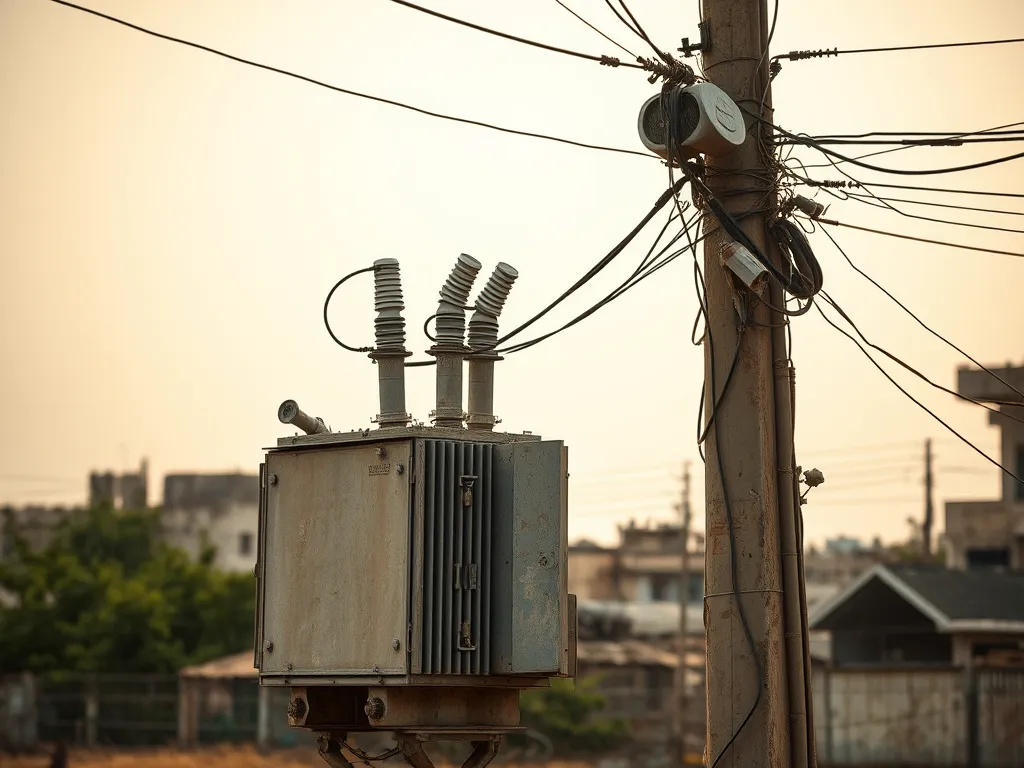
Addressing Electricity Grievances in Mirzapur requires a comprehensive approach to effectively tackle the persistent issues faced by residents. Many locals experience frequent power outages, voltage fluctuations, and inadequate supply, leading to disruptions in their daily lives. To resolve these grievances, the local administration should prioritize upgrading the existing infrastructure and increasing the capacity of power supply networks. Additionally, establishing a responsive customer service system that allows residents to report issues easily will enhance communication between consumers and utility providers. Community awareness programs can also educate residents about energy conservation practices, ultimately leading to more sustainable electricity consumption and improved quality of service.
Here are the key takeaways from the analysis of the grievance and the departmental response regarding the electricity crisis in Mirzapur
1. The “Policy vs. Practice” Gap
There is a stark contradiction between the high-level political promise of 24-hour uninterrupted power and the ground reality. While the department officially claims to provide round-the-clock supply, it experiences frequent “unplanned” and “maintenance-related” outages that effectively nullify this claim for the average consumer.
2. Infrastructure in Decay (Addressing Electricity Grievances in Mirzapur)
The core physical issue is the dilapidated state of the distribution hardware. The wires, poles, and transformers are aging and inadequate. Specifically:
- Position low-voltage (440V) lines dangerously beneath high-voltage (11kV/33kV) lines.
- This poor design means that minor repairs to a local wire require a total shutdown of the major feeder line, causing widespread outages for minor localized issues.
3. Bureaucratic Dismissal (Addressing Electricity Grievances in Mirzapur)
The Department of Electricity utilized a “general response” strategy to close a specific technical complaint. By citing the RDSS (Revamped Distribution Sector Scheme) and newspaper notifications as a blanket excuse, the Executive Engineer avoided addressing the specific technical failure at the Bathua Road transformer.
4. Technical Bottlenecks (Addressing Electricity Grievances in Mirzapur)
The distribution system in Mirzapur follows a three-step transformation process. The failure is occurring at the final stage of delivery:
- Step 1: High Voltage (33,000V) from production centers.
- Step 2: Medium Voltage (above 1,000V) to local transformers.
- Step 3: Low Voltage (440V) to homes.
The team often breaks the entire chain during basic maintenance, which should be isolated in a modern system, because Step 3 infrastructure is “flimsy” and poorly mapped.
5. Lack of Credibility in Reporting
The grievance redressal process appears to be a “paper exercise.” The closing of the case on the PG Portal without a site inspection or a resolution to the “dilapidated” wires indicates a lack of accountability and a failure to take the consumer’s technical observations seriously.
The 24-Hour Electricity Myth: Addressing Electricity Grievances in Mirzapur
The promise of 24-hour electricity has long been a centerpiece of political rhetoric in India. However, for residents like Shri Yogi M.P. Singh of Surekapuram Colony in Mirzapur, the reality on the ground tells a much darker—and dimmer—story. A recent grievance filed through the PG Portal (Ref No: 60000250065394) has brought to light a systemic disconnect between the Department of Electricity’s official claims and the structural failures plaguing the distribution network.
The Grievance: A Case of “Flimsy Grounds” (Addressing Electricity Grievances in Mirzapur)
The core of the issue lies in a massive disruption of power that lasted an entire day in Mirzapur. According to the complainant, the department defended the outage as necessary “maintenance work” under the RDSS (Revamped Distribution Sector Scheme). Specifically, the staff stated that they needed to renovate a low-voltage transmission line located near the Surekapuram Gate because it was positioned dangerously below a high-voltage line.
The complainant argues that this constitutes a “flimsy ground” for a city-wide shutdown. In a well-engineered urban grid, localized repairs on a 440V line do not necessitate plunging an entire sector into darkness. This indicates a fundamental flaw in how the local grid maps and manages its resources.
The Department’s “General” Response
In a response that can only be described as bureaucratic boilerplate, the Executive Engineer of the Electricity Distribution Division-Mirzapur stated:
“Electricity is being supplied 24 hours a day in the urban area. Supply is affected only in case of break-down due to maintenance work… Information about planned shut-down is given through newspapers.”
This response completely bypasses the specific technical grievance. It fails to address why a 200-meter repair job results in prolonged, undeclared outages or why the infrastructure is in such a “dilapidated state” that it cannot support the 24-hour supply promised by the Chief Minister and Prime Minister.
Understanding the Power Chain
To understand why these disruptions are so frequent, one must look at the three-step process of power distribution. The complainant, with technical precision, highlights how the system is currently failing:
- Generation & Transmission: High-voltage power (33,000V) travels from centers like Anapra or Obra to local distribution centers.
- Step-Down Distribution: Medium-high voltage lines (above 1,000V) carry power to local transformers.
- Local Delivery: These transformers step down the power to 440V for household use via low-voltage lines.
The bottleneck in Mirzapur appears to be at Step 3. Because low-voltage lines are often strung haphazardly beneath high-voltage lines, any minor repair requires a total “shut down” of the higher-level feed for safety, effectively killing power for hundreds of households for a job that should be localized.
Infrastructure in Decay: The RDSS Reality
The RDSS Scheme aims to reduce line losses and modernize the grid. However, if the “wires, poles, and transformers” remain in a dilapidated state, the scheme functions more as a patch-kit than a cure. Citizens frequently report “break-downs,” indicating that the department lacks the “appliances” necessary to maintain a continuous load.
The gap between the “24-hour claim” and the “maintenance reality” shows a lack of accountability. When the portal closes a grievance with just a general report attached, it signals to consumers that their specific issues—such as the poor placement of cables at Jabalpur Road—are not being investigated.
Conclusion: Moving Beyond Rhetoric
For the citizens of Mirzapur, 24-hour electricity remains a slogan rather than a service. A “General Response” to a “Specific Grievance” is a denial of justice. The Department of Electricity must move beyond newspaper announcements and address the structural hazards of overlapping transmission lines and aging equipment. Until the “dilapidated state” of the hardware is addressed, the political promise of 24-hour power will continue to be interrupted by the harsh reality of a flickering bulb.
To ensure your grievance reaches the right hands for a technical review, here are the validated contact details and technical parameters for the concerned authorities in Mirzapur and Lucknow.
1. Key Public Authorities (Mirzapur & Varanasi Discom)
These officials oversee the Electricity Distribution Division-II (EDD-II), Mirzapur, which is the primary subject of your grievance.
| Authority / Office | Officer Name | Mobile Number | Official Email ID |
| Executive Engineer (EDD-II, Mirzapur) | Manish Kumar Srivastav | 9450963598 | ee.2mirzapur@puvvnl.in |
| Superintending Engineer (EDC, Mirzapur) | Ram Das | 9415304000 | se.mirzapur@puvvnl.in |
| Chief Engineer (Mirzapur Zone) | J.P.N. Singh | 9450963509 | ce.mirzapur@puvvnl.in |
| Managing Director (PuVVNL, Varanasi) | Shambhu Kumar, IAS | 0542-2318437 | md@puvvnl.in |
2. Nodal Oversight (Chief Minister’s Office)
Since your grievance was closed by the State Government portal, the following officer is the nodal contact for the CM’s Secretariat in Lucknow:
- Officer Name: Shri Arvind Mohan (Joint Secretary)
- Office Address: Room No. 321, U.P. Secretariat, Lucknow.
- Contact Number: 0522-2226350
- Grievance Monitoring Email: arvind.12574@gov.in (or contact via Jansunwai Portal)
3. Application & Web Portal Links
If you wish to escalate the “closed” status of your grievance, use these links:
- PG Portal (Central):pgportal.gov.in
- Action: Use the “Feedback” option on your closed registration (PMOPG/E/2025/0042006). Rate it “Poor” to trigger the Appeal mechanism.
- Jansunwai (UP State):jansunwai.up.nic.in
- Action: File a fresh “Send Reminder” or “Complaint” specifically mentioning the failure of EDD-II Mirzapur to address the technical design flaw.
- PuVVNL Official Directory: puvvnl.up.nic.in
4. Technical Parameters: Wavelength & Clearance
As you correctly noted the three-stage transmission system, here are the technical benchmarks you can use in your rejoinder to argue against the “dilapidated state” of the wires:
- System Frequency: 50 Hz (Standard Indian Grid).
- Theoretical Wavelength ($\lambda$): 6,000 km.
- Critical Technical Issue: The Clearance Distance.
- For a 33 kV line passing over a 440V line, the vertical clearance should ideally be at least 1.2 to 2 meters.
- Your Argument: The “breakdown” is not a maintenance issue but a Design Violation. The department is using RDSS funds for “repairs” when they should be using them for “Re-routing” or “Underground Cabling” to prevent city-wide shutdowns for local fuse repairs.
Next Step Recommendation (Addressing Electricity Grievances in Mirzapur)
Would you like me to draft a formal Rejoinder letter to the Superintending Engineer (Mirzapur) specifically citing that “General Maintenance” under RDSS is an insufficient excuse for the structural design flaw at Bathua Road?


Facing a similar challenge? Share the details in the box below, and our team of experts will do their best to help.