
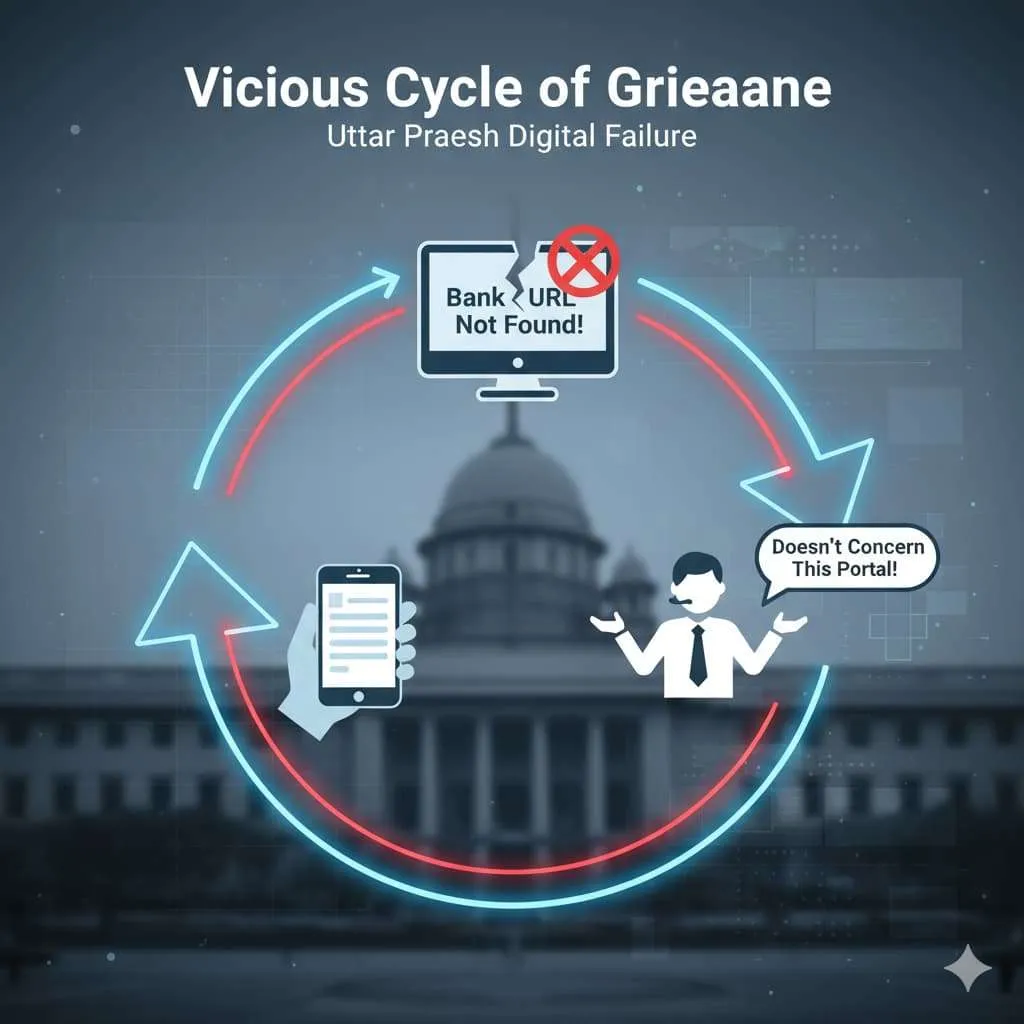
The Vicious Cycle of Grievance: When the System Fails to See Its Own Flaw A Glitch in the Digital Machinery of Governance
The promise of Digital India lies in making governance smooth, accessible, and responsive, ultimately enhancing the relationship between the government and its citizens.
By leveraging technology, the initiative aims to empower citizens with information and services at their fingertips, fostering greater transparency and accountability in governmental processes.
However, a vicious cycle occurs when systems meant to solve problems become problematic themselves, undermining the very objectives they were designed to achieve.
When digital platforms fail to deliver seamless user experiences or are plagued by bureaucratic red tape, they can inadvertently alienate the very populace they intend to serve.
In such cases, promising advancements can spiral into frustration and distrust, leading to reluctance in embracing the digital revolution that Digital India represents.
Thus, it’s crucial for ongoing assessments and improvements to be made in these systems to align them with their foundational goals and ensure they truly benefit the citizens.
This is the absurd situation faced by applicant Mahesh Pratap Singh alias Yogi M. P. Singh regarding the dysfunctional RTI portal of the Government of Uttar Pradesh. It illustrates perfectly how individuals can get trapped in a cycle, where grievances become a continuous loop without resolution.
The Core Complaint: A Dysfunctional Payment Gateway
The issue is clear: the RTI online application website is failing during the crucial payment step, which has caused significant frustration for users relying on its functionality to submit their requests in a timely manner.
Mr. Singh’s email history with the RTI-Online helpline, spanning November 19th and 24th, 2024, repeatedly cites the same error, indicating a persistent problem that not only hinders his application process but also highlights the larger systemic issues plaguing the site.
This failure at such a critical juncture raises concerns about the effectiveness of the support system in place, as multiple attempts to resolve the issue have yielded no satisfactory solution.
Furthermore, the lack of real-time updates or troubleshooting assistance exacerbates the situation, leaving users feeling helpless and unsupported during a time when access to information is paramount for civic engagement.
- “Bank URL Not Found!”
- “Rajkosh Payment Gateway having issues!”
This error isn’t a minor inconvenience; it’s a complete technical roadblock that significantly hampers the democratic process. It prevents any citizen from submitting an online RTI application, thus denying them their right to access information that is crucial for transparency and accountability in governance.
As a result, this situation perpetuates a cycle of repeated grievances, leaving many, like Mr. Singh, caught in a frustrating limbo where their voices go unheard and their concerns unaddressed.
This ongoing issue not only affects individual citizens but also undermines the trust that people have in the system designed to serve them. It’s imperative that this technical malfunction is rectified promptly to restore functionality and ensure that all individuals can exercise their rights without obstruction.
The Grievance Paradox: Being Told the Problem Doesn’t Exist
Mr. Singh, following the correct procedure for an administrative and technical complaint, lodged a grievance on the Jansunwai Portal (Registration No.: GOVUP/E/2024/0085048). He is now, stuck in a loop. Acknowledging the dysfunction should be straightforward, yet it morphs into a vicious grievance cycle, creating the Vicious Cycle of Grievance.
His grievance was about the dysfunctional website. The purpose was to get the technical team, involved in maintaining the RTI portal to fix the broken Rajkosh Payment Gateway. This is where the vicious aspects of certain grievance cycles intensify. It is as if caught in an endless grievance loop.
The Staff’s Response: A Failure to Understand causing Vicious Cycle of Grievance
Despite the clear technical nature of the complaint, the response from the concerned staff was a stunning example of misdirection: instead of addressing the specific issues raised, they focused on unrelated aspects and presented a series of vague reassurances that did little to clarify the situation.
Their communication lacked the precision necessary to alleviate the concerns of the complainants, as they seemed more interested in deflecting responsibility than providing a meaningful resolution.
In doing so, they not only overlooked the essential details of the grievance but also created further confusion and frustration among those seeking answers.
This approach was not only disappointing, but it also illustrated a worrying trend of avoidance rather than engagement with technical matters that required immediate attention and expertise.
“…you are saying that matter does not concern with this portal.”
The staff seemed to overlook the core submission—that the complaint was not about an RTI query being refused, but about a broken government website.
As Mr. Singh correctly articulated, a complaint about a dysfunctional website concerns the working of the public staff and the delivery of digital services. This makes it perfectly appropriate for the Public Grievance/Jansunwai Portal. By dismissing the complaint as “not concerning this portal,” the staff created a grievance loop. The system designed to resolve issues is itself overlooking the issue’s fundamental nature. This emphasizes the ongoing Cycle of Grievance.
Who Is Accountable for Digital Failure?
This incident raises serious questions about the state of digital governance and bureaucratic oversight:
- Technical Accountability: Why is a critical feature like the Rajkosh Payment Gateway, allowed to remain broken for days, effectively shutting down the online RTI process and contributing to the Vicious Cycle of Grievance?
- Administrative Accountability: Why did the officer-in-charge, Shri Arvind Mohan (Joint Secretary), or their team, fail to correctly interpret the complaint? It should have been, forwarded to the appropriate IT/Technical department for resolution.
- Citizen Service Mindset: Does this indicate a lack of training or a fundamental misunderstanding among public staff? They should address all service delivery issues, including technical ones, through the Public Grievance Portal.
As of the last update on November 24, 2024, the status was, listed as ‘Under process’ under the attention of Shri Arvind Mohan. For the sake of all citizens seeking information, it is critical that this complaint is correctly, re-routed to the technical team. They must resolve the persistent “Bank URL Not Found!” error and restore full functionality to the UP RTI online portal. This will break the vicious cycle of repeated grievances.
What has your experience been with reporting technical grievances on government portals? Share your thoughts in the comments below, especially if you’ve faced a similarly frustrating cycle.
In Gujarat model RTI fee is paid and RTI draft is available but grievance number is not sent


Facing a similar challenge? Share the details in the box below, and our team of experts will do their best to help.