
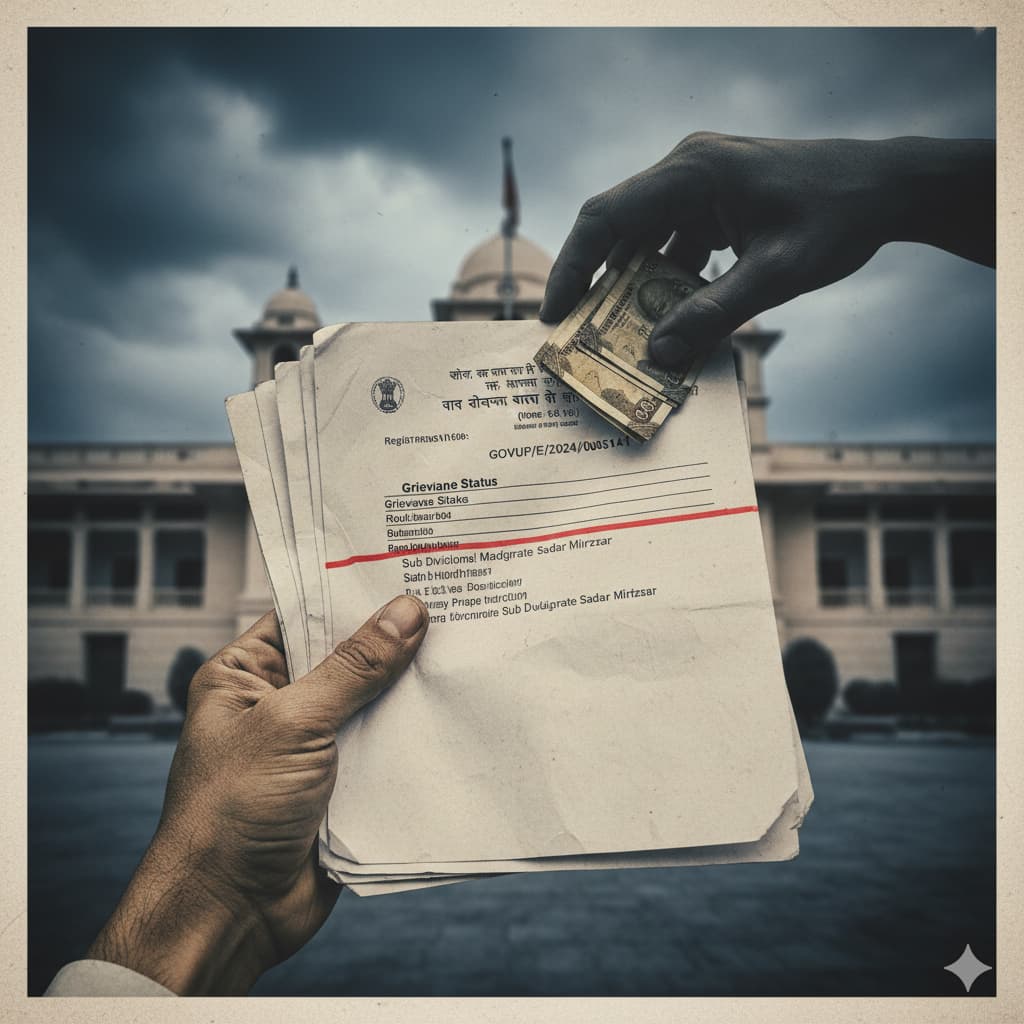
A Cry for Accountability: Corruption Allegations Rock Mirzapur Tehsil
Corruption allegations rock the Tehsil Sadar office as the recent grievance records filed by Yogi M. P. Singh, about the Sub Divisional Magistrate Sadar, Mirzapur, reveal serious issues that have raised significant public concern.
They depict alleged deep-rooted corruption and a lack of transparency within the Tehsil Sadar office, painting a troubling picture of governance in the region.
These complaints detail specific instances of staff demanding bribes for basic public services, such as the issuance of essential documents and permits, which are often required for residents to access their rights.
Furthermore, they highlight systemic failures in addressing serious allegations of misconduct, indicating that the mechanisms meant to uphold integrity and accountability within public offices are either insufficient or entirely ineffective.
As these issues come to light, there is an urgent need for an investigation to ensure that the public can trust their local authorities and that justice is served for the community affected by these egregious practices.
The Allegations of corruption rocking tehsil: Bribery in Plain Sight
The core of the grievances involves allegations of staff openly demanding money, which raises serious ethical questions about the integrity of the organization.
This troubling behavior demonstrates how corruption allegations can rock the very foundation of ethical conduct, undermining public trust and fostering an environment of dishonesty.
These payments, which are purportedly for services, should be transparent and free of arbitrary charges, reflecting a commitment to fairness and accountability.
Furthermore, the implications extend beyond individual actions; they cast a shadow over the organization as a whole and highlight the need for rigorous oversight and reform to ensure that all operations adhere to the highest standards of integrity and professionalism.
The $300 Notice Fee
In a specific incident (Grievance No. GOVUP/E/2024/0077180), Keshav Prasad alleged that an individual from Tehsil, who presented himself as a member of the Tehsil staff, demanded a bribe from him in an unsolicited and coercive manner.
This individual, capitalizing on his supposed authority, explicitly asked him to pay Rs. 300 for the delivery of an important notice that was to come from the Tehsildar Sadar’s Court.
This notice pertained to a property mutation that Keshav Prasad needed to complete, a process that is often complicated and requires official communication.
The individual not only insisted on this payment under the guise of expediting the process but also added that the amount would cover “expenses of the petrol,” highlighting a sham justification for his unethical demand.
Keshav felt compelled to report this incident, emphasizing the prevalence of corruption and the urgent need for accountability in local administrative practices.
The complainant pointedly asks whether the authorities sanction such charges and questions whether someone has arbitrarily “extorted” them. They demand accountability from the staff by insisting on the name and designation of the person who requested the bribe. This reveals a systemic issue where basic court process services illegally monetize.
Arbitrary and Inconsistent Reports
Grievance No. GOVUP/E/2024/0083141 further alleges that the Sub Divisional Magistrate Sadar is “overlooking corruption arbitrarily.” It also claims that the concerned staff submitted an “arbitrary and inconsistent report… without touching the submissions of the grievance,” calling it a “mockery of the law of land.”
Indeed, such corruption allegations rock the administrative integrity, raising serious questions about the accountability of public officials and their commitment to uphold the law. They point to a deeper problem of administrative cover-up, where those in power may be shielding their subordinates from scrutiny or consequences.
This environment fosters the potential for further malfeasance, as there is a troubling implication that illicit activities may be ongoing and unchallenged. Furthermore, there is also a blatant disregard for genuine complaints, where the voices of concerned citizens and their legitimate grievances are dismissed or ignored entirely, contributing to a culture of fear and opacity within the administrative framework.
This situation not only undermines public trust but also hampers efforts for reform and accountability within the government.
The Crisis of Accountability: Lekhpal Handling Corruption Cases
One of the most worrying points raised is the nature of the inquiry and redressal process itself. The complainant notes that high-ranking officials like the Sub Divisional Magistrate face serious allegations of corruption. The concerned Lekhpal—the lowest-ranking official in the administrative hierarchy—handles these allegations.
As the complainant forcefully states:
Does the question arise? Can the matter about serious allegations of corruption be addressed by the Lekhpal of the tehsil? Are the sub divisional magistrates sadar the administrative heads of the public authority?
This administrative setup, where lower-rank officials investigate complaints against senior rank. The system they work in, raises serious doubts about the impartiality and effectiveness of the internal grievance redressal mechanism. The rating of applicant is (Poor). The remark accompanying the ‘Case Closed’ status highlight the complainant’s profound dissatisfaction with the outcome. Thus, it appears that corruption allegations rock the trust in this system.
A Call for True Anti-Corruption Governance
The complaints are not only about individual corruption but also challenge the idea of “corruption-free governance” by “political leaders.” The complainant states that staff are openly asking for bribes during the day light. It is showing a “rule of anarchy” and deep-seated corruption allegations rocking the established order.
The grievance history includes a prior complaint from 2022 (Grievance No. GOVUP/E/2022/59214), showing these issues are ongoing. Staff dismissed earlier complaints. Staff said they couldn’t resolve them. The applicant “did not mention a specific problem but spoke about anarchy and corruption.”
The applicant demands data on property registration and pending mutation cases over the last 20 years. This seeks to uncover evidence of systemic irregularities in the crucial mutation process after land registry. These findings further show how these corruption allegations rock the framework to its core. This is an area particularly prone to corrupt practices.
The documents vividly plead for transparency and accountability in how public authorities work. He also insists on maintaining the integrity of the department. They challenge the notion of “pseudo honesty.” They call for concrete tools and actions. These are necessary to tackle serious allegations of corruption rather than settling for perfunctory closures.
What should have the appropriate mechanism to investigate serious corruption allegations against administrative heads like the Sub Divisional Magistrate?
S.D.M. Sadar may entertain the appeal of Anil Kumar Maurya
Think about quantum of corruption in Tehsil Sadar, matter of corruption overlooked


Facing a similar challenge? Share the details in the box below, and our team of experts will do their best to help.