
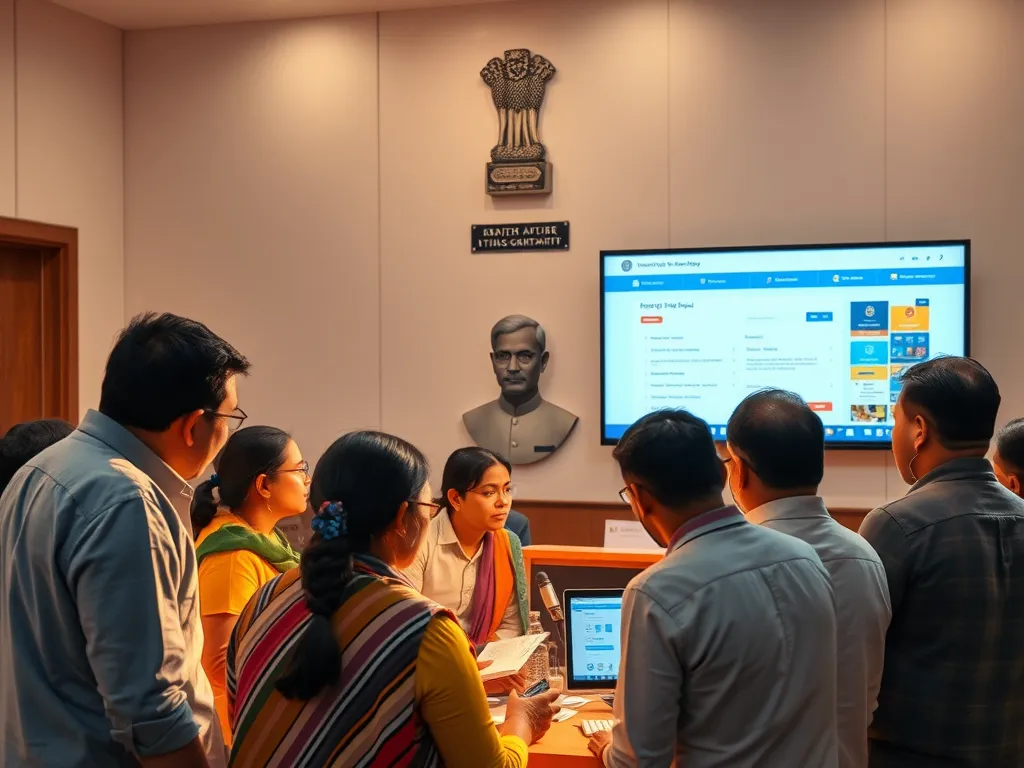
Examining corruption in Mirzapur’s Tehsil Administration reveals a multifaceted issue that adversely affects governance and public trust. Instances of fraudulent practices, nepotism, and bribery undermine the efficacy of local government services, leading to critical inefficiencies in the delivery of resources and public welfare. The lack of transparency in administrative processes exacerbates the plight of ordinary citizens who depend on fair and just access to essential services. Moreover, the pervasive influence of corruption creates a culture of impunity, where accountability is often absent. Addressing this rampant corruption is critical to creating a more equitable and efficient administrative framework.
Here are the key takeaways from the analysis of the grievance and RTI filing:
1. The “Accountability Gap” in Digital Governance
While the Jansunwai/IGRS portals aim for transparency, local officials currently use them to “dump” grievances. The portal acts as a post office rather than a monitoring body, allowing officials to submit inconsistent reports without fearing scrutiny from the Chief Minister’s Office (CMO).
2. Administrative Defiance of Judicial Orders
A major takeaway is the collapse of the hierarchy. When a local Lekhpal ignores a partition order from the Additional Sub-Divisional Magistrate’s Court for over seven months, it indicates that grassroots revenue staff treat judicial mandates as optional.
3. Tactical Misdirection (The “Police Diversion”)
The case highlights a common bureaucratic tactic: Departmental Shifting. By labelling a revenue and land-partition matter as a “Police” issue, the administration successfully: (Examining Corruption in Mirzapur’s Tehsil)
- Shielded the Revenue Department from answering for the delay.
- Closed the grievance using a “Sub-Judice” excuse provided by the police, who have no jurisdiction over land partition.
4. The “Mute Spectator” Syndrome
The CMO’s staff often accepts reports that are logically flawed or physically illegible. The failure of the CMO to audit the quality of these disposals emboldens lower-level corruption. The RTI seeks to strip away the anonymity of these officers and assign individual responsibility.
5. Procrastination as a Tool for Corruption
The blog emphasises that undue delay is not just a lapse but a symptom of corruption. By stalling the compliance of court orders, officials create a high-pressure environment for applicants, which is often a precursor to demanding illegal gratification.
Examining Corruption in Mirzapur’s Tehsil: Anatomy of a Dysfunctional Public Grievance System
In Mirzapur’s Tehsil, the digital transformation of governance in Uttar Pradesh promised to end “Jungle Raj”—the era of bureaucratic lawlessness. Authorities envisioned portals like Jansunwai and the IGRS (Integrated Grievance Redressal System) as direct bridges between the common man and the Chief Minister’s Office (CMO). However, activist Yogi M. P. Singh’s registration of DOCMO/R/2025/60448 under the RTI reveals a troubling reality: these portals increasingly serve as digital graveyards where accountability goes to die.
When the machinery of the state becomes a “mute spectator” to the arbitrary and inconsistent reports submitted by its officers, the very foundation of the Rule of Law begins to crumble.
The Core Dispute: Judicial Orders vs. Bureaucratic Apathy
At the heart of this specific grievance is a blatant disregard for a judicial mandate. On September 13, 2024, the Court of the Additional Sub-Divisional Magistrate (ASDM) in Sadar, Mirzapur, passed a clear order regarding the partition of land in Village Babura. The court determined the shares of the parties involved and specifically directed the Lekhpal (land record officer) to submit the ‘Faat’ (division report). Examining corruption in Mirzapur’s Tehsil is crucial as it impacts the implementation of such orders and the overall trust in local governance.
The legal expectation was simple: compliance. However, seven months later, the order remained ignored. This is not merely a “delay”; it is administrative rebellion. When a lower-level functionary like a Lekhpal can successfully defy a Magistrate’s court order for over half a year, it signals that the chain of command in the district administration has snapped.
The “Police Diversion” Tactic: Shifting the Goalposts
One of the most alarming aspects of this case—and a common frustration for portal users—is the arbitrary misdirection of complaints.
Although the grievance strictly concerned revenue matters (land partition and non-compliance by a Lekhpal), the system redirected the inquiry to the Circle Officer (City) and the Police.
By involving the police in a civil revenue matter, the administration achieved two things:
- Dilution of Responsibility: The administration shielded the SDM and Tehsildar, who are legally responsible for the Lekhpal’s conduct, from answering.
- Creation of a “Sub-Judice” Shield: The police report eventually claimed the matter was “pending in court,” providing a convenient excuse to close the grievance without taking action against the erring official.
This “circular routing” is a systemic flaw where authorities use the portal to shift responsibility and pass the buck until the complainant is exhausted.
The CMO as a “Mute Spectator”
The RTI filed by Mr Singh poses a piercing question: Who in the Chief Minister’s Office is vetting these reports? Examining corruption in Mirzapur’s Tehsil portal should not be a mere formality. If a District Magistrate (DM) submits a report that is “arbitrary” and decides that the police should handle a land partition matter, the CMO staff is expected to exercise due diligence. In this instance, the CMO accepted a report from the police regarding a revenue court’s non-compliance.
By accepting “illegible” documents (as noted in point 5 of the RTI) and logically flawed explanations, the CMO inadvertently validates the “anarchy” at the grassroots level. If the highest office in the state does not flag a report that contradicts a court order, it sends a message of impunity to corrupt subordinates.
The Transparency Gap: Why RTI is the Last Resort
The fact that a citizen had to file an RTI to ask for the names and designations of officers who handled their grievance proves that the Jansunwai portal lacks internal transparency.
- Points 1 & 2 of the RTI: Seek to identify who decided that the police should handle a land partition matter.
- Point 4 of the RTI: Seeks to identify who in the CMO accepted the “arbitrary” report of the Circle Officer.
These questions highlight the anonymity of incompetence. On the portal, responses are often signed by generic designations or uploaded without a name, making it impossible to fix individual accountability for “cryptic” and “misleading” disposals.
Systemic Consequences: Promoting “Jungle Raj”
The term “Jungle Raj” is used by the applicant not as a political slogan but as a description of an environment where Rule of Law is substituted by Rule of Whim. (Examining Corruption in Mirzapur’s Tehsil)
- Erosion of Public Trust: When citizens see that even a court order cannot be enforced through the “honoured” IGRS portal, they lose faith in digital governance.
- Institutionalised Corruption: Procrastination is often a veil for corruption. By delaying the Faat report, the Lekhpal creates an opportunity for illegal gratification. When the portal fails to monitor this delay, it effectively protects the corrupt.
- Judicial Overhead: When administrative portals fail, the burden shifts back to the courts in the form of Contempt of Court petitions, further clogging an already burdened legal system.
The Path to Reform
To restore the credibility of the Jansunwai and Public Grievance portals, the government must move beyond “status updates” and toward “quality audits.”
- Mandatory Human Review: The CMO must have a dedicated cell to audit “resolved” cases where the applicant has provided negative feedback, especially in cases of court order non-compliance.
- Strict Penalties for Misrouting: Officers who intentionally divert revenue matters to the police to avoid accountability should face disciplinary action.
- Legibility and Verification: No report should be accepted by the portal if the attachments are illegible or if the report does not directly address the “Right to Reason.”
Conclusion (Examining Corruption in Mirzapur’s Tehsil)
The case of Yogi M. P. Singh is a microcosm of a larger struggle for administrative honesty in Uttar Pradesh. The Public Grievance portal should be a sword for the citizen, not a shield for the bureaucrat. Until the Chief Minister’s Office stops being a “mute spectator” and starts holding the “Section Officers” and “Tehsildars” accountable for their reports, the digital bridge to justice will remain broken.
For your records and for the purpose of follow-up actions, here are the structured contact details and application identifiers of the concerned public authorities mentioned in your grievance and RTI.
1. Primary Application Identifiers (Examining Corruption in Mirzapur’s Tehsil)
| Type of Reference | Identification Number | Date of Filing |
| RTI Registration No. | DOCMO/R/2025/60448 | 27/05/2025 |
| Grievance Reference No. | 60000250091069 | 27/05/2025 |
| Earlier IGRS Reference | GOVUP/E/2025/0013414 | 09/02/2025 |
2. Chief Minister’s Office (CMO) – Nodal Officials (Examining Corruption in Mirzapur’s Tehsil)
These are the officers in Lucknow responsible for overseeing the processing of your RTI and grievance at the state level.
- PIO (Public Information Officer):
- Name: Anurag Sinha (Section Officer, C.M. Sec-3)
- Mobile: 9454413729 / 0522-2226454
- Email: anurag.13729@gov.in
- Office: Room No. 330, 3rd Floor, Lok Bhawan, Lucknow.
- Nodal Officer (RTI Cell):
- Name: Sanjay Chaturvedi (Section Officer)
- Mobile: 9454410972 / 0522-2226455
- Email: sanjay.10972@gov.in
- Office: Room No. 328, 3rd Floor, Lok Bhawan, Lucknow.
3. District Authorities (Mirzapur) (Examining Corruption in Mirzapur’s Tehsil)
The following officers are the local executors of the state’s orders and the primary respondents to your grievance.
- District Magistrate (DM) Mirzapur:
- Name: Priyanka Niranjan
- CUG Mobile: 9454417567
- Email: dmmir@nic.in / mvsadamzp@gmail.com
- Office Phone: 05442-252480
- Tehsildar (Sadar) Mirzapur:
- CUG Mobile: 9454417672 / 9454417855
- Landline: 05442-220188
- Location: Wellesly Ganj, Mirzapur (Near Collectrate)
4. Digital Portals for Monitoring & Appeals (Examining Corruption in Mirzapur’s Tehsil)
If you wish to escalate the matter, use the following official web links:
- Jansunwai (Grievance Tthis option to):jansunwai.up.nic.in
- Action: Use this to send Reminders for references crossing 30 days.
- UP RTI Online Portal: rtionline.up.gov.in
- Action: Use this portal to file a First Appeal if the PIO fails to provide information within 30 days.
- District Website (Mirzapur): mirzapur.nic.in
- Action: Check “Public Utilities” for updated staff lists.
Next Steps for You (Examining Corruption in Mirzapur’s Tehsil)
Since the 30-day window for the RTI (Section 7(1)) is a critical legal threshold, I suggest the following:
Would you like me to draft a “Reminder” letter specifically addressed to the District Magistrate of Mirzapur and send it via Registered Post? (This creates a physical paper trail that is harder for the CMO to ignore than digital-only submissions).


Facing a similar challenge? Share the details in the box below, and our team of experts will do their best to help.