
Urgent Attention Needed: Allegations of Deep-Rooted Corruption in Mirzapur Tehsil Office
The digital grievance redress system has exposed serious allegations that have raised significant concerns among the local populace. These complaints point to deep-rooted corruption and a lack of accountability within the Tehsil Sadar office in Mirzapur, Uttar Pradesh, where systemic issues seem to hinder the proper functioning of the office.
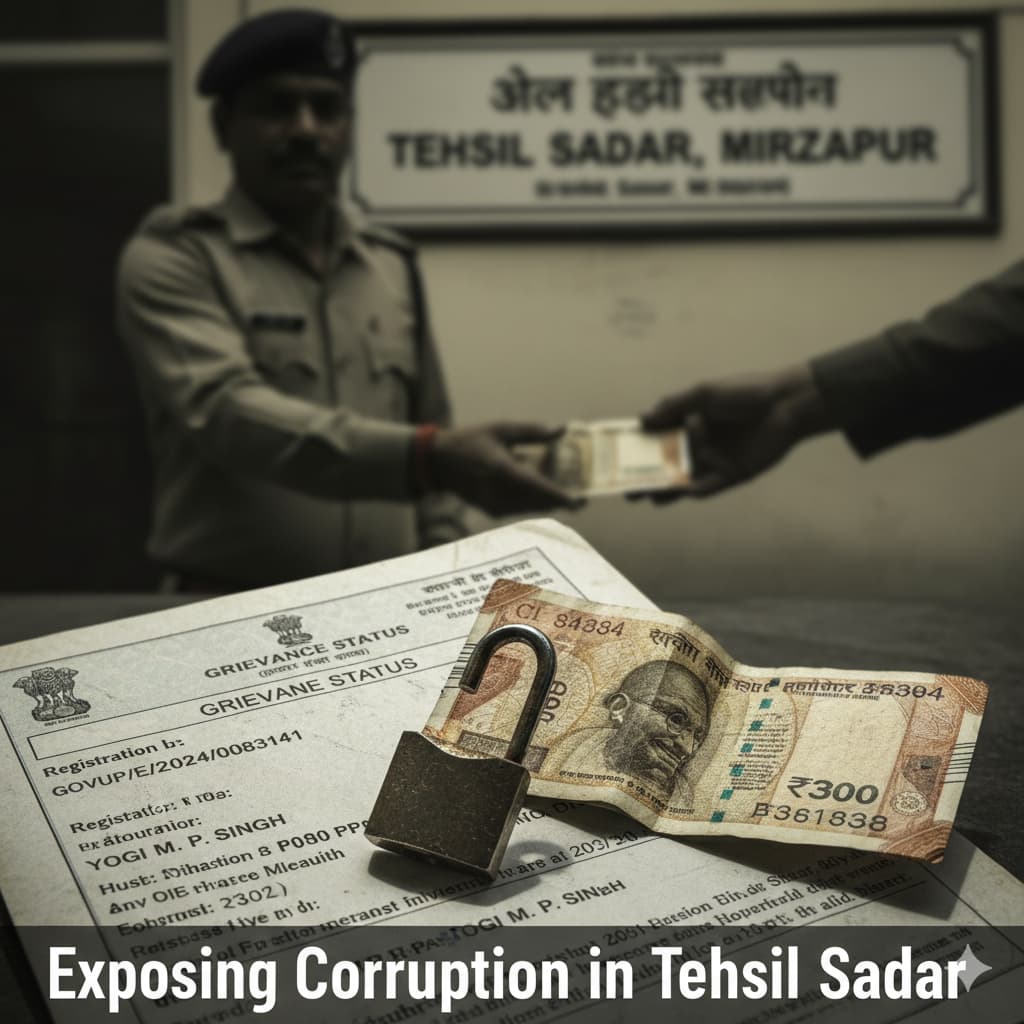
Exposing corruption in Tehsil Sadar, the complaints filed by Yogi M. P. Singh offer detailed information on multiple instances of misconduct that jeopardize the integrity of public service. Public servants allegedly demanded bribes for issuing necessary documents and facilitating essential services, all while providing arbitrary and often misleading reports.
This not only undermines trust in governmental institutions but also effectively makes a “mockery of the law of the land,” as citizens are left to navigate an unjust system where their grievances go unheard, and their rights are trampled upon due to rampant corruption.
Moreover, the lack of prompt action on these complaints illustrates a broader failure in addressing systemic issues within public administration, fostering an environment where such unethical practices can flourish unchecked.
The Core of the Allegations about Exposing Corruption in Tehsil Sadar
The grievances registered with the Government of Uttar Pradesh (GOVUP) under various numbers, including GOVUP/E/2024/0083141 and GOVUP/E/2024/0077180, show a disturbing picture of how exposing corruption in Tehsil Sadar is crucial: the reports detail numerous instances of financial misconduct, abuse of power, and the detrimental effects these have on local communities.
Community members have come forward with testimonies illustrating a pattern of favoritism in the allocation of resources and public services, which not only undermines trust in government institutions but also exacerbates the plight of the disadvantaged.
Such revelations highlight the urgent need for transparency and accountability measures that can restore faith and equity in the administrative processes of the region, ensuring that every citizen’s voice is heard and respected.
- Bribery for Public Service: A key complaint revolves around an anonymous staff member of Tehsil Sadar. This staff member allegedly asked aggrieved applicant Keshav Prasad for ₹300. The staff member made the demand simply for delivering a notice. The notice, issued by a semi-legal court, involved a property mutation case. The staff member reportedly claimed that this money covered “public services,” including petrol costs. The complainant questions whether officials officially allow such fees or if they represent open extortion.
- Arbitrary and Inconsistent Reports: The Sub Divisional Magistrate (SDM) Sadar Mirzapur is, accused of “overlooking corruption arbitrarily.” The grievances state that staff submitted an “arbitrary and inconsistent report.” They did this without properly addressing the core submissions of the complaint. The report particularly neglected to tackle alleged corruption in the processing of property mutations. This deliberate effort aims to evade accountability and avoid exposing corruption in Tehsil Sadar.
- Systemic Failure: The complainant argues that these incidents show a “rule of anarchy”. Staff openly ask for bribes in daylight. This situation contradicts the political claims of providing corruption-free governance. This suggests not just isolated incidents, but a systemic issue within the working of the public authority.
Earlier Unaddressed Grievances approving Exposing Corruption in Tehsil Sadar
The complaints also refer to an older grievance (GOVUP/E/2022/59214) from 2022, which has raised significant concerns about the persistence of unresolved issues.
The Tehsil Sadar staff reportedly dismissed the complaint without thorough consideration, stating that the applicant “did not express individual problem but raised the matter about anarchy and corruption.
This response is particularly troubling as it implies a failure to acknowledge the severity of the allegations presented.
By essentially sidestepping the critical issue of exposing corruption, they declared they were “not amenable to redress the grievance,” which raises questions about their commitment to transparency and accountability.
The lack of a robust framework to address complaints not only undermines public trust but also perpetuates a culture of impunity, where serious issues can be overlooked without due diligence, thus leaving the applicant and others affected in a state of confusion and frustration over their grievances.
The current demand from the complainant includes:
- The Tehsildar Sadar must give a full explanation on whether charges like ₹300 are, officially sanctioned for serving court notices.
- Disclosure of the name and designation of the staff member who demanded the bribe from Keshav Prasad.
- Transparency on property mutation records. How many plots registered and mutated in the last 20 years? How many still have pending title disputes?
Call for Transparency and Integrity
Shri Arvind Mohan (Joint Secretary) in the Chief Minister Secretariat, Uttar Pradesh has received these grievances regarding corruption and mismanagement. He will command an immediate investigation into these alarming allegations, ensuring that the necessary steps are taken to restore public confidence.
Thus, those concerned will take decisive action to address the issues raised. For a democracy to work effectively, it is imperative that public authorities maintain transparency and accountability in their operations, ensuring that the citizens can trust their institutions.
When the very staff responsible for upholding the law openly demand bribes, they not only undermine the rule of law but also falter the department’s integrity and credibility in the eyes of the public.
This issue underscores the critical importance of exposing corruption in Tehsil Sadar, as it highlights the systemic failures that allow such corruption to thrive, ultimately harming the rights and welfare of the community.
It is essential for citizens to remain vigilant and active in reporting such malpractices to ensure that their voices are heard and that those responsible are held accountable for their actions.
The seriousness of these allegations warrants a thorough and impartial inquiry. This inquiry is necessary to guarantee that the promise of corruption-free governance is not merely a slogan. It should be a lived reality for the citizens of Mirzapur.
What is the most effective way for the Chief Minister’s office to tackle these issues? How should they handle the recurring allegations of corruption in the Tehsil offices?
Representation about deep-rooted corruption in process of mutation is being overlooked by Tehsildar Sadar
Abhiraji Nishad: A Voice Against Illegal Alcohol in Naugaon


Facing a similar challenge? Share the details in the box below, and our team of experts will do their best to help.